

- Congolese President Félix Tshisekedi aims to leverage the ambitious Kivu-Kinshasa Green Corridor to transform a war economy into an economy of hope.
- The Kivu-Kinshasa Green Corridor—an idea first publicly announced during the 2025 World Economic Forum in Davos—aims to create one of the largest protected areas in the world, connecting Goma in the country’s east to Kinshasa in the west.
- Proponents of the project, environmentalists, and other observers have hailed the concept, while acknowledging that many questions remain unanswered—particularly regarding the management of mining, oil, gas, agricultural, and conservation concessions.
- On paper, the project could create over 500,000 jobs—particularly for young
Congolese people—preserve more than one million hectares of land, and help transport vital food supplies from the east to the massive consumer market of Kinshasa, home to over 20 million inhabitants.
KINSHASA, Democratic Republic of the Congo — Félix Tshisekedi is banking on one of Africa’s most ambitious conservation and development plans to transform the future of the Democratic Republic of the Congo.
He recently reiterated this vision in Bandundu during the annual Conference of Provincial Governors. “Through this Green Corridor, we are choosing to replace a war economy with an economy of life, work, and hope,” Tshisekedi said.
According to official documents and public statements, the Kivu-Kinshasa Green Corridor would stretch from eastern DRC all the way to Kinshasa in the west. If implemented as planned, it would cover more than 544,270 square kilometers (210144 sq miles) —an area comparable in size to France—and would integrate conservation, economic development, and community protection. The initiative was first announced during the World Economic Forum in Davos in January 2025.
Conservation Spaces and Drivers of Economic Stability
Individuals involved in the planning process told Mongabay that the initiative could create more than 500,000 jobs—particularly for youth and women—preserve over one million hectares of land, and transport food products from the East to the major consumer market in Kinshasa.
For the Congolese government, the Kivu-Kinshasa Green Corridor goes beyond mere forest protection. “The objective is to protect our forests, restore ecosystems, create sustainable jobs, support responsible agriculture, stimulate local processing, and better connect the production [hubs] in the East to the major consumer markets of the West,” Tshisekedi emphasized to the provincial governors.
Stakeholders involved in the initial discussions—including the Director of Virunga National Park, Prince Emmanuel de Merode—told Mongabay that the Kivu-Kinshasa Green Corridor is part of a broader strategic vision aimed at viewing Congo’s protected areas not merely as conservation spaces, but also as drivers of economic stability.
“The idea was to imagine a corridor that really drives the transformation of this incredible wealth in the East,” de Merode told Mongabay while in the Salonga National Park. He added that the initiative also aims to correct a historical imbalance between eastern Congo—rich in resources—and Kinshasa, a city of approximately 20 million inhabitants that still relies heavily on food imports.
“Food for 20 million people is non-existent and has to be imported from Brazil, from Europe, from South Africa,” he said. “And yet Congo has this opportunity to be food self-sufficient.”
According to de Merode, planners have been tasked with developing a model capable of transporting “one million tons of food from the East to Kinshasa,” creating “half a million jobs,” and simultaneously protecting the forests. The goal is to utilize conservation landscapes as engines for development, while supporting local communities. “It is a protected area unlike any that has ever been created before,” he noted.
Significant Financial Investment Required
To bring this concept to fruition, significant financial investment will be required from both the public and private sectors. The European Union—which has supported conservation and development efforts in the Congo Basin for decades—believes that this “Green Corridor” could successfully reconcile environmental protection with job creation and economic opportunities.
Fabrice Basile, a senior official at the European Union delegation in Kinshasa, described the Kivu-Kinshasa Green Corridor as “a Congolese initiative” that garnered EU interest following its announcement in Davos. He noted that partners are already testing its feasibility through pilot initiatives—most notably a transport convoy carrying goods from eastern Congo to Kinshasa.
“Agricultural produce and other goods from the East often fail to reach the western part of the country, and vice versa,” he stated. “Opening up this territory is, in essence, enabling development.”
Exceptional Potential, Yet Many Unanswered Questions
Despite this optimism, many details remain unclear. Alfred Ntumba, publisher of the Kinshasa-based digital media outlet EnviroNews, believes the initiative is promising but still lacks clarity.
“The corridor cuts across lands that have already been allocated,” he said. “There is mining, agricultural, forestry, and conservation concessions—and even hydrocarbon concessions. We don’t yet know how all of this will be managed.”
According to him, this raises questions regarding governance and the benefits for local communities. “We are told that this will be a corridor featuring community-based conservation, but how will that actually work?” he asked. “As for the revenue that could be generated by all these activities—how will it be redistributed to the communities? Many questions still remain.”
Advocacy organizations have voiced similar concerns, while still acknowledging the project’s potential. Bonaventure Bondo, head of the Forests Campaign at Greenpeace Africa, hailed the initiative as “a major opportunity to strengthen the DRC’s climate leadership,” but warned that it must be implemented carefully.
Joe Eisen, of the Rainforest Foundation UK, also highlighted the corridor’s potential, emphasizing the critical importance of governance and the participation of local communities.
Concerns regarding consultation have already surfaced. A report by Climate Home News in February 2025 revealed that some Indigenous representatives claimed they had not been consulted.
“As native peoples, we know nothing,” Kapupu Diwa Mutimanwa, president of the League of Indigenous Pygmy Associations of Congo, told the outlet. “We have not been consulted about this project.”
However, proponents of the initiative believe that lessons learned from existing experiences—particularly those surrounding Virunga National Park—could help guide its implementation.
“Virunga is a success,” Basile said, while acknowledging the challenges. ““The Virunga model can be replicated in part. We have to respect each area and its specific features.”
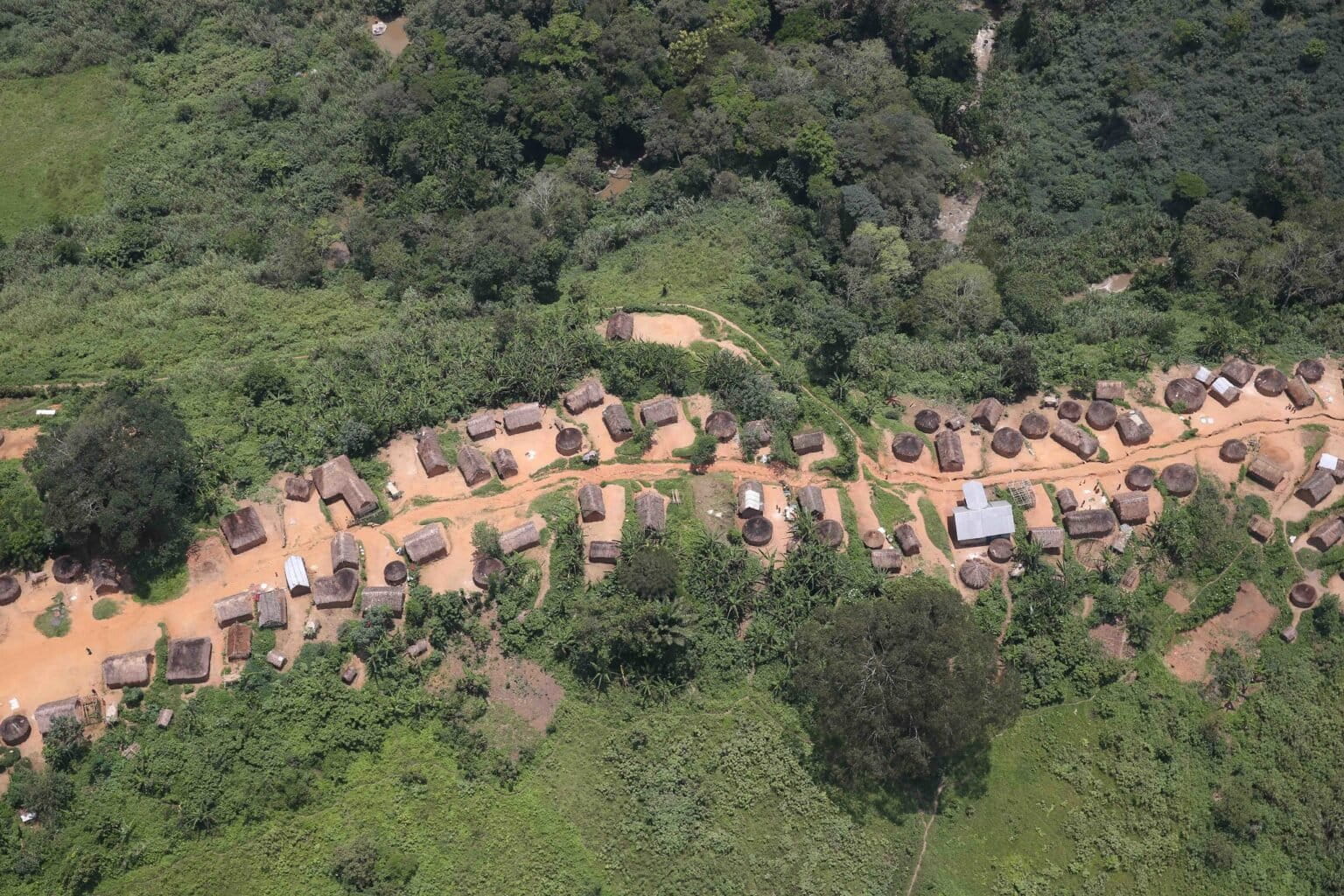
Banner image: The proposed Green Corridor would extend from Kivu, in the eastern Democratic Republic of the Congo, to Kinshasa, in the west. An aerial view of a village in South Kivu, DRC. Image by MONUSCO via Flickr (CC BY-SA 2.0).
Feedback: Use this form to send a message to the author of this post. If you want to post a public comment, you can do that at the bottom of the page.