


- Several recent features published by Mongabay have shared the emotional strain that conservationists are under from increasing environmental degradation, job losses, moral injury, and a sense of isolation.
- Various organizations and initiatives have emerged in response to the need to build an emotionally resilient conservation community, and two conservation professionals who co-founded one of these describe what they’ve learned in a new commentary.
- “The emotional toll of conservation is real, and so is our capacity to respond to it. Regardless of your role, we invite you to join any of these movements toward a conservation culture of care,” they write.
- This article is a commentary. The views expressed are those of the authors, not necessarily of Mongabay.
Recent Mongabay articles by Jeremy Hance, Vik Mohan and Nerissa Chao, and Rhett Butler have laid bare a painful reality in conservation: the emotional price of witnessing biodiversity loss, the “epidemic of suffering” and burnout, and the psychological stresses assailing professionals on the frontlines. These articles document eco-grief, compassion fatigue, isolation, and moral injury with clarity and urgency, giving voice to struggles that many conservationists have carried in silence.
What these pieces don’t fully highlight is that conservationists are not standing idly by. Just as we dedicate ourselves to protecting ecosystems and species under pressure, we are simultaneously advocating for our own well-being by stepping up to support one another by building practical solutions from within the field itself.
In early 2025, amid growing global instability for conservationists — job losses, funding shortfalls, and relentless ecological decline — we founded Revive, a global working group of the Society for Conservation Biology. Revive is a community of practice created by conservationists, for conservationists.
Our approach is simple yet potent, and informed by more than 100 working group members in 30 countries as well as peer-reviewed evidence: equip individuals, teams, and organizations with evidence-based resilience tools to reshape the norms of our workforce. Together, we are building a culture of care that supports an inspired, emotionally resilient conservation community where well-being is valued and nourished as a foundational part of our work.
And we are not alone. Conservationists have launched organizations and initiatives to rekindle our passion, connect with community, and drive culture change. Lonely Conservationists, Conservation Optimism, and the Good Grief Network nurture community through stories and peer support. The Climate Mental Health Network and Unthinkable provide youth, parents and teachers tools for building emotional resilience from an early age. One Earth Sangha, The Work that Reconnects Network and The Rest of Activism foster self-inquiry into existential threats of separation from nature to reinspire action.
Each of these resources (and many others) was seeded by a conservationist thinking, “I’m tired and heartbroken — and so are my teammates.” Our recognition of the humanity in our work provides us a space for healing by opening doors for connection and validation, equipping us with practical tools to navigate the weight of the day, and empowering us all to forge ahead together. This involves being vulnerable — with ourselves and others — and that is the very point: to tenderly care for ourselves and each other just as we care for the Earth.
While general resources on mental health and emotional resilience can be helpful, the emotional toll of working in conservation — addressing existential threats with insufficient resources — is unique enough that our workforce needs tailored approaches. One-size-fits-all solutions such as employee assistance programs (a free counseling service offered by employers in the United States) can worsen feelings of eco-grief and isolation because general counselors are typically unfamiliar with the conservationists’ feelings and work realities. When a source of your trauma offers an ineffective balm, it can feel disingenuous or manipulative. Additionally, organizations exclusively promoting self-care techniques and individually based solutions misplace the responsibility of care. It is just as much the role of an entire team, its leadership, teachers, funders and policymakers to shift the expectation, norms and culture.
At Revive, in partnership with the growing network of conservationist well-being groups, we are taking a multiscale, multidimensional approach to develop tailored resources and programming for international conservation professionals. These include knowledge-building and -sharing tools like research collaborations and webinars, as well as practice-oriented tools like wellness workshops, peer support groups, grants for team wellness initiatives, and financial subsidies for conservationists to work with conservation mental health specialists.
Along the way, we are learning from Indigenous practitioners and other environmental stewards who have faced generational exhaustion and trauma, and building evidence for the effectiveness of these approaches tailored for the conservation workforce. With this approach, we are growing the capacity of individual conservationists and organizational leadership, as well as teachers, funders and policymakers who shape the conservation system, to understand and feel why a culture of care within the conservation profession is integral to the very success of conservation.
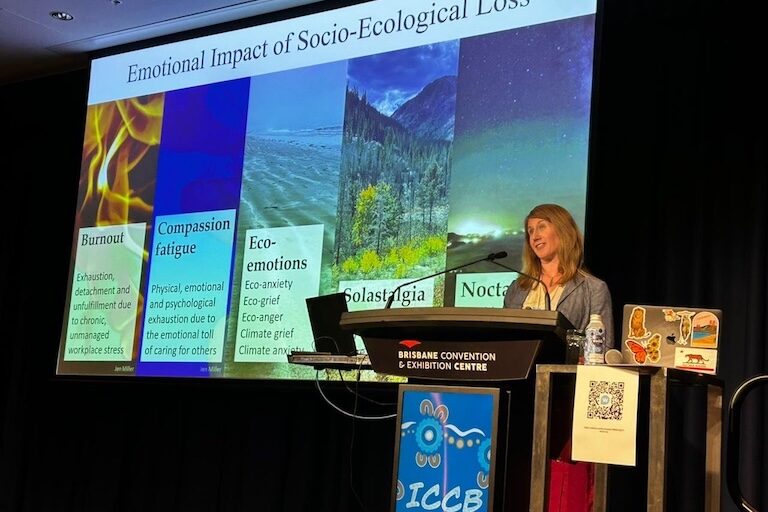
Systemic change in the conservation workforce is possible with a holistic “both-and” mindset, recognizing that collective intention drives both individual behavior change and overarching culture change. The recent Mongabay articles are the latest invitation for each of us — you, reader, included — to explore existing resources, to create new ones tailored for your own community’s needs, and to talk more openly and authentically about our personal and professional challenges.
If you are an organizational leader, share these resilience resources with your team and make space for their utilization. Research shows that consistent integration of these tools and ways of operating can lead to more effective conservation outcomes.
The emotional toll of conservation is real, and so is our capacity to respond to it. Regardless of your role, we invite you to join any of these movements toward a conservation culture of care. Recognize, importantly, that we do not need to invent care from scratch — it already exists in our DNA as conservationists.
If conservation is fundamentally an act of love for the natural world, then it stands to reason that we also have the necessary mindset and motivation to show that same reverence to ourselves.
Our task now is to make that care a prerequisite instead of an afterthought.
Jen Miller is a wildlife conservationist and meditation teacher who manages the Sea Otter Fund at the Wildlife Conservation Network. Kelly Guilbeau is a conservation social scientist who is pursuing a doctorate of public health on the well-being of conservation professionals.
Banner image: Just as the resilient redwoods have evolved to survive repeated fires, the conservation workforce is equipping itself to withstand repeated hardships. Photo courtesy of Jen Miller.
See related coverage:
Emotional and psychological stresses beleaguer conservation professionals (commentary)
‘An epidemic of suffering’: Why are conservationists breaking down?
Citations:
Pienkowski, T., Keane, A., Castelló y Tickell, S., De Lange, E., Hazenbosch, M., Khanyari, M., … Milner‐Gulland, E. J. (2023). Supporting conservationists’ mental health through better working conditions. Conservation Biology, 37(5). doi:10.1111/cobi.14097
Gerber, L. R., Reeves-Blurton, Z., Gueci, N., Iacona, G. D., Beaudette, J. A., & Pipe, T. (2023). Practicing mindfulness in addressing the biodiversity crisis. Conservation Science and Practice, 5(7). doi:10.1111/csp2.12945
Loffeld, T. A. C., Black, S. A., & Humle, T. (2025). From burnout to engagement: Enhancing the wellbeing and performance of conservationists. Frontiers in Veterinary Science, 12. doi:10.3389/fvets.2025.1567931
