

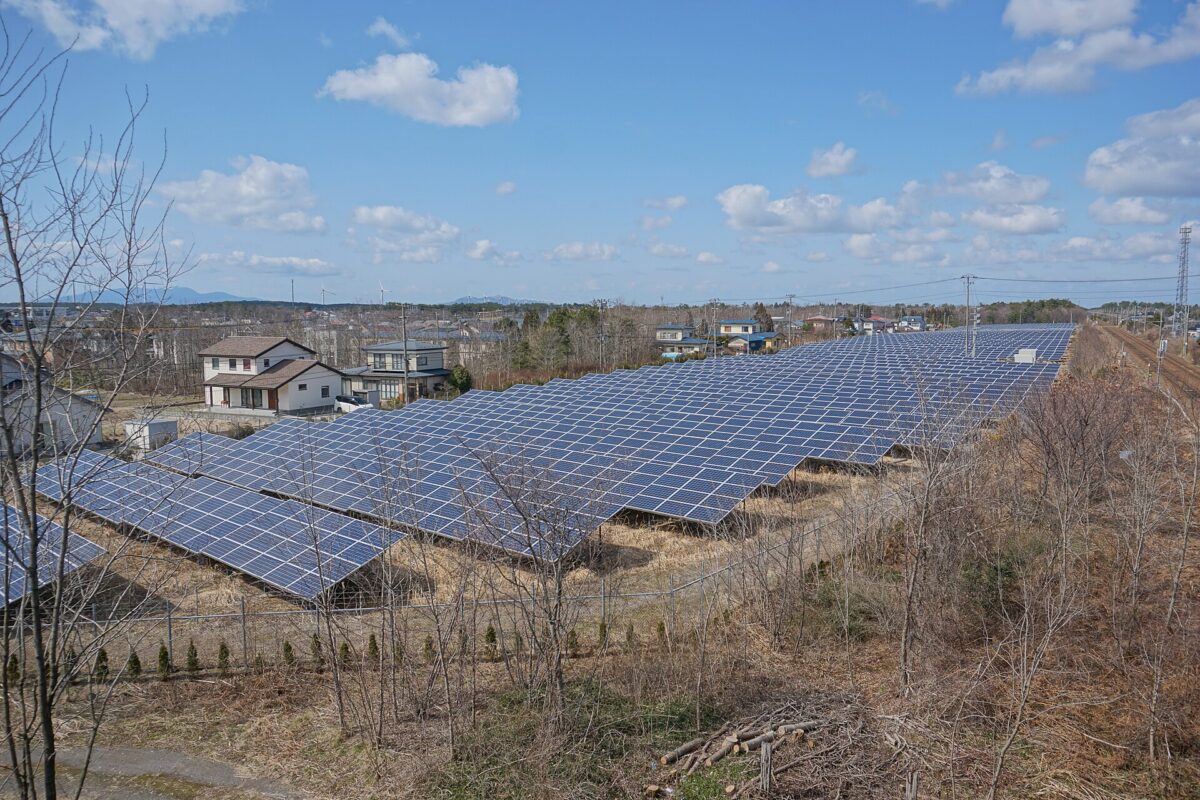
The refinancing of GSSG Solar and Voltaiyo’s 104 MW Jupiter Portfolio comes as Japan’s first-generation feed-in tariff (FIT) projects approach the end of guaranteed rates, forcing owners to reassess revenue strategies in a shifting post-FIT market.
Japan’s maturing solar sector is entering a decisive post-FIT phase, as GSSG Solar and Voltaiyo KK secure refinancing for a 104 MW portfolio of legacy FIT projects with SBI Shinsei Bank – a deal that underscores lender confidence in well-run assets even as guaranteed tariffs begin to expire.
The 104 MW portfolio consists of eight operating projects across four electricity grid areas on the islands of Honshu and Kyushu. Colorado-based GSSG Solar is the transaction sponsor , Voltaiyo KK is its Tokyo-based operating partner. The deal marks the sixth time GSSG Solar has acted as sponsor for an SBI Shinsei Bank loan.
Adrian Archambault, partner, valuation at GSSG Solar, said lenders’ underwriting approach for FIT assets approaching expiry has not fundamentally changed, but operational track record now carries more weight. “Operational projects have the opportunity to benefit from actual production metrics and operational execution,” he told pv magazine.
GSSG Solar CEO Tomakin Archambault said the refinancing marks “an important milestone” for the partnership, reflecting aligned interests and approaches to investment in Japan’s power sector decarbonization.
Industry estimates based on IEA-PVPS data indicate Japan reached approximately 100 GW of cumulative solar capacity by the end of 2024. Fiscal 2026 is the final year of auction-based support for ground-mounted commercial solar above 250 kW, with no further auctions planned from fiscal 2027 onward, according to summaries aligned with Japan’s Ministry of Economy, Trade and Industry (METI). As guaranteed rates expire, projects face a substantial revenue gap against wholesale market prices.
Repowering is emerging as one option for owners of first-generation FIT plants. Masaya Ishida, director of the Tokyo-based Renewable Energy Institute (REI), said most modules installed under Japan’s early FIT program were designed for 20-year operation and typically generate sufficient revenue without replacement. He said repowering can be cost-efficient across project sizes because developers can reuse existing land, mounting structures, and grid connections with new, lower-cost modules. Ishida described the repowering opportunity as “a big market,” driven in part by growing corporate demand for new renewable energy supply.
Adrian Archambault said the Japan market is shifting in ways that support post-FIT asset values, pointing to rising energy costs driven by Japan’s dependence on imported fuel and growing corporate and merchant demand for solar power. GSSG is maintaining revenue optionality on the Jupiter Portfolio, weighing merchant exposure, feed-in premium participation, and corporate power purchase agreements.
GSSG Solar Japan Asset Management currently manages 223 MW of solar assets in Japan beyond the Jupiter Portfolio. The company said the refinancing model is relationship-driven and applicable across that broader fleet.
Voltaiyo, which recently rebranded as a standalone company under the Obton umbrella and entered a capital relationship with ICG, said the transaction reflects its origination capabilities and international capital relationships. Voltaiyo CEO Mikkel Berthelsen said the deal reflects “the origination capabilities of the Voltaiyo team” and its deep international capital relationships.
Japan’s FIT program has been central to GSSG Solar’s Japan strategy since the company closed its first Shinsei Bank financing on a 47 MW solar project in Suwa, Nagano prefecture, in May 2016. The Jupiter Portfolio refinancing is the sixth transaction the two institutions have completed together.
Japan added between 5.8 GW and 6 GW of solar in 2025, according to RTS Corp. estimates, taking cumulative capacity past 100 GW – a market built largely on FIT-era investment now facing a structural revenue transition as guaranteed rates give way to merchant and corporate PPA exposure.
This content is protected by copyright and may not be reused. If you want to cooperate with us and would like to reuse some of our content, please contact: editors@pv-magazine.com.