

Canvas canopies, hand fans, damp cloths and solar reflective paint may not sound like elaborate medical interventions. But in Pakistan’s hottest neighborhoods, they can act as a lifeline for pregnant women and newborns from low-income households.
In a recent trial of affordable cooling solutions led by researchers at Pakistan’s Aga Khan University, low-tech interventions were able to cut indoor temperatures by 3-4° Celsius (5-7° Fahrenheit). Air-conditioning, and even fans, are often not available due to unreliable electricity supply.
“Many commonly recommended heat interventions assume reliable electricity, formal workplaces, and universal phone access, making them impractical for many women in low-income countries,” Gregory Wellenius, director of the Center for Climate and Health at Boston University, told Zuha Siddiqui for Dialogue Earth.
Temperatures in Pakistan often reach 40°C (104°F), with “feels like” temperatures nearing 50°C (122°F) in the summer. Climate change is making heat waves in the region much more likely and frequent, according to World Weather Attribution, a network of scientists studying extreme weather events.
“The heat exhausts me. My body feels like lead,” Asiya, a woman identified only by her first name, told Siddiqui.
Asiya lives in Lyari, one of the most densely populated neighborhoods in Karachi, and is pregnant with her third child. “During my last pregnancy two years ago, I took showers thrice a day to cool down because I could feel my baby kicking in distress,” she added.
The urban heat island effect traps heat in densely built urban areas, elevating city temperatures. In Karachi, Pakistan’s largest city, heat is projected to make the city an additional 2-7°C (4-13°F) hotter, on top of global warming projections.
Social dynamics are also important to consider for solutions to excess heat. For example, canvas canopies and bamboo pole structures create spaces where women from conservative families can sit outdoors while still observing purdah, a practice that includes face-veiling in front of unrelated men.
Asiya, for example, told Siddiqui that her husband doesn’t allow her to stand by the window, which would provide heat relief, due to cultural and religious conventions.
Neha Mankani, a midwife who runs a clinic on Karachi’s Baba Island, told Siddiqui that she has observed rising second-trimester pregnancy losses. She estimated that at least half of her patients now face some kind of heat-related complication, including hypertension and respiratory illnesses, as well as neurological issues in newborns.
A 2026 study across Pakistan found that 9-13% of low birth weight cases were attributable to heat exposure.
Mankani distributes care packages to combat the heat: cotton clothes to replace heat-trapping polyester, spray bottles for misting water, rehydration salts, washcloths that can be dampened, and hand fans.
Pakistan’s neonatal mortality rate is more than double than that of neighboring India and Bangladesh, according to data from the World Health Organization.
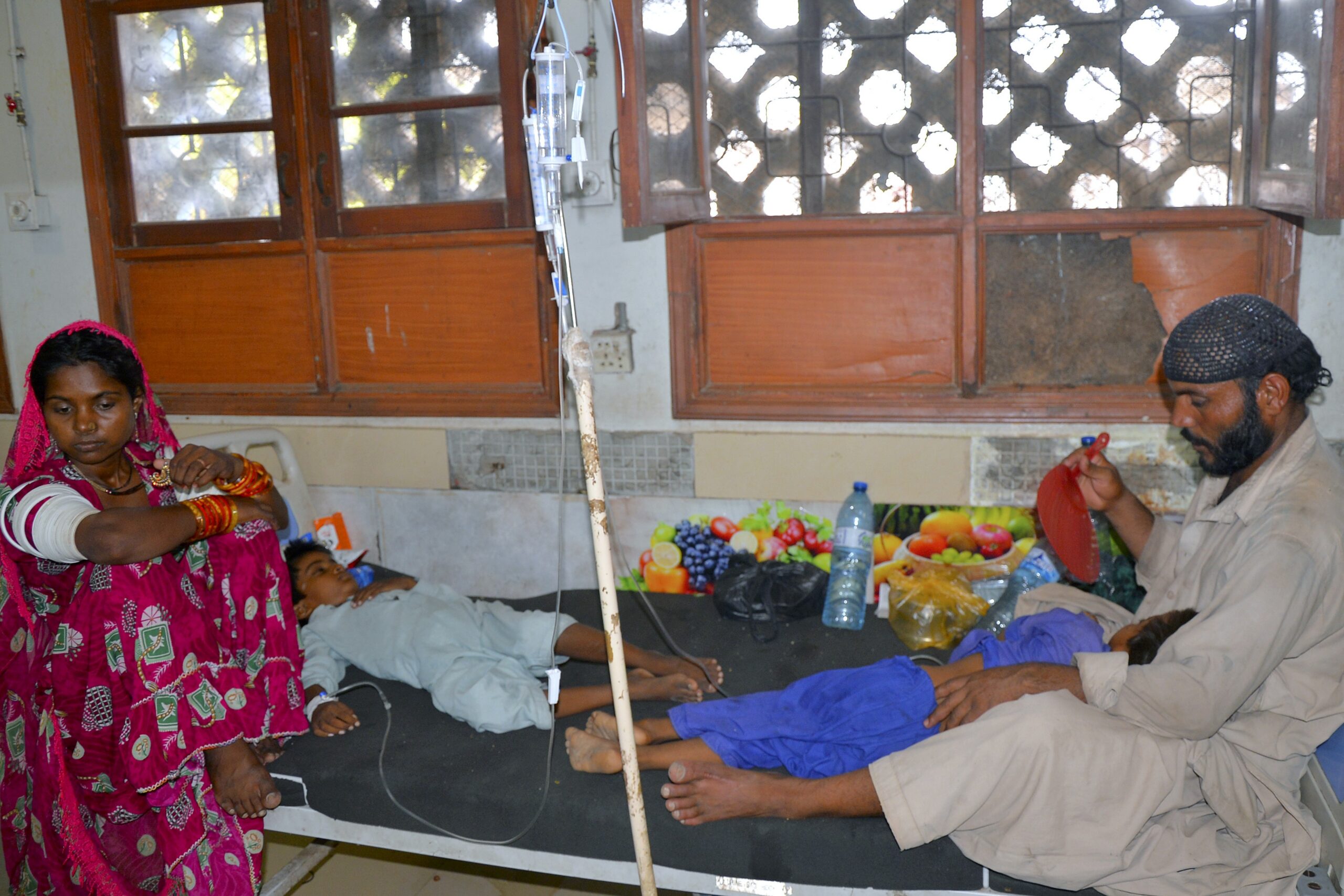
Banner image: Children suffering from gastroenteritis due to heat at a hospital in Hyderabad, Pakistan, in May 2024. Image © Pervez Masih/AP Photo.