

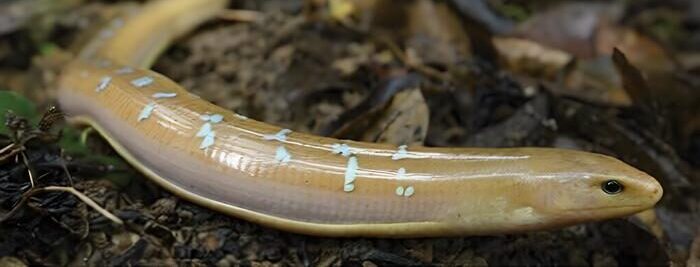
A new study has cleared up a century’s worth of identity confusion surrounding a secretive, legless lizard found in Taiwan’s forests.
Researchers from National Taiwan Normal University confirmed the Formosan legless lizard (Dopasia formosensis) is a distinct species endemic to the island, separate from the more widespread Hart’s glass lizard (D. harti), under which it was previously clubbed.
Legless lizards, often mistaken for snakes, possess several distinct features. The lizards have movable eyelids that allow them to blink, small external ear openings, and a longitudinal lateral fold that allows their skin to expand for breathing or carrying eggs.
For nearly a century, scientists have debated whether Taiwan is home to one or two species of Dopasia legless lizards. Japanese zoologist Kyukichi Kishida first described Ophisaurus formosensis as a distinct species of legless lizard, endemic to Taiwan, in 1930 (the lizards were subsequently placed under the genus Dopasia). He noted that O. formosensis and O. harti, co-occurred in Taiwan but had slight differences in coloration: O. harti had blue spots while O. formosensis didn’t. However, in 2003, researchers concluded the two were a single species, and that the color differences were between females and young lizards, and males. The debate continued, the confusion stemming from the loss of the original specimen that Kishida had referred to after World War II.
Legless lizards are notoriously difficult to find in their natural habitat since they stay hidden under leaf litter and humus. Dopasia is also protected in Taiwan. So, for the new study, the researchers relied on museum specimens from Taiwan and other countries and citizen science data from the Taiwan Roadkill Observation Network to shed light on their taxonomy.
“Roadkill data are very useful for understanding the distribution and season activity of Dopasia formosensis,” study co-author Si-Min Lin told Mongabay by email. “Because this species is only active above ground for a short period each year, records from large citizen-science databases can provide important information on when and where it appears. Much of our current understanding of its habitat and forest-type requirements has come from such records.”
Their analysis showed that the Taiwanese specimens are part of a lineage distinct from those in other parts of Asia.
The research team designated a “neotype,” a new official reference specimen, and confirmed that the blue markings are actually a form of sexual dichromatism, or color-based sex difference. Mature adult males display these conspicuous blue spots as a sexual signal, while females and juveniles are a plain bronze.
Although the Formosan legless lizard is broadly distributed in Taiwan, Lin said the reptiles are rare wherever they occur. “This may mainly reflect its secretive habits rather than a truly small population size,” he said.
The researchers emphasize that establishing a stable scientific identity is vital to protecting the animal’s future.
Banner image: A young D. formosensis male in its natural habitat. Image by Yu-Jhen Liang via Lin et al., 2026 (CC BY 4.0).