

How many marine fish species do bottom trawls catch? Researchers now have a list, and it’s long, running to some 3,000 species, according to a recent study.
Bottom trawling is a commercially popular, and controversial, fishing method in which boats drag weighted nets along the seafloor. Usually they target commercially valuable marine life at the bottom of the ocean, such as rockfish, cod, and invertebrates like shrimp. However, the nets can, and do, catch all sorts of bottom-dwelling animals, such as seahorses.
Study co-author Sarah Foster, who leads the Project Seahorse initiative at the University of British Columbia, Canada, said her team was trying to understand how bottom trawling affects seahorses when she was asked a simple question: How many fish species do bottom trawls catch, and what they are?
“I was surprised to realize there was no clear answer,” Foster told Mongabay by email. “One of the most basic questions in fisheries is what is actually being caught, and yet, for bottom trawling, that baseline understanding was missing.”
So the researchers reviewed documents reporting bottom trawl catches, and recorded nearly 3,000 species of marine fish. “Our estimates suggest the true number could be double that,” Foster said.
They also highlighted a size bias: larger fish tended to be documented more than smaller ones, which were often collectively listed under categories such as “mixed fish” or “trash fish.”
“First, it means we don’t actually know what fisheries are catching — and we cannot manage what we do not measure,” Foster said. “Second, this practice effectively undervalues those species. These are not just incidental organisms , many play vital roles in ocean ecosystems and also support human livelihoods.”
The study found that while nearly 1,700 of the bottom-trawled species are listed as being of least concern on the IUCN Red List, about 237 species are threatened.
Information for many species is completely lacking: Roughly 23% of the species are listed as data deficient or not listed at all, meaning there’s been no evaluation of their conservation status, the study found. This suggests that bottom trawl fisheries operate “without a full understanding of the risks to marine life,” Foster said.
She added the findings support favoring more selective fishing methods, and restricting where and when bottom trawling is allowed.
Ray Hilborn, a fisheries expert at the University of Washington, U.S., who wasn’t affiliated with the study, told Mongabay he wasn’t surprised by the number of species the study recorded. But he added the paper overstates trawling’s global impact without sufficient spatial context. “Certainly in some places trawling is intense, but only a small fraction of the continental shelves have ever been trawled,” he said.
Foster said that “species of conservation concern turned up in bottom trawl catches in every region we examined except Antarctica. That tells us the biodiversity impact isn’t confined to any one [trawling] hotspot.”
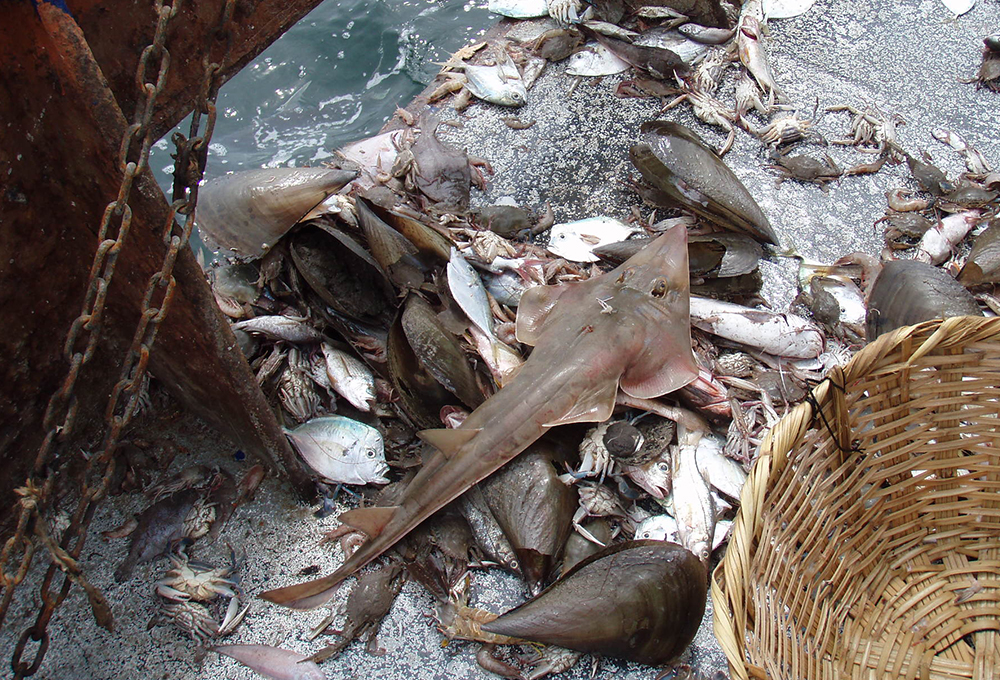
Banner image: A critically endangered giant guitarfish, sometimes caught by bottom trawls. Image courtesy of Sarah Foster.