

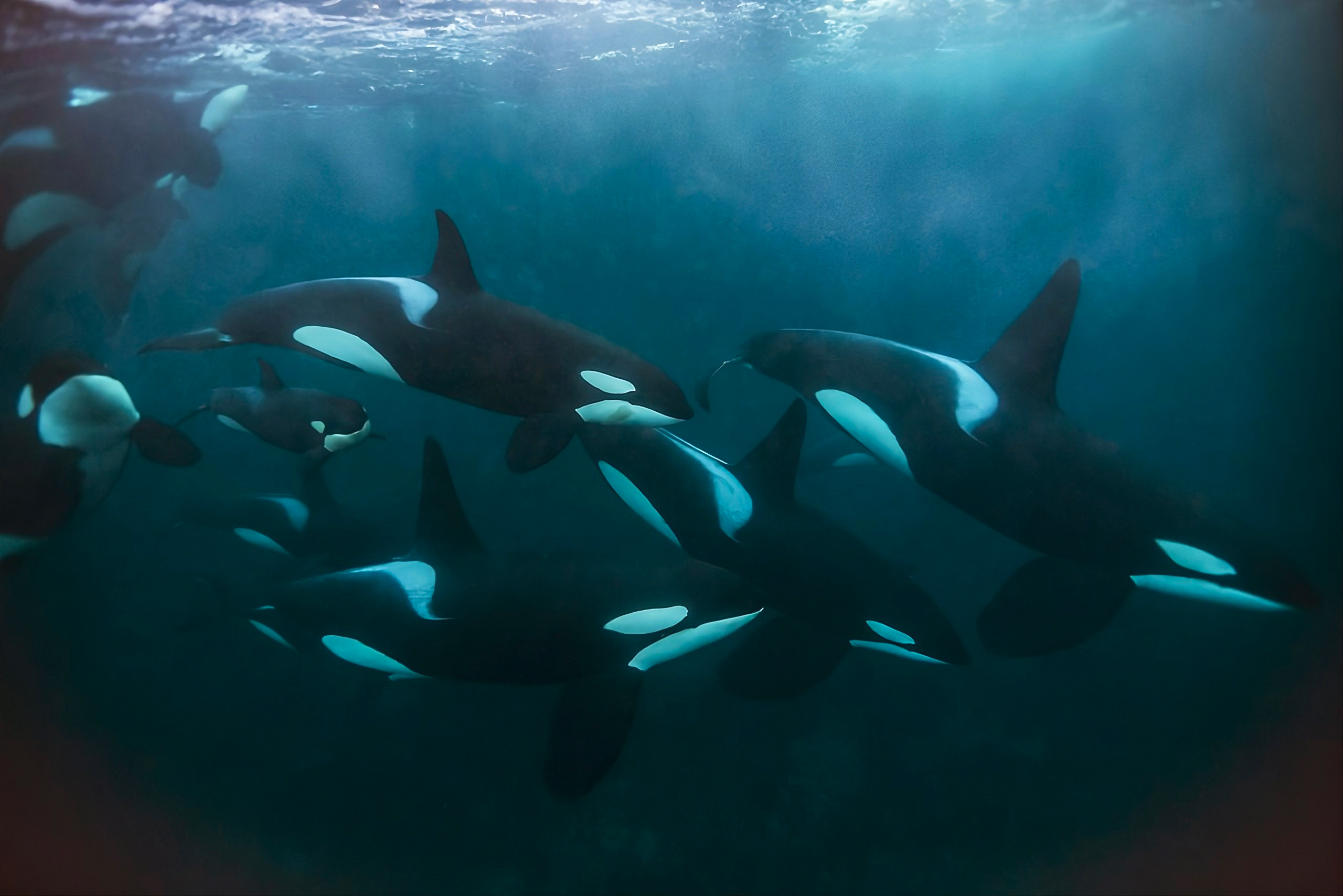
- An AI initiative is listening to southern resident orcas in real-time to help them steer clear of vessels and noisy coastal construction.
- OrcaHello builds on a network of underwater microphones to detect orcas and push out alerts that have helped pause coastal construction and redirect boat traffic as the orcas pass by.
- Southern resident orcas are considered an endangered subspecies, with only 76 remaining individuals.
- Major threats to the species include a decline in their food sources, primarily Chinook salmon, along with noise pollution and vessel traffic.
Where are the orcas at?
Answering that question with pinpoint accuracy is crucial to protecting the famed “southern resident” orcas off North America’s northern Pacific coast.
An AI-driven initiative is now helping parse through large amounts of ocean sounds to identify and detect the orcas in real time. OrcaHello is working with scientists and government agencies to detect the presence of this specific group of orcas and minimize the impact that coastal activities may have on them.
Southern resident orcas (Orcinus orca ater) are considered an endangered subspecies made up of three distinct pods. According to the Center for Whale Research, a U.S.-based nonprofit that studies this group exclusively, there are only 76 remaining individuals of these orcas as of December 2025. A decline in the populations of Chinook salmon (Oncorhynchus tshawytscha), their primary source of food, along with noise pollution and vessel traffic are major threats to their survival.
“Inbreeding is also starting to be a problem, which is what you’d expect for a small population,” David Bain, chief scientist at Orca Conservancy, another nonprofit focused on the southern resident orcas, told Mongabay in a video interview. “That means the decline is going to resume unless we make conditions better.”
OrcaHello was developed to look specifically into the issue of noise pollution and vehicle traffic.
“It’s a real-time AI alert system that’s listening 24/7 for orca calls,” Akash Mahajan, who co-developed the tool, told Mongabay in a video interview.
The tool builds on Orcasound, an open-source network of underwater microphones, or hydrophones, installed throughout the Puget Sound area off Washington state in the U.S. These hydrophones essentially livestream underwater audio, which OrcaHello listens to in order to detect orcas and understand their movements.
OrcaHello started in 2019 as a hackathon project, and evolved and developed over the course of the COVID-19 pandemic. It has since expanded to 7 locations with the help of volunteers and grants. Since its inception, positive orca detection alerts were published on more than 150 days.
The team trained the machine-learning model to listen to the livestream of ocean audio to accurately detect any calls made by southern resident orcas. “The model’s job is to not fire on false positives and to fire only on things that could potentially and highly likely be southern resident killer whales,” Prakruti Gogia, co-developer of the initiative, told Mongabay in a video interview.
Once the model detects an orca call, experts review the alert before confirming or rejecting it, following which alerts are sent out to the people who subscribe to the tool. The moderators also often tap into their expertise and add more information to the alerts, which could include details on the type of call or the specific pod it might be emanating from.
Scientists and conservationists then relay this information to government agencies and other stakeholder organizations to take appropriate action that could minimize disturbances to the orcas. For example, “if there is pile-driving, which is noisy construction, going on in the Port of Seattle when an alert goes out, one of our experts tells the port to pause the construction while the whales are in the area,” Gogia said.
Oftentimes, Bain said, OrcaHello picks up orca calls hours before they reach a specific construction site. “So we can talk to the construction crew and tell them that the orcas are likely to get here around noon,” he said. This has allowed the crew to reschedule their work to prioritize less noisy maintenance work when the orcas are passing by.
The alerts from the tool have also helped with planning fisheries management and rescheduling boat traffic. The team has also used the tool to build a verified and annotated data set that will come in handy for future research purposes. “We can use this to look at seasonal presence of the orcas and the times they are active,” Bain said.
The OrcaHello team eventually plans to scale the technology to more locations and possibly even expand it to help detect other species. But for now, the plan is to stay focused on the southern resident orcas and use the tool to get even more nuanced data on the group.
“Over time, you could have a more interesting AI built over this to distinguish call types,” Mahajan said. “There’s lots that can happen on that front.”
Banner image: Southern resident orcas, an endangered subspecies, are threatened by a decline in their food sources, noise pollution and vessel traffic. Image courtesy of Paul Nicklen.
Abhishyant Kidangoor is a staff writer at Mongabay. Find him on 𝕏 @AbhishyantPK.
Koala on the road? AI signs could alert drivers in real time
