

- Miriam Horn’s Homesick for a World Unknown presents George B. Schaller as a figure best understood through accumulation rather than revelation, tracing a life oriented outward toward animals and the field.
- Drawing on journals, letters, and archival material, the book moves between landscapes and institutions, emphasizing how Schaller worked and how knowledge was produced under field conditions rather than focusing on personal introspection or narrative drama.
- Horn situates Schaller within broader shifts in zoology and conservation, showing how his long-term observational approach both reflected and helped shape changing scientific practices and conservation thinking.
- In an April 2026 exchange with Rhett Ayers Butler, Horn discussed the challenges of writing about a subject who resisted interpretation, as well as the practical and structural decisions involved in shaping the biography.
Some biographies are built around revelation. Others proceed by accumulation, assembling a life from fragments that resist easy interpretation. Miriam Horn’s Homesick for a World Unknown: The Life of George B. Schaller falls into the latter category. It takes as its subject George Schaller, a figure widely regarded as one of the most consequential field biologists of the twentieth century, yet one who spent much of his career deflecting attention from himself. Writing about such a person presents a structural problem: how to render a life whose central impulse was to look outward.
Horn approaches this constraint directly. Her biography draws heavily on field journals, letters, and archival material, allowing Schaller’s habits of observation to shape the narrative without turning the book into a compilation of documents. It is neither a conventional intellectual history nor a purely personal account , instead, it tracks a method of seeing as much as the arc of a career, moving fluidly between landscapes and institutions.
That balance reflects Horn’s own trajectory. Before turning to long-form writing, she spent years working within conservation institutions, including the Environmental Defense Fund (EDF) and the United States Forest Service (USFS). Those experiences inform her treatment of Schaller’s work, which rarely fits neatly into disciplinary categories. He is presented both as a scientist and as a practitioner working within systems shaped by politics, funding, and local realities. The biography follows him across multiple regions, but its emphasis is less on cataloguing his achievements than on how knowledge is produced under field conditions.
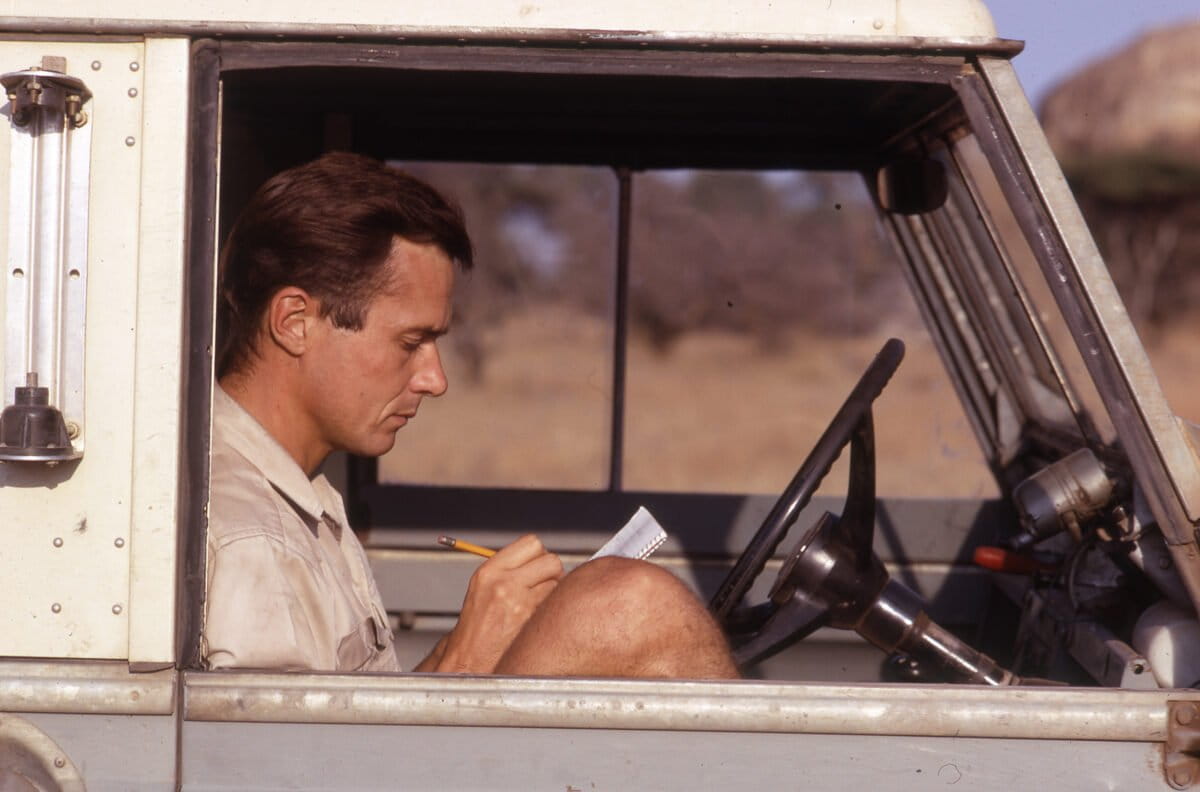
The book arrives at a pivotal moment, as Schaller’s career unfolded during a period when zoology and ecology were shifting from specimen collection and controlled study to the messy, sustained observation of the wild. Horn situates his work within that transition without overstating his distinctiveness. He appears as part of a broader shift, though his consistency and scale set him apart. Her account of his early work with mountain gorillas, for instance, dwells on his decision to remain unarmed, to wait, and to accept uncertainty.
But the biography is concerned with more than science. Schaller’s later involvement in conservation policy, and his gradual, hard-won recognition of the role of local communities in sustaining wildlife, run through the book. These sections are handled with restraint. The book does not move toward a single, settled model. Instead, it follows a series of adjustments shaped by experience.
In a recent exchange with Mongabay, Horn described how she worked through these tensions: between archive and narrative, between subject and author, and between a life that resists interpretation and a form that demands it. She also reflects on the practicalities of writing about a figure who preferred animals to people, and whose legacy is dispersed across landscapes rather than institutions.
Review of Homesick for a World Unknown | George Schaller photo-gallery

An interview with author Miriam Horn
Rhett Ayers Butler for Mongabay: How did you decide to become a writer?
Miriam Horn: Like every little kid, I loved telling stories. And from the first time my mom took me to the library, books were my surest refuge. But it didn’t even occur to me to dream of writing one: I thought they were all like the Greek myths, sent to us from some faraway place and time. It wasn’t until my late teens, when I was on a six-year break from college, that I met workaday writers. As a seasonal employee, working summers at the Forest Service and winters at ski resorts, I was often tasked with shepherding visiting journalists. That sent me back to college with the idea of becoming a journalist. Which is what I did, writing for magazines and newspapers before tackling my first book.
Mongabay: You note that Schaller agreed to a biography only late in life, in part because of your conservation background. How did your experience at the USFS and EDF shape your access and your questioning?
Miriam Horn: Beyond teaching me invaluable practical things—like what happens to a forest when you clearcut it, and how tough it can be in high mountains to restart the succession process–both organizations operate on a principle that Schaller himself came to live by: that humans are not separate from nature, but integral to ecosystems. The Forest Service, at its best, balances human uses—grazing and logging—with habitat and watershed protection. EDF partners with big farmers and ranchers because it’s those families’ choices that largely determine the fate of our grasslands and water and wildlife, and vice-versa. My last book was about such working people seeking to be good neighbors to the nonhumans who share their world: ranchers figuring out how to live with wolves , industrial-scale farmers restoring the soil’s microbial ecology.
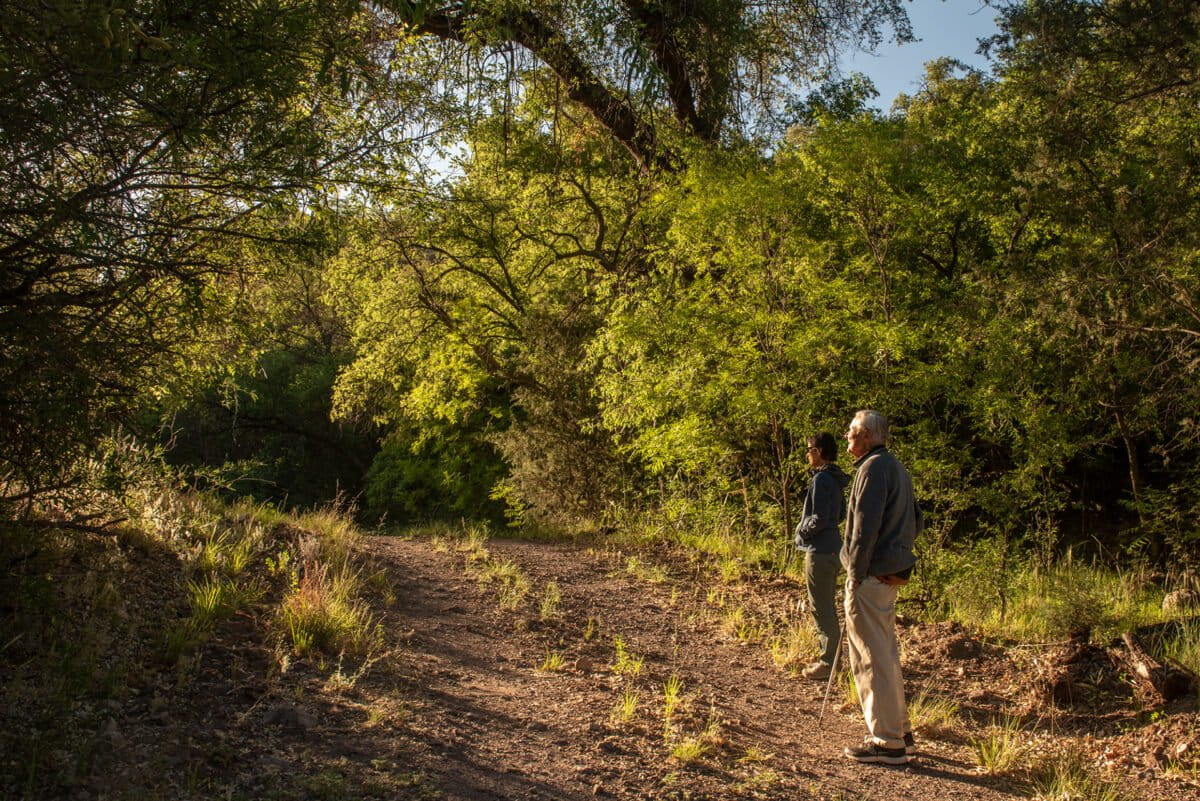
George had said “no” to many prospective biographers but said “yes” to me because (he later told me) he trusted that my experience on the ground had schooled me in the complexities.
Mongabay: Your earlier books often focus on systems and policy, while this one centers on a single life and draws heavily on archival sources. Did that require a different reporting or narrative approach?
Miriam Horn: I don’t see quite such a sharp divide. I’ve never been able to write about policy except through the stories of people whose lives are shaped by those larger forces. And Schaller himself often dove into policy, proving a deft diplomat despite his intensely reserved nature. He helped to create national parks in Pakistan, Brazil, China, Afghanistan, Mongolia and Laos that together cover an area the size of France, securing migratory routes for Marco Polo sheep, birthing grounds for Tibetan antelope, and the possibility for nomadic herders to carry on their traditional ways. He won protections against overhunting and trafficking—of animal parts like tiger bones and penises, and of live animals including Giant Pandas—and helped ensure that fees from trophy hunting go to local people and that communities design and lead all these protective regimes.
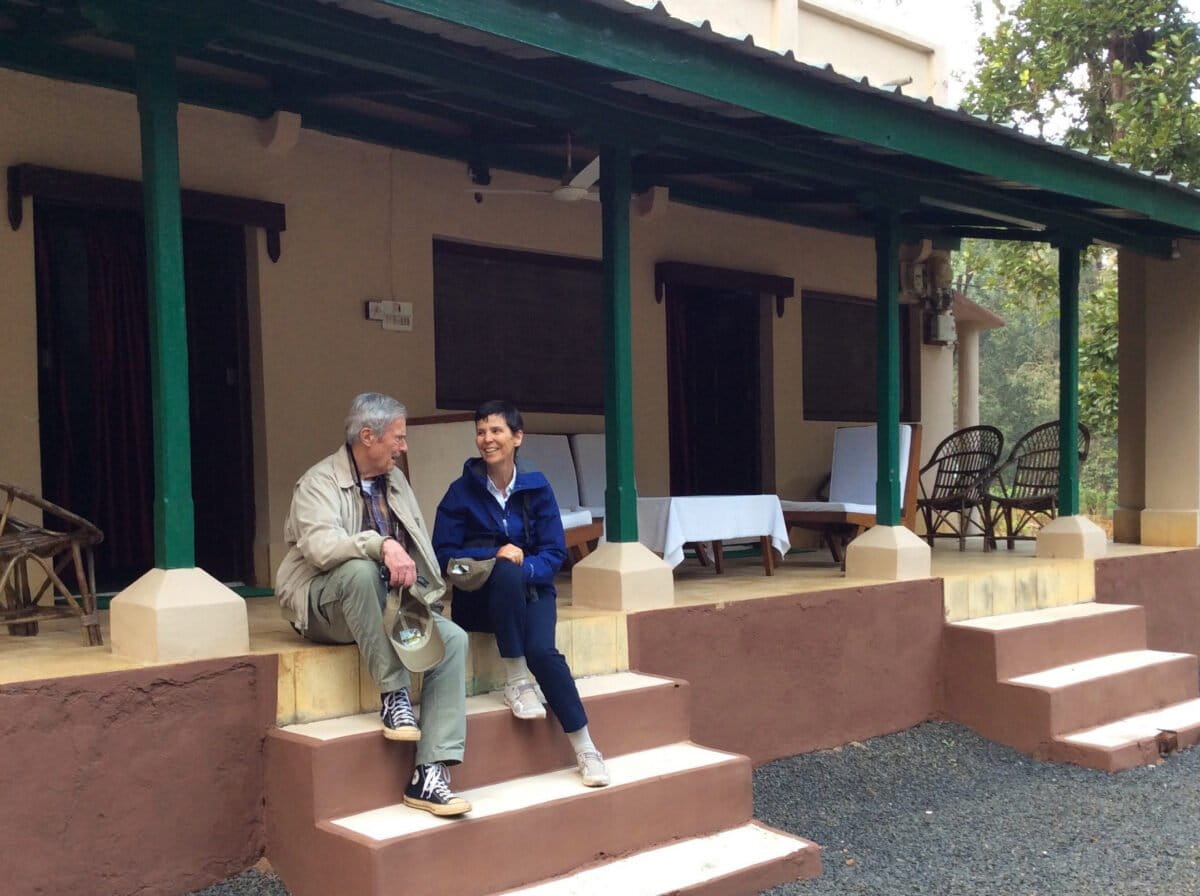
But yes, this is my first book to focus on a single life. And while I still did lots of reporting— including travel with George to India and Mexico, and interviews over years with his family and colleagues in sixteen countries—this took me deeper into archives than I’d ever been. Which I loved. It felt like a real-life Remains of the Day to read the letters his mother Bettina wrote to her best friend back in America, in the 1920s from her fancy Swiss boarding school and then—as George’s German diplomat father was moved from one occupied country to another—from the palaces she danced in and fire-bombings she shepherded her sons through. I felt like a time traveler in the Wildlife Conservation Society archives at the Bronx Zoo, holding in my hands the September 1960 telegram sent by New York Zoological Society President Fairfield Osborn ordering George, when Congo erupted after the Belgians’ abrupt departure, to “get out” without delay. A telegram George ignored, pretending he’d never received it.
Mongabay: Compared with your earlier work, this book feels more intimate and literary. Was that a conscious stylistic decision, or something that emerged from the material?
Miriam Horn: George’s own writing has all the qualities I admire most: a pared-down clarity and economy, quiet and precise in its rendering of dramas big and small. For 30 minutes, a tiny boy mite strokes the rump of a girl mite as she spins herself into the ground. It stood always as my standard to aspire to. I also came to feel that this was the work I’d spent my life preparing for, drawing into it all the writers I’d admired most, from Vladimir Nabokov to William Carlos Williams, Lewis Thomas and Eudora Welty—models of intent observation of the world as it is, the miracles of jellyfish and “Red Admirable” butterflies, the desire to see the world through another’s eyes.

And ultimately my goal was to reveal this man. How was he able to step free of the fear that has driven so much of human history? To defy the authority of all the Great Men of Science? To endure so much anguish in service of the most vulnerable and persecuted beings on Earth?
Mongabay: After spending seven years immersed in Schaller’s life and work, what stayed with you most strongly once the project was finished?
Miriam Horn: George’s rendering of individual animals is so vivid that some—like the blackback gorilla he called Junior, who became his closest ape friend—will live with me forever. I also got the incredible opportunity to see his legacy at work in the Himalaya , trekking with one of his proteges, a young woman named Tshiring Lhamu Lama who grew up herding her family’s yaks and is now Nepal’s leading snow leopard conservationist. Putting into practice Schaller’s recognition that you can only protect a predator if you also protect the human families who share its world, she provides herders with stone corrals and strobe lights to keep the leopards away from their goats and sheep.

More abstractly, Schaller’s life sheds light for me on so much happening in the present world. Listening to AI devotees, I think about all that he came to know only through his own animal body: the senses and “gut feelings” and intuitions we’ve developed over millions of years of evolution. I think about how he was kept alive in the remotest places on Earth by communities still honoring the oldest human value: the welcome offered the stranger. And how despite his legendary physical strength and fearlessness—Peter Matthiessen joined him on their famous journey with trepidation, having heard that George’s last companion had turned back with “boots full of blood”—he never mistook swagger and guns for courage, or dominance for freedom.
Mongabay: You open with Schaller’s decision to approach mountain gorillas without a gun, despite widespread warnings. Why did you choose that entry point for his story?
Miriam Horn: Well, it’s hard to beat a 400-pound silverback beating his chest and charging for sheer drama. But the gorillas were also where he first upended both scientific practice and our understanding of animals, seeding the way he would work for the rest of his life. Until then, zoologists had mostly studied big wild animals only after they were dead, or at best caged. George was the first to meet these creatures in their world, and on their terms. Visiting the gorillas week after rainy week until they got used to his presence, he over the next two years came to know their distinct personalities and rich social lives. That they were so obviously kin—as tender, antic, anxious, lazy, jealous, petulant and sorrowful as any troop of humans—bequeathed him an empathy he carried to truly fierce predators. And that they were indeed not what the experts had told him fortified an anti-dogmatism he would also carry for the rest of his life, so impressing Michael Crichton that he wrote George into the sequel of Jurassic Park, offered to a young scientist as an exemplar, a renegade who proved expert after expert to be “wrong…just wrong.”
Mongabay: Schaller’s childhood is marked by displacement, war, and social isolation. How directly do you think those early experiences shaped his capacity for solitude in the field later?
Miriam Horn: His childhood prepared him for lots of what he would face traversing the planet’s harshest terrain: not only months cut off from the people he loved but also physical privation (cold, exhaustion, hunger) and the opaque dangers that arise when trying to navigate cultures–human or animal—that you don’t understand. His boyhood experience surviving in a warzone came in particularly handy in places like Afghanistan and post-Soviet Mongolia. It also shaped him, I think, philosophically and morally: complicating his view of which species is most violent , seeding his commitment to protect Earth’s most reviled and persecuted beings.
Mongabay: You describe his method as a radical departure from mid-20th-century “objective” zoology. Was there a particular archive or field note that made that break especially clear to you?
Miriam Horn: I saw the first glimmers in a letter he wrote to his mom from college (the Univ. of Alaska) describing an accidental encounter with a grizzly— who charged. George hadn’t yet learned that the worst thing you can do is run, so got chased like a zig-zagging rabbit. A moment later, he reconsidered. “I think he was mostly curious,” he wrote his mom. Later that day, he nearly collided with a moose, both “thinking our own thoughts … not looking where we were going.” Apologizing to the moose, George stepped off the path.

That dawning recognition of animals’ inner lives—then a thoroughly heretical view—came into full bloom with the mountain gorillas. Reading those journals, I got to watch day by day as George won their acceptance and came to love best those moments when he became the object of their gaze. He always sat where they could see him, usually up on the branch of a tree. One afternoon an ape holding her baby swung up alongside, glancing sidelong at him like a stranger on a park bench. Another, ambling down a path, tapped his leg as if he were just another gorilla to get him to move out of her way.
Mongabay: Kay Morgan Schaller appears repeatedly as a steady, often unsung presence. How did you approach portraying her role?
Miriam Horn: Kay’s centrality to the story was impossible not to see.

George himself reminded me of it every time I saw him. But it was evident from my very first visit to their home, where when conversation with taciturn George would stall, she’d nudge him along or fill in details herself. She was, after all, right there with him for many decades: keeping their sons from toddling into the tiger ravine or bottle-feeding their rescued lion cub. And she had her own wonderfully vivid, funny, acerbic voice, writing long letters (mostly to her mom) of life as a “housewife”: baking bread in their leaky stove in the middle of the Congo rainforest, fertilizing her zinnias with zebra dung in the Serengeti, breaking ice to get water in the pandas’ bamboo jungle—all places she loved as much as George did.


After a time, her health prevented her from joining arduous trips into places like Tibet , one of the hardest things for me to chronicle was her sadness. The profound strains of George’s long absences were the price both paid for his deepest commitment, to our largest circle of kin.
Mongabay: Schaller avoided self-disclosure and even described himself as a “biographer of animals,” not of himself. Much of your book draws on journals, letters, and long silences rather than confessional interviews. How did that shape your approach to portraying him as a character?
Miriam Horn: As I’d been told, and then saw for myself, George is a reticent and awkward talker but unexpectedly revealing in his writing, especially in his field journals. So I went with that, and found treasures beyond my wildest imaginings. Few biographers get to be the first to read a daily chronicle (20,000+ pages) recording in real time everything seen, heard, smelled, tasted, and felt by one of history’s most acute sensoria. Or know the magic of opening a notebook from fifty years ago and watching a still-brilliant feather or pressed flower flutter out. I discovered that he sometimes used the back of journal pages to scribble more-personal yearnings and anguish.
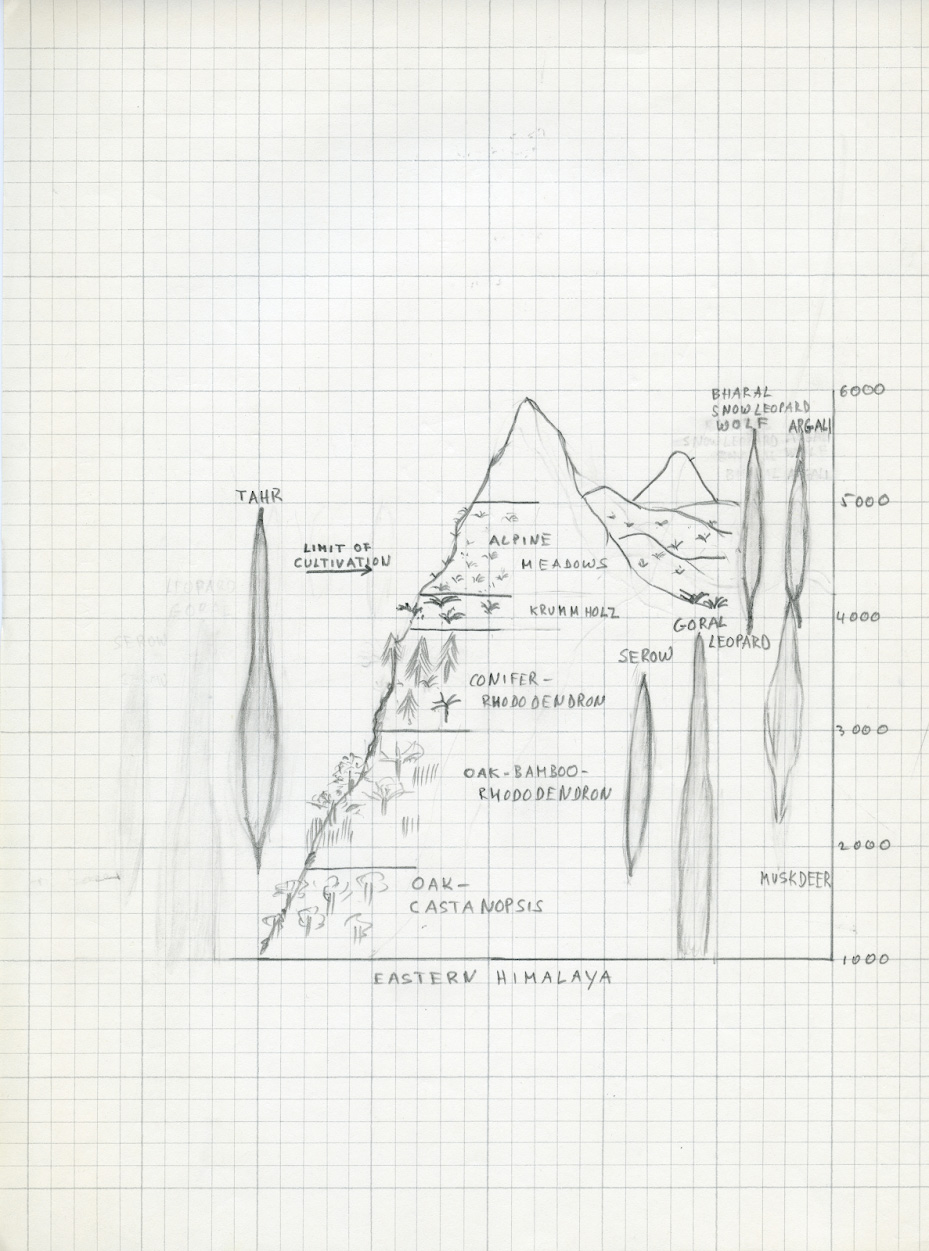
I also had artifacts others had saved: Peter Matthiessen kept every letter sent him by George or Kay, and sons Eric and Mark shared their journals, preserving their unguarded view of their often distant, sometimes extraordinarily present father.
Mongabay: Schaller’s field journals are described as both scientifically exacting and deeply lyrical. How did you balance quoting his voice with maintaining your own narrative voice?
Miriam Horn: It was a challenge , his writing so often seemed impossible to improve on. But over time and many drafts and cutting I got more ruthless, to keep the story roaring along. And there was so much distillation, and then piecing together a million shards—including all the other voices—that by the end it sorted itself out.
I do hope my book will send people back to his, so they can savor at length the wonders of his accounts.
Mongabay: Schaller’s shift from pure science toward conservation policy unfolds gradually in the book. Was that evolution something he articulated clearly, or something that emerged more in retrospect?
Miriam Horn: Well even on his earliest expeditions, under the influence of people he’d read (Aldo Leopold, Niko Tinbergen, Frank Fraser Darling) and been mentored by (especially Olaus Murie and the G’wichin and Batwa peoples) he’d made groundbreaking ecological studies—taking in the whole ecosystem with its myriad interdependencies. For the gorillas, he compiled lists of all the plants these giant vegetarians eat, and where they traveled to find suitable mates, to know what habitat was critical to protect.
In India, he quantified just how many chital deer a tiger needs to eat, making the case that to protect the endangered cat required protecting their prey.

It wasn’t until in Pakistan in the 1970s, however, that he really understood the scope of the “great dying” befalling the world. Walking for weeks at a stretch and seeing just a handful of animals, he realized that the parks he’d worked in until then—Virunga, Kanha, the Serengeti—were aberrations in their abundance , most of the world was already emptied of wildlife. He became ever more outspoken on the need for science to serve conservation, laying the ground for the emergent field of conservation biology.
Mongabay: Schaller worked across many regions and was often most effective when least visible, especially in China. How did you decide which field periods and places to linger on, and how did you document low-profile impact?
Miriam Horn: George had so many extraordinary adventures, I had the luxury of cherry-picking the most dramatic: his week sleeping near a snow leopard, who even let him admire her cub , getting hopelessly lost in a Himalayan blizzard , being encircled by opium traders alone in remote Afghanistan , or landing Zelig-like, as he often did, at the center of history, studying pandas (for instance) in the tense aftermath of China’s Cultural Revolution.

I also chose episodes that illustrated the many cutting edges he worked on, like his beta use of remote sensing technologies to track Brazil’s jaguars and Tibet’s bears, although with ever-increasing ambivalence.
As for documenting his impact despite his low profile, I followed his lead in tracing what he counts his most important legacy: the generations of scientists he helped inspire and train in Africa, South America and especially Asia, many of them now leading conservation in their home countries.
Mongabay: Many readers will come to the book already familiar with figures like Jane Goodall or Dian Fossey. What did you hope this biography would add or correct in that wider cultural story?
Miriam Horn: Most people are surprised to learn that George preceded them both: it was his model of habituating and living with gorillas, and even naming them, that inspired Jane to undertake the same with chimps—and Louis Leakey to ask George to visit and teach her some basics in her first months in Gombe.

He was the one who laid the ground for all who in the years since have studied sentience and social relationships in elephants, wolves, cephalopods, hawks and myriad other species. Those who count him their model and hero range from David Attenborough to Stanford primatologist Robert Sapolsky.
And his impact went far beyond science: director Stanley Kubrick based the Dawn of Man sequence that opens 2001: A Space Odyssey on Schaller’s gorilla work.
Mongabay: The title suggests a longing not just for lost ecosystems but for a way of relating to the nonhuman world. How did you arrive at it, and what dimensions of Schaller’s work does it capture for you?
Miriam Horn: Growing up in the fearful chaos of wartime Europe—shunned wherever he was, either because of his American mother or his German father—George found solace in the forest and in tales of turn-of-the-century explorers. George was still only dreaming of following their footsteps into remotest Tibet when he himself wrote the words we used for the title. “Is it possible,” he’d wondered, “to be homesick for a world unknown?”

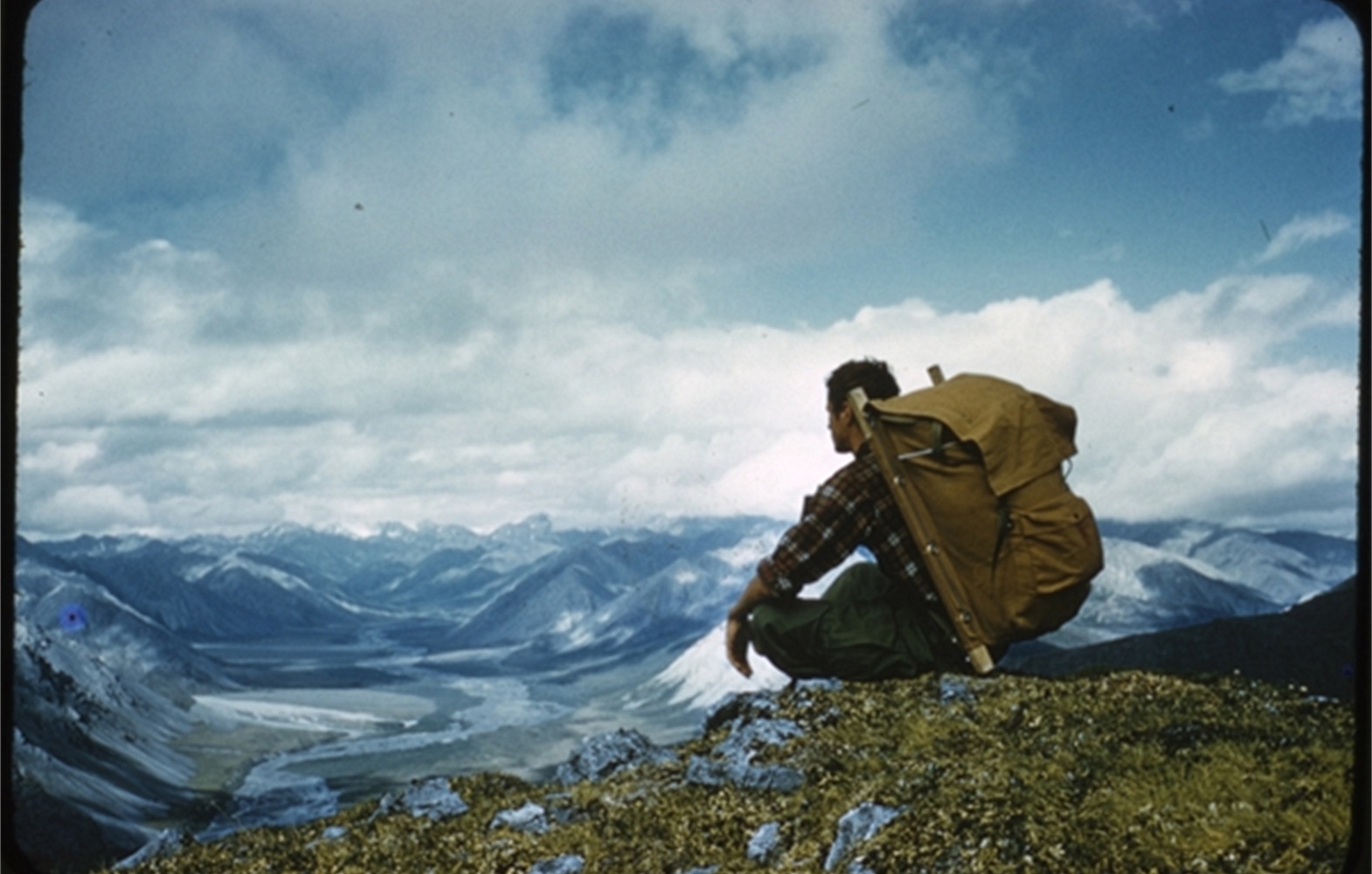
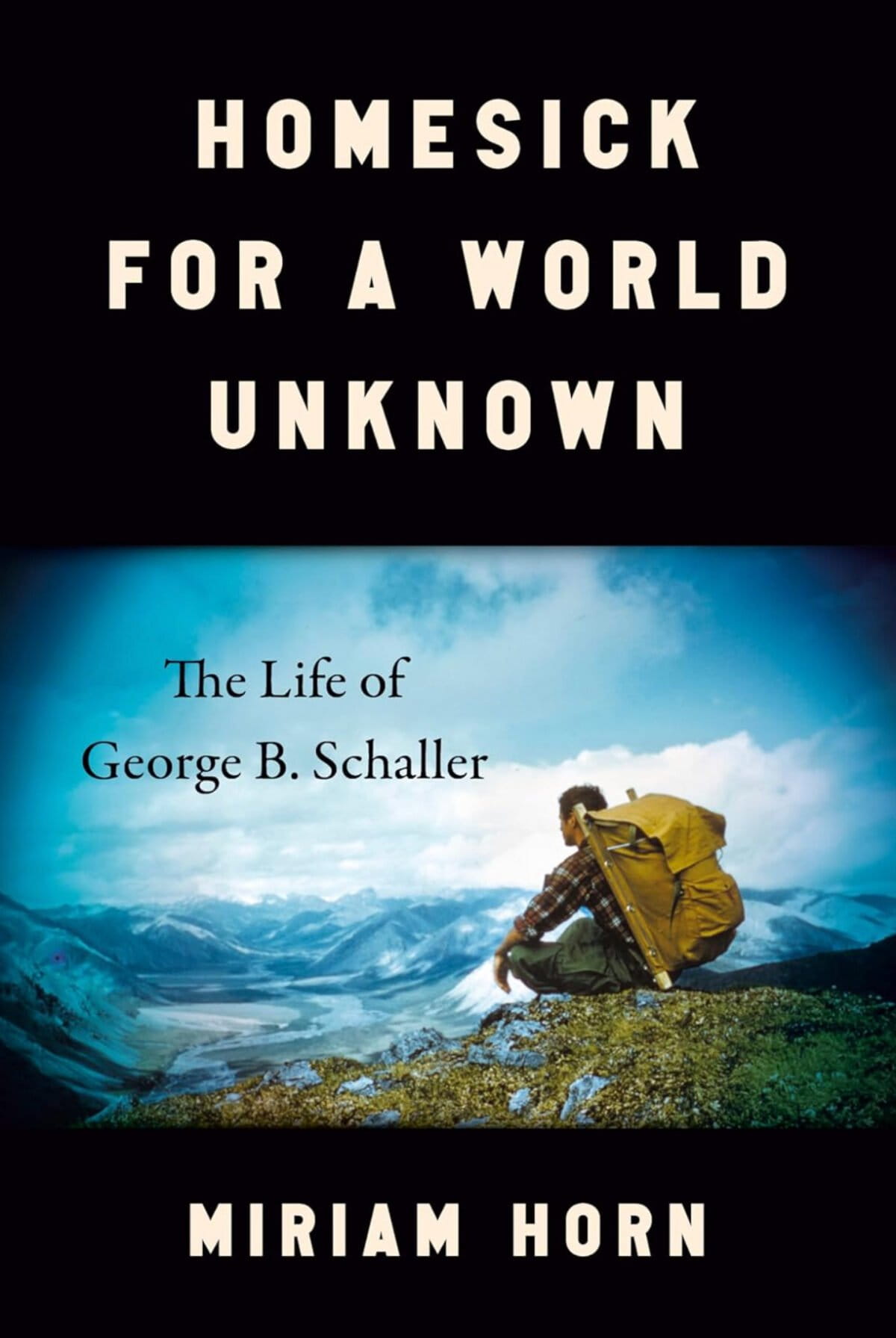
What I love about it is the many meanings it holds, including the beautiful one you suggest. The cover echoes another: at 23, he is looking into Alaska’s north slope, a world he has not yet explored but knows is home. That we are seeing him from the back alludes to a compositional technique used by German Romantic painters, the Rückenfigur, also true to who he was. It was never about him, but about the portal he could open for the rest of us to this world.
George Schaller: The field biologist who helped redefine conservation
