

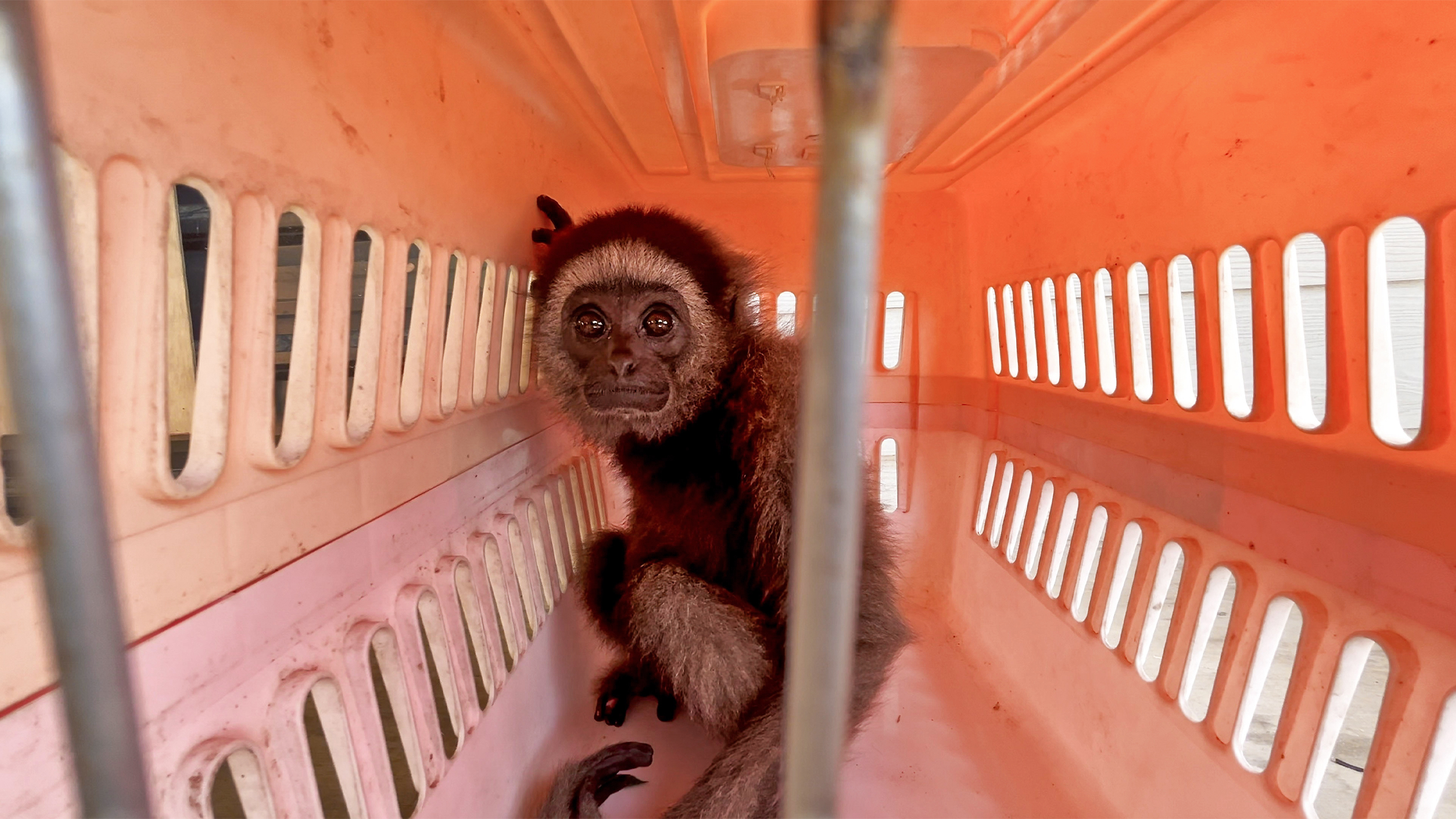
- As gibbon trafficking reaches record highs, conservationists say reducing demand is critical to tackling the illegal trade.
- But motivations for wanting to buy a gibbon vary widely between buyer communities, which means the solutions must be tailored accordingly, experts say.
- Surveys of people who voluntarily surrendered gibbons to a sanctuary in Malaysia found that most cited as motivation a love of animals or desire for their children to have an animal to play with.
- In India, by contrast, a sanctuary manager says gibbons are coveted as status symbols, and most arrive at the center via confiscation rather than voluntary submission.
“When we first got Joy, we thought she was a monkey,” says Esther.
A hunter had come to her village in the Malaysian state of Sabah, on the island of Borneo, to sell wild meat. He showed Esther (not her real name) and her husband a weeks-old primate with long arms, dark skin and large, round eyes. Worried the animal might otherwise be killed for food, she decided to take her home. It was only later that she realized Joy was not a monkey, but a gibbon.
Gibbons are small apes, more closely related to chimpanzees and humans than to monkeys. Across their range in South and Southeast Asia, they are increasingly threatened by the exotic pet trade. Despite laws that prohibit their capture, sale and ownership, demand for pet gibbons continues to drive illegal trade in wild-caught animals, much of which now plays out online.
In 2025, gibbon trafficking seizures reached an all-time high, with confiscations of 336 individual gibbons recorded between January and August alone, accounting for around 20% of all records since 2016, according to an analysis by wildlife trade monitoring network TRAFFIC. Because gibbons are highly social animals and will defend their young to the death, the capture of an infant gibbon often represents the annihilation of an entire family group.
Between 2016 and August 2025, more than 200 seizures were recorded, but “in reality, the trade is likely much bigger,” says Elizabeth John of TRAFFIC. While Indonesia and Vietnam have historically dominated the trade, India and Malaysia have emerged as key countries in recent years. Most cases, John says, appear to take place domestically, with only 29 seizures during this time period involving international smuggling attempts — though this may also reflect animals being seized earlier in the trade chain, before they reach borders.
Why do people buy gibbons?
“Primates have always fascinated people,” John says, and gibbons are particularly appealing “because of their uniqueness and rarity.”
But demand and the reasons that drive it differ across countries, and over time, she says.
Around a quarter of recorded cases in the TRAFFIC analysis were voluntary surrenders rather than confiscations, an indication that some buyers may not fully understand what they are taking on.
At the Gibbon Conservation Society, which runs rehabilitation centers in Sabah and Peninsular Malaysia, most of the 40 gibbons rescued in recent years were handed over voluntarily by their owners.
The profiles of former owners vary widely, says founder Mariani “Bam” Ramli. They span rural and urban settings, different age groups and genders, though they are more likely to come from higher-income households. In most cases, they acquired their gibbons through informal networks or online. Of the 40 gibbons, two were bought to be raised for meat. The rest were taken in as pets.
“Most of them say they love animals, or they want their children to have an animal to play with,” Ramli says.
In parts of India, the picture looks somewhat different. At the HURO Foundation, which rescues and rehabilitates western hoolock gibbons (Hoolock hoolock) in the northeastern Indian state of Meghalaya, around 90% of gibbons admitted since 2009 arrived through confiscations.
HURO Foundation director Florian Magne describes two overlapping forms of demand: local capture and trade in rural areas, and an emerging market among wealthy urban buyers willing to pay significantly higher prices. These circuits can connect, with locally kept animals sometimes entering wider commercial networks.
Here, gibbons are often perceived as status symbols. “They are seen as prestigious pets, attracting attention and conferring social status,” Magne says.
In recent years, private zoos and collections owned by India’s elites have been linked to cases involving rare and nonnative primates, pointing at these establishments as growing sources of demand in both domestic and international trade networks.
Online, influencers and social media content can amplify the appeal of keeping wild animals like gibbons as pets. In some places, these ideas are beginning to displace older cultural norms. For example, in Meghalaya’s Garo Hills region, traditional beliefs once held that harming or detaining a gibbon was a sin. “Unfortunately, these cultural beliefs are gradually disappearing,” says Magne.
When owners change their minds
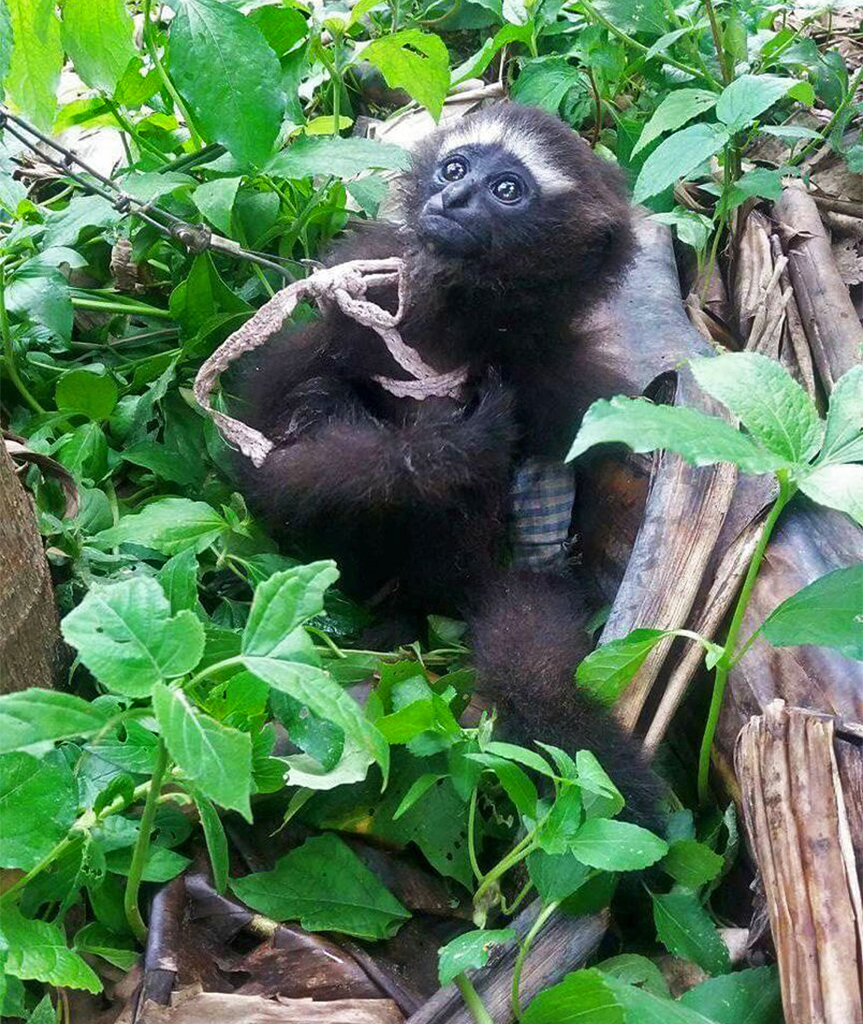
When Esther brought Joy home, she was initially delighted. She responded to her name and played with the family. “Every morning Joy would sing,” she says. “She became my alarm.”
It was only after a relative pointed out that Joy was a gibbon — and that keeping her was illegal under Malaysian wildlife law — that she began to reconsider. “From the moment I found out, I wanted to let her go,” she says.
Eventually, she decided to take Joy to the Gibbon Conservation Society’s center in Sabah.
Fear of legal consequences was cited by only two people who surrendered gibbons to the Gibbon Conservation Society. In Malaysia, enforcement and public awareness remain relatively weak, Ramli says, with gibbons often overshadowed by higher-profile species such as orangutans (Pongo pygmaeus). Meanwhile, Magne says that in Meghalaya, administrative corruption and gaps in enforcement mean that fear of the law is rarely a deterrent.
More often, owners give up pet gibbons because they can no longer cope. As wild animals, gibbons become increasingly difficult to manage when they reach adulthood. Many people who bring gibbons to the Gibbon Conservation Society also say they want the animals to return to the wild. In practice, returning captive gibbons to the wild is notoriously difficult. Successful releases require years of rehabilitation and careful site selection, and are not always possible.
Social media analyses suggest exotic pet content often spreads misinformation, presenting gibbons as cute and manageable pets, and obscuring information about the practical and ethical implications of keeping wild animals at home.
Changing behavior
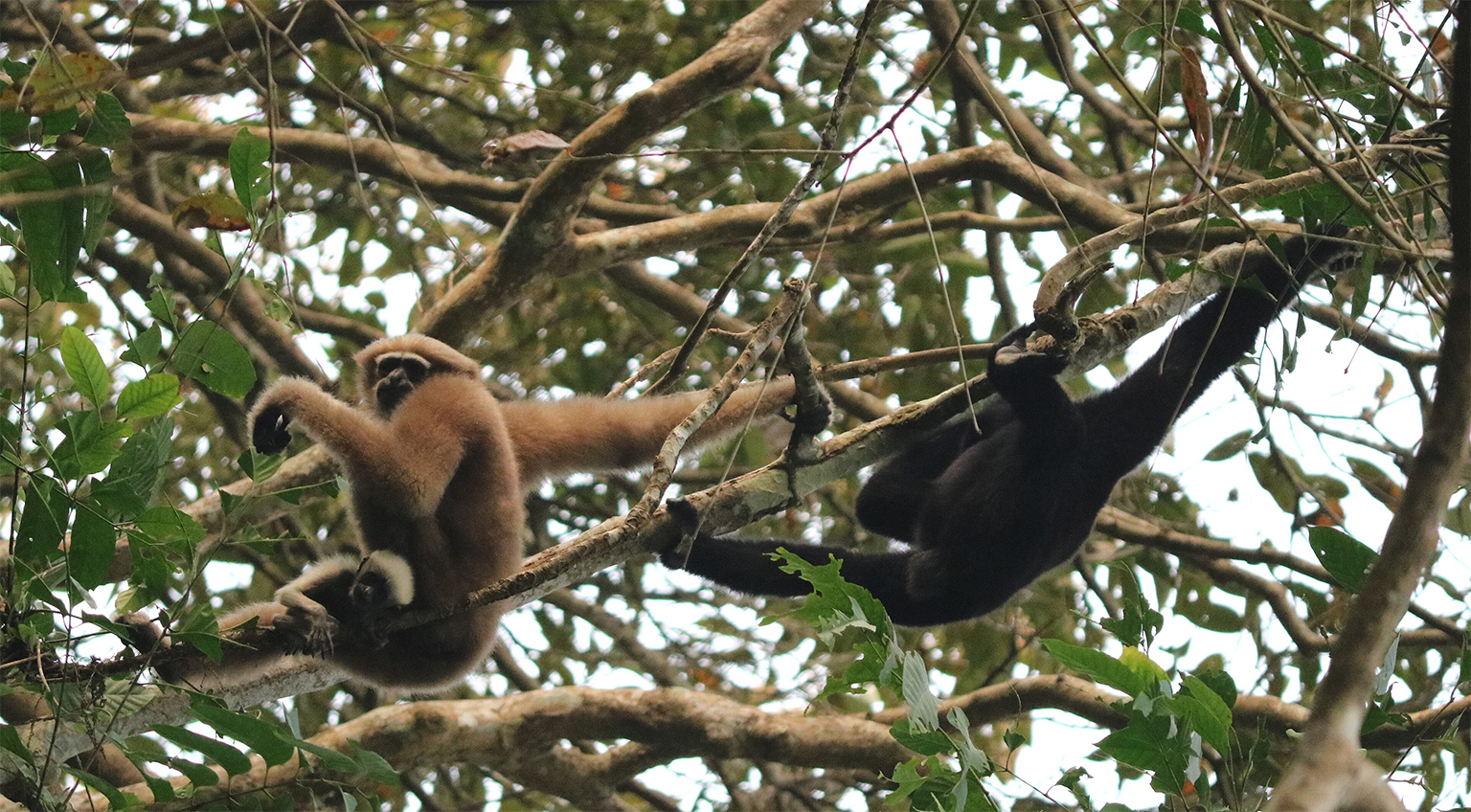
Reducing demand is “absolutely critical” for addressing the illegal trade of gibbons, says Susan Cheyne, vice chair of the Section on Small Apes at the IUCN, the global wildlife conservation authority. But what works depends on why people are buying gibbons in the first place.
For long-term change, says TRAFFIC’s Elizabeth John, what’s still missing is a clear picture of buyers and their motivations. “We need a thorough study of pet buyers in specific locations where demand is greatest or growing” she says.
Guidance developed by TRAFFIC for countries that have signed up to CITES, the treaty on the international wildlife trade, stresses that the design of interventions should be grounded in an understanding of the target audience and behavior. In places where lack of awareness is the primary issue, spreading information may be enough. Where keeping a gibbon is tied to status or identity, shifting social norms may be necessary.
In practice, efforts to reduce demand are still evolving. The Gibbon Conservation Society runs public education programs and has helped shut down exotic pet accounts on Malaysian social media through targeted campaigns. Cheyne points to Gibbonesia, an Indonesian initiative that combines online outreach with on-the-ground work to shift public attitudes, as a promising example. The message, she says, should be clear: “Keep gibbons wild.”
Banner image: Joy the gibbon, when he was surrendered to a rehabilitation center. Image courtesy of Gibbon Conservation Society.
Correction: Due to a translation error, an earlier version of this article described Joy, the surrendered gibbon, as male.
Gibbon trafficking pushes rehabilitation centers to the max in North Sumatra
Citation:
Moloney, G. K., Tuke, J., Dal Grande, E., Nielsen, T., & Chaber, A. (2021). Is YouTube promoting the exotic pet trade? Analysis of the global public perception of popular YouTube videos featuring threatened exotic animals. PLOS ONE, 16(4), e0235451. doi:10.1371/journal.pone.0235451
FEEDBACK: Use this form to send a message to the editor responsible for this story. If you want to post a public comment, you can do that at the bottom of the page.
