

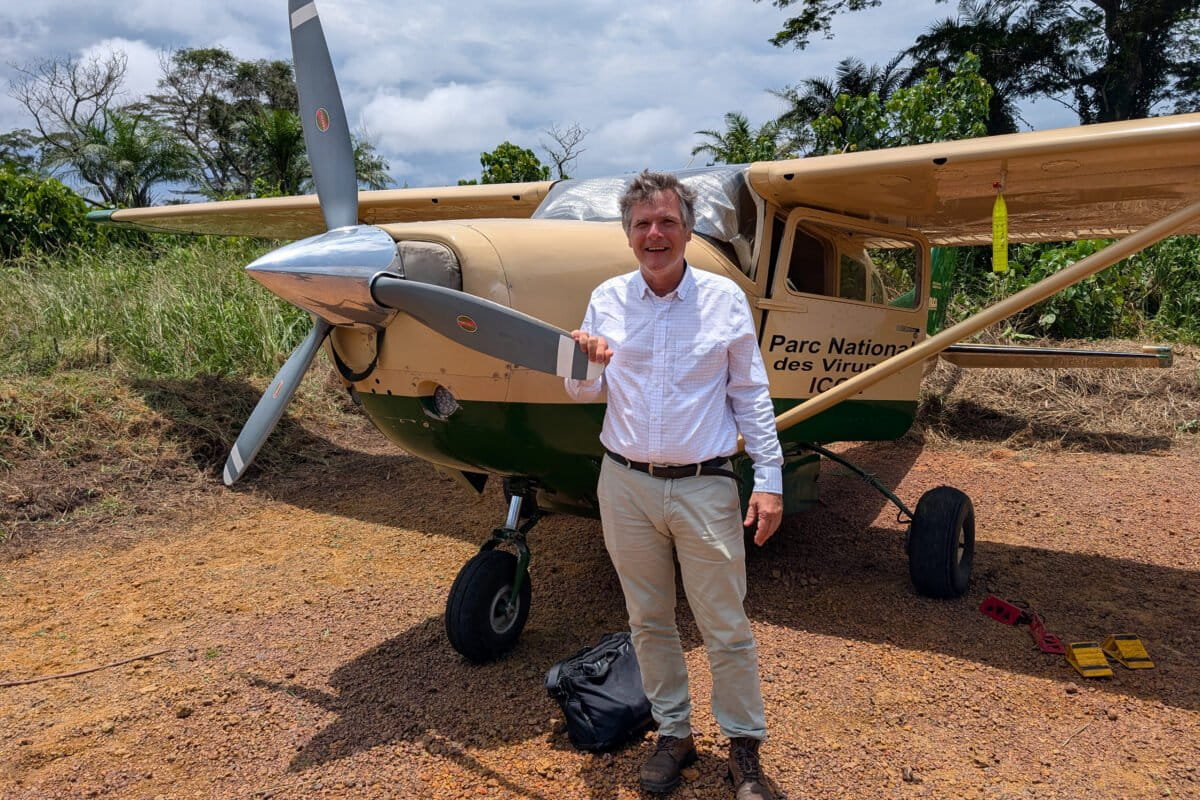
- In eastern Democratic Republic of the Congo, pressure on Virunga National Park reflects deeper economic and governance dynamics, where conservation competes with immediate livelihood needs tied to charcoal production and agriculture.
- Emmanuel de Merode frames environmental decline as a consequence of how people earn a living, arguing that protecting biodiversity requires addressing energy access, jobs, and local economic systems.
- Virunga has developed an integrated model built around renewable energy, small business development, financial access, and localized security, aimed at shifting incentives away from conflict-linked and extractive activities.
- The proposed Green Corridor extends this approach across a national scale, testing whether a viable economic system can be built that depends on maintaining forests rather than clearing them, despite ongoing conflict and political constraints.
In eastern Democratic Republic of the Congo, discussion of conservation often centers on loss: forests cleared, wildlife depleted, conflict spreading across landscapes that once supported some of the richest ecosystems on Earth. At Virunga National Park, those pressures are concentrated. The park, Africa’s oldest, contains glaciers, volcanoes, forests, and wetlands within a single protected area. It also sits within a region shaped by decades of instability, where armed groups, informal economies, and weak governance are part of daily life.
Emmanuel de Merode, who has led Virunga since 2008, does not begin with ecology. His training is in anthropology, and that shapes how he describes the park. The condition of wildlife, he suggests, follows from deeper forces. Forest loss, poaching, and insecurity are not simply environmental problems. They emerge from how people earn a living, how authority functions, and how money and resources circulate.
In eastern Congo, conservation cannot be separated from the economy. For many communities around Virunga, the choices are immediate. Clearing forest for agriculture or producing charcoal can generate income that supports a household. The benefits of conservation are harder to see and often accrue far beyond the region. The imbalance shows up in daily decisions about fuel, food, and access to land. As de Merode describes it, the system asks some of the poorest populations to bear the cost of protecting assets valued globally.
The pressure on the park is reinforced by conflict. Since the mid-1990s, eastern Congo has been the site of prolonged violence involving militias, foreign armed groups, and competing political interests. These dynamics have had direct ecological effects. Large mammal populations declined sharply during the early 2000s. Rangers, tasked with protecting the park, have been frequent targets. More than 200 have been killed over the years.

De Merode’s approach developed from this context. A turning point came in 2007, during a period of intensified violence that included the killing of seven mountain gorillas. Investigations linked these events to the charcoal trade supplying Goma, a city of roughly two million people with few alternatives for energy. At its core, the crisis was about energy and livelihoods. Those findings forced a shift in the response.
Over the following years, Virunga built a system centered on renewable energy, particularly small-scale hydroelectric plants. The aim was to reduce pressure on forests by replacing charcoal while building a different economic base. Electricity enabled small businesses, from welding and milling to refrigeration and food processing. These activities created employment. De Merode’s argument is straightforward: energy enables business, business creates jobs, and jobs change incentives that draw people into armed groups or illegal activities.

The model extends beyond energy. Financial services have been integrated through smart meters that track electricity use. Consumption data provides a record of activity, allowing small enterprises to access credit without conventional collateral. Repayment is tied directly to power usage. The mechanism is simple and addresses a persistent constraint in places where formal banking systems are limited and transaction costs are high.
Security has also been reworked. Traditional responses, often slow and reactive, left communities exposed. Virunga has developed rapid-response systems and forward operating bases designed to shorten response times to threats and create localized stability. These are paired with economic initiatives, so that areas benefiting from improved security also gain access to jobs and infrastructure.
Agriculture provides another example. In parts of eastern Congo, commodities such as cocoa have been tied to conflict financing. Armed groups have used violence to control harvests and channel production into illicit trade networks. Virunga’s response has been to shorten the value chain and secure it. Farmers sell directly into a system that processes products locally, capturing more value and reducing exposure to coercion.
These elements form what de Merode describes as a competing economic system. The idea is that conflict in eastern Congo is sustained in part by an economy built on extraction and informal trade. Changing the status quo requires introducing an alternative that is viable at scale. Small interventions can demonstrate feasibility, but they do not shift the broader balance. The challenge is to reach a point where the alternative begins to displace the existing system.
The Couloir vert Kivu-Kinshasa, or Green Corridor, is envisioned as that alternative. Established through national legislation in 2025, the corridor extends the approach developed in Virunga across a much larger geography. It is not a protected area in the conventional sense. It includes cities, farmland, and infrastructure. The aim is to connect regions of agricultural production in the east with demand in the west, particularly in Kinshasa, while maintaining the integrity of the Congo Basin forest.

The corridor is conceived as a network of economic hubs, each combining energy, agriculture, processing, logistics, and security. Rather than attempting comprehensive development at once, the model builds nodes that can be linked over time. Energy remains the starting point, followed by value-added production and transport systems. The scale is large: the area covered is bigger than many countries, and the population runs into the millions.
The approach has limits. Recent resurgences of conflict have disrupted parts of the system. Infrastructure can be damaged, access restricted, and revenues reduced, particularly from tourism. De Merode acknowledges that economic interventions alone cannot resolve the broader political dynamics shaping the region. External interests, regional tensions, and long-standing governance challenges continue to influence outcomes.
Even so, the effort is treated as a necessary test. Without an alternative model, the trajectory of the Congo Basin is likely to follow patterns seen elsewhere, where infrastructure expansion and resource extraction lead to fragmentation and loss. The corridor seeks to determine whether a different path is possible, one in which economic activity depends on maintaining the forest rather than clearing it.
The following is based on a series of conversations with de Merode conducted over the course of several days in Democratic Republic of the Congo by Rhett Ayers Butler and David Akana. The interview has been edited and condensed.

AN INTERVIEW WITH EMMANUEL DE MERODE
What is your background, and how did you come to work in Virunga?
I was born in Tunisia and grew up in Kenya. My parents are Belgian, but I’ve never really lived in Belgium. Kenya is what shaped me. It’s where I developed an understanding of landscapes, but more importantly, of people — how communities function and how they relate to their environment.
I didn’t come into this through a traditional conservation path. I was never particularly interested in approaching nature purely from a biological or scientific perspective. What interested me more was the human side — communication, behavior, systems. That’s why I studied anthropology rather than biology.
That perspective has stayed with me. If you look at conservation through a purely ecological lens, you miss the underlying drivers of what is happening. In many cases, the outcomes we see — deforestation, poaching, conflict — are not failures of knowledge about ecosystems. They are failures to understand the human systems around them.
I’ve been working in eastern Congo since 2001, so about 25 years now. When I first arrived, I expected conservation to be difficult, but I was struck by how often the approach didn’t match the reality.
That doesn’t work here. The context is too complex. You’re dealing with conflict, with extreme poverty, with governance challenges.

Working in Virunga forced a different way of thinking. When you are responsible not just for wildlife but for people’s security, you can’t afford to get it wrong. The stakes are too high. That pushes you to look at the entire system — not just the animals or the forest, but the economy, the governance structures, the incentives that drive behavior.
Over time, that has shaped the approach we’ve taken. It’s less about applying a predefined model and more about understanding the specific dynamics of a place and building something that responds to those conditions.
That is really where the approach comes from. It’s not theoretical. It’s a response to the realities on the ground.
How would you describe Virunga — both in terms of its ecological significance and the context in which it exists today?
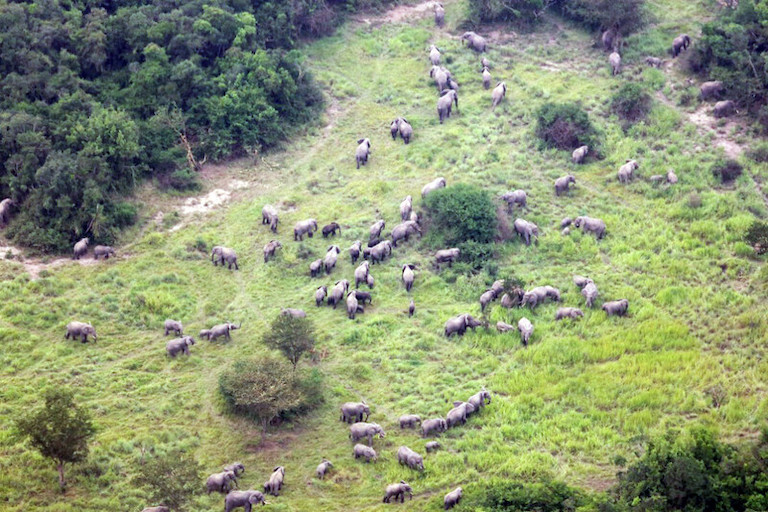
Virunga is the oldest national park in Africa, created in 1925. It was established because of its extraordinary biological value, and that remains true today. The scale and diversity of the landscape are difficult to overstate. You move from the glaciers of the Rwenzori Mountains — over 17,000 feet — down through alpine zones and into dense tropical forest, and then further into savannas and wetlands.
Across that gradient, the park supports an exceptional range of species. It has a remarkable diversity of mammals and reptiles, and over 700 species of birds. It is also one of the only places on Earth where you find three types of great apes — mountain gorillas, chimpanzees, and bonobos — within the same landscape.
But Virunga is defined as much by conflict as it is by ecology. Since the mid-1990s, following the Rwandan genocide, the region has been the center of prolonged instability.
The human toll has been enormous. Estimates suggest that between eight and eleven million people have died across eastern Congo during this period.
That conflict has had a direct and devastating impact on wildlife. Between the late 1990s and early 2000s, most large mammal populations in the park declined by 80 to 95 percent.

The mountain gorillas were the exception, but not because they were insulated from the conflict. They survived because of an intensive protection effort by rangers, often at great personal risk. More than two hundred rangers have been killed in the line of duty.
What makes Virunga unusual is not just that conflict exists alongside biodiversity, but that the two are deeply intertwined.
That is why the park cannot be understood purely as a conservation area. It is a landscape where ecological, economic, and political systems intersect.
Was there a specific moment or experience that fundamentally changed how you think about conservation in Virunga?
In 2007, we went through a period that forced us to fundamentally rethink what we were doing. There was a series of killings of mountain gorillas.

At the same time, our rangers were under constant attack. We were losing people, and despite all the effort we were putting into protection, we were failing to secure the one species we were there to protect.
There is an image that stayed with me from that period. It shows a group of women standing at the boundary of the park, asking a man with a gun for permission to enter and cut trees for charcoal.
Those women need charcoal to cook food and boil water. Without it, they cannot survive.
As we dug deeper, the link became clear. The city of Goma, with a population of around two million people, depended almost entirely on charcoal for energy.
The killings were not random. They were strategic.
Once we understood that, it changed how we thought about the problem.
The cause was the absence of viable alternatives. That realization marked a turning point. That is what led to the shift toward energy, and more broadly, toward building an alternative economic system.
Can you talk about the confrontation with SOCO, the attack on you, and what that experience taught you about the role of media and accountability?
At one point, the biggest threat to Virunga didn’t come from militias or local pressures. It came from an oil company. SOCO International, a UK-listed firm, had secured exploration rights that overlapped with the park. If they had proceeded, it would have fundamentally altered the future of the landscape.
What made it particularly difficult is that this wasn’t just a technical or environmental dispute. There was violence around it. People in local communities were intimidated, detained, and in some cases tortured. It became clear that this was not something that could be resolved through conventional channels alone.
We spent several years trying to understand how to respond. One of the key lessons was about jurisdiction. If you rely solely on local legal systems in a fragile context, it is very difficult to hold a company accountable — particularly when it operates internationally.
SOCO was listed in the UK. That meant there was a potential legal pathway through British jurisdiction, particularly around corruption. But getting a case to that level requires more than evidence. It requires attention.
That’s where media became central.
We began documenting what was happening — collecting evidence, building a case. Over time, that grew into a substantial body of material. But we also realized that evidence alone would not be enough. The system is constrained by resources, and cases rise in priority based on what is perceived as being in the public interest. In practice, that often means visibility.
So we made the decision to turn the investigation into a film. That became Virunga. It was a way of bringing the story into the public domain in a way that would be difficult to ignore.
We were careful in how we handled it. Before releasing the film, we provided SOCO with an opportunity to respond. It was important that the process remained credible and legally sound.
Around the same time, we compiled a detailed case — hundreds of pages of evidence — documenting corruption and human rights abuses. That material was submitted to the relevant authorities.
It was during this period that I was attacked.
After delivering documents to the court in Goma, I was driving back toward the park. On the road, armed men were waiting. They opened fire on the vehicle. I was hit twice in the chest.
I managed to get out of the car and into the forest. At that point, it was a matter of survival. Local villagers found me and took me to hospital on a motorbike.
It was a close call.

Shortly afterward, the film was released. It gained international attention. Leonardo DiCaprio became involved as an executive producer, and it reached a wide audience through major distribution platforms. At the same time, organizations like Human Rights Watch conducted their own investigations.
One of the key findings was direct evidence of payments from company representatives to armed groups operating in the region. That shifted the situation significantly.
There was never a formal prosecution that reached a conclusion. But the impact came through other channels. The combination of evidence, media exposure, and reputational risk affected the company’s position. Its valuation dropped sharply, and the pressure became unsustainable.
Eventually, SOCO withdrew from the park.
That outcome shaped how we think about the role of media. It demonstrated that journalism and public attention can have a direct effect on events — not just by informing people, but by influencing the systems that determine accountability.
It also reinforced the importance of building alternatives.
Stopping the oil project was one step. But it did not solve the underlying problem, which is how to create economic value without destroying the landscape.
That is what led directly into the next phase of work — investing in renewable energy and building a different economic model around the park.
In that sense, the confrontation with SOCO was not just about preventing a specific project. It was part of a broader transition — from defending the park against external threats to building a system that makes those threats less viable in the first place.
How do you think about the cost of conservation from the perspective of local communities living around the park?
If you want to understand why conservation struggles in places like eastern Congo, you have to look at the economics from the perspective of the people living there.
Virunga is a World Heritage Site. It delivers value at a global level — biodiversity, carbon storage, ecosystem services that benefit people far beyond the region. But those benefits are not what local communities experience on a daily basis. What they experience is the cost.
If a family converts a hectare of forest into agricultural land, they can generate somewhere between $1,200 and $1,500 per year. That is a significant income in this context. When you scale that across the park — hundreds of thousands of hectares — you are effectively asking local communities to give up the possibility of earning over a billion dollars annually.
That is not an abstract number. It translates into very concrete trade-offs. It is the difference between being able to feed a family or not, to pay for school, to access basic services.
At the same time, the restrictions imposed by conservation are immediate and visible. People are prevented from accessing land, from cutting trees for fuel, from using resources that they depend on for survival.
There is an image that captures this very clearly. It shows a group of women standing at the edge of the park, asking a man with a gun for permission to enter and collect charcoal. At first glance, the roles seem obvious — the women as victims, the armed man as the enforcer. But in reality, both are part of the same system.
The women need charcoal to cook food and boil water. Without it, they cannot meet basic needs. The man with the gun is enforcing a law that he may not fully believe in, but which he is required to uphold. He is also operating within a system shaped by conflict and scarcity.
This is where the idea of injustice comes in. The global community benefits from the protection of the forest, but the cost is borne locally by some of the poorest populations in the world. When that imbalance becomes too great, people begin to reject the system.
And when they reject it, they don’t simply disengage — they look for alternatives. In this context, those alternatives often involve militias or informal systems that allow access to resources outside the law.
That is how conservation, if it is not structured properly, can inadvertently contribute to instability. It creates pressure points that can be exploited by armed groups.
This is why the issue cannot be addressed through enforcement alone. You can increase patrols, strengthen laws, and impose restrictions, but if the underlying economics remain unchanged, the pressure does not disappear. It builds.

What is required instead is a rebalancing of costs and benefits. If protecting the forest imposes a cost on local communities, then the system has to provide an alternative source of income that is at least as compelling as what is being lost.
That is the foundation of the approach we’ve taken. The goal is not simply to reduce illegal activity, but to create an economic structure in which conservation becomes the more rational choice.
Until that balance is achieved, conservation will continue to struggle in environments like this.
What role does the illegal economy play in sustaining conflict in and around Virunga?
The militias are not operating in a vacuum. They are part of a functioning economic system.
That system is built on the illegal extraction and trafficking of natural resources.
Every report from the UN Group of Experts since 2001 has pointed to this as the underlying cause of conflict in eastern Congo.
Once we understood that, the implication was straightforward. You cannot resolve the conflict by enforcement alone.
Why did you focus on energy as a starting point, and how has that shaped the broader approach in Virunga?
When we stepped back after the 2007 crisis, it became clear that everything we were dealing with — the charcoal trade, the militias, the pressure on the forest — was tied to one issue: energy.
Charcoal wasn’t just an environmental problem. It was the foundation of the local economy and, at the same time, one of the main sources of revenue for armed groups. If you wanted to change anything, you had to start there.
Virunga is a mountainous landscape with very high rainfall. The rivers carry a lot of energy. So we began looking at whether we could capture that and convert it into electricity. That was the starting point — building hydroelectric plants that could supply power locally.
At the beginning, it was experimental. But over time, we built out a system. We now have multiple hydro plants, and the price of electricity has dropped to the point where it is cheaper than charcoal. That is the critical shift. Once electricity becomes the more affordable option, behavior changes. People don’t need to rely on cutting the forest.
What followed from that was not just an energy project, but the foundation of an economy.
We structured it as a utility, but it operates as a social enterprise. We generate the power, build and maintain the infrastructure, manage the grid, and handle the billing. The revenues are reinvested back into the system — into the park and into community development.
Today, the company produces more electricity for the population than the national utility. That wasn’t the goal initially, but it reflects the scale of what has developed.
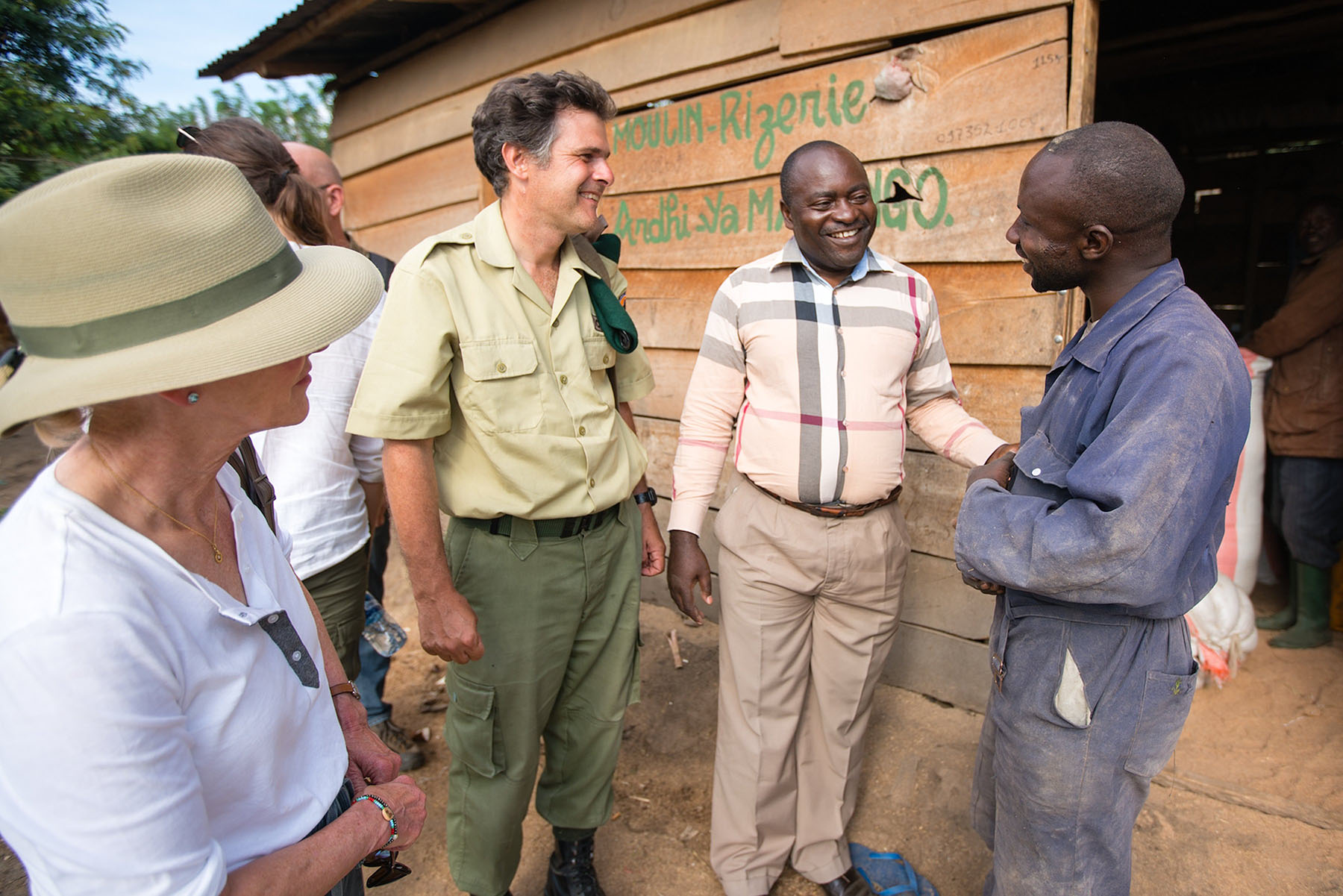
A related challenge has been how to maintain energy supply in an active conflict zone. In most cities, electricity depends on a single high-voltage transmission line. In eastern Congo, that is a critical vulnerability. When fighting intensifies, those lines are often targeted or damaged, and repairing them under fire is extremely dangerous. To address this, we redesigned the system to build redundancy into the grid. Instead of relying on one line, we developed parallel transmission routes with what we call “bridging lines” between them. If one line is cut, power can be rerouted through the second. If both are damaged, the system allows electricity to “zigzag” around the affected areas, maintaining supply to essential services like Goma’s water pumping stations. It’s a highly unusual design — effectively a grid engineered to function in the middle of a war — but it reflects the reality we operate in.
The important point is that energy is not just about providing light. It enables everything else. Once you have reliable electricity, you can start building businesses — welding workshops, refrigeration, carpentry, small manufacturing. You begin to see an entire layer of economic activity that simply wasn’t possible before.
That is where the next step came in, which is finance.
One of the constraints we encountered was that people couldn’t access capital. Even when electricity was available, they didn’t have the means to invest in equipment or start businesses. Traditional banking systems don’t function well in this context. The transaction costs are too high, and the risks are considered too great.
So we started to rethink how finance could work in this environment. The solution we developed was to link financial services directly to the energy system through smart meters.
Every connection to the grid is monitored through a meter that tracks electricity consumption. That data becomes a proxy for economic activity. If you have six months of consistent usage, you effectively have a record of your business performance. That can serve as a form of creditworthiness.
Instead of going through a traditional bank, a small business can access a loan through the system. The repayment is then tied directly to their electricity usage. If they repay the loan, they continue to receive power. If they don’t, the system can shut off the supply.
It removes the need for collateral and drastically reduces the cost of administering loans.
The economics of it are important. The cost of renewable electricity is significantly lower than diesel generation. Even when you add a surcharge to repay the loan, the total cost remains below what people would otherwise pay for energy.
That creates a situation where it is always in the borrower’s interest to repay. It’s cheaper to stay within the system than to fall out of it.
This has allowed us to extend financing to people who would otherwise be excluded entirely. It also accelerates the development of small businesses, which in turn increases demand for electricity. The two systems reinforce each other.
We’ve structured this through a microfinance arm — a partnership that effectively turns the energy grid into a financial platform. Payments can be made directly through the meter. In some cases, it functions almost like a bank within the household.
What this does is begin to break what you might call the poverty trap. People gain access to energy, then to capital, then to income-generating activities. That creates a pathway out of dependence on extractive or illegal activities.
At a larger scale, the energy system also underpins the industrial side of the economy. It allows us to develop processing facilities — for example, in agriculture — so that value is created locally rather than exported.
All of this contributes to shifting the balance away from the war economy. The militias rely on controlling resources like charcoal and agricultural products. When you introduce an alternative system that is more efficient and more profitable, you begin to erode that control.
It’s not immediate, and it’s not complete. But over time, the effect is cumulative.
The broader objective is to build an economy that is self-sustaining. We’ve deliberately moved away from relying solely on grants. Grants are finite. When they end, the system collapses if it hasn’t become viable on its own.
By building revenue-generating infrastructure — energy, finance, industry — you create a model that can continue to function and expand.
That is really the core of the approach.
You start with energy. Energy enables business. Business creates jobs. Jobs reduce the incentive for conflict.
And all of it, if designed properly, reduces pressure on the forest.
How does job creation fit into your strategy for reducing conflict and reintegrating people who might otherwise join armed groups?
One of the most important things we’ve learned is that conflict, in this context, is not just ideological or political — it is economic. People don’t join armed groups because they want to fight. They join because there are no alternatives. If you want to reduce violence in a lasting way, you have to compete in the labor market.
That became very clear once we started building out the energy system. Electricity doesn’t just power households , it enables economic activity. Small businesses begin to emerge — welding, carpentry, milling, refrigeration, food processing. Then you start to see larger operations — factories, workshops, service providers. Each layer creates employment.
We began measuring this over time, and the relationship is quite consistent. For every megawatt of electricity delivered into the local economy, you create between 800 and 1,000 jobs. That’s not theoretical — we’ve tracked it over years of operation.
When you start to scale that, the numbers become significant. The system we are building has the potential to generate tens of thousands of jobs, and over the past several years, we’ve already created a substantial number.
What matters even more is who is filling those jobs. When we audited the workforce, we found that a meaningful share — around one in ten — were people who had previously been part of armed groups.
That is a critical shift. It shows that when viable alternatives exist, people move away from violence. Not because of ideology, but because the opportunity cost changes. If you can earn a stable income, support your family, and live without constant risk, that becomes the rational choice.
The structure of these jobs also matters. They are not short-term or externally funded positions. They are tied to functioning economic systems — energy production, agriculture, processing, logistics. That gives them durability.
At the same time, we’ve had to think carefully about how to integrate people into these systems. It’s not enough to create jobs , you have to build the capacity to fill them. That’s why training is such a central part of the model — from technical skills in engineering and maintenance to roles in manufacturing and services.
In some cases, the transition is quite direct. Someone who might otherwise be drawn into militia activity instead enters a training program, then moves into employment within one of these sectors. Over time, that creates a different kind of social structure — one where economic participation replaces reliance on armed groups.

There is also a broader effect at the community level. As employment increases, local economies stabilize. That reduces the incentive for displacement and makes it easier for people to remain in place. It also strengthens the legitimacy of the systems providing those opportunities — whether that is the park, the state, or the emerging private sector.
None of this is immediate. It takes time to build enough economic activity to shift the balance. But once it reaches a certain scale, the effects become cumulative.
The park, in that sense, is no longer just a protected area. It becomes part of a larger economic system — one that provides an alternative to the structures that sustain conflict.
And ultimately, that is what reintegration looks like in this context. It is not a separate program. It is the result of building an economy that people can enter instead of a militia.
What changes did you make to security on the ground, and how do systems like forward operating bases and rapid response fit into your approach?
Security is fundamental to everything we are trying to do. Without it, none of the economic systems hold. Investment doesn’t come, businesses don’t function, and people revert to survival strategies that often reinforce the conflict.
What we found early on is that the conventional approach to security in these areas wasn’t working. The response times were too slow — often six hours, sometimes days. By the time any intervention arrived, the damage had already been done. That creates a situation where communities feel abandoned, and once that trust is lost, it is very difficult to rebuild.
So we focused on reducing that response time dramatically. The first step was to create a system where the community itself initiates the response. We distributed tens of thousands of simple “panic buttons” connected through a long-range radio network. When someone presses the button, it goes directly to a central security cell. From there, we have a strict protocol: acknowledge within minutes, deploy quickly, and reach the site within roughly twenty minutes.
That alone changes the dynamic. When people know that help will arrive quickly, the psychological environment shifts. It creates a sense of protection that was previously absent.
But rapid response is only one part of the system. The second is how forces are positioned and managed on the ground. That is where the Forward Operating Bases — the FOBs — come in.
These are not typical military installations. They are designed specifically for this context. Physically, they are fortified compounds — built with reinforced walls capable of withstanding attacks, including heavy weapons. Inside, they house the army units in a controlled environment.
The reason for that design is important. In many rural areas, when soldiers are stationed directly within communities, it creates tension and often leads to abuse or exploitation. By placing them within secure, self-contained bases, you create a separation between the military and the civilian population. The soldiers are protected, better supplied, and more disciplined, and the community is not subjected to their day-to-day presence.
At the same time, the command structure is different. The army is present, but it operates under a framework that prioritizes civilian protection. The national parks authority, through the rangers, maintains oversight of these bases, and the system is designed so that interventions are triggered by the community rather than imposed externally.
In practical terms, each FOB becomes the anchor point for a broader system. It provides security coverage for a defined area, supports rapid response, and creates the conditions under which economic activity can take place.
The example of Mutwanga illustrates how this works. Before the system was put in place, the town was under constant attack. Within a short period, dozens of people were killed, and much of the population fled. The army response was slow and inconsistent.
We worked with the community, religious leaders, and the military to establish a base and the associated response system. The community contributed labor to build it — thousands of people showed up, and the base was constructed in a matter of days.
Once it was operational, the difference was immediate. The combination of rapid response capability and a permanent, secure presence changed the incentives for armed groups. Attacks became far more difficult to carry out, and the level of violence dropped sharply. In the period since the system was established, there have been no further civilian casualties in that area.
But the FOB is not just a defensive structure. It is part of a broader model that links security and economics. Around each base, we develop economic activity — agriculture, processing, small industries. The idea is that the base creates a zone of stability, and within that zone, the economy can begin to function.
This is sometimes described as a “carrot and stick” approach. The “stick” is the ability to respond quickly and deter violence. The “carrot” is the development of a viable economic alternative — jobs, income, infrastructure.
The two have to work together. If you only provide security, you don’t address the underlying drivers of conflict. If you only provide economic opportunities without security, those investments are captured or destroyed.

Another important aspect is sustainability. These bases are designed to become self-financing over time through the economic activity they support. That is a critical distinction from traditional peacekeeping models, which depend on continuous external funding.
At scale, the Corridor envisions a network of these FOBs — each paired with an economic hub. Together, they form a distributed system of security and development across the landscape.
It is an unusual model. A conservation organization is not typically associated with building and managing security infrastructure at this level. But in this context, where the drivers of conflict are tied directly to natural resources, it becomes a necessary extension of the mandate.
Ultimately, the objective is not to militarize conservation. It is to create conditions where both people and ecosystems can exist without constant threat.
Without that foundation, nothing else holds.
Can you explain how something like cocoa production becomes linked to conflict, and what you’ve done to change that dynamic?
Cocoa is a good example of how tightly the economy is linked to violence in eastern Congo. It looks like a normal agricultural commodity from the outside, but on the ground it is deeply entangled with conflict.
In areas controlled by the ADF, the entire system is structured around coercion. The pattern is very consistent. At the beginning of the harvest season — typically around August, and again in February — there are spikes in violence. The militias carry out attacks on villages and farms. People are killed, or they flee. The objective is not random , it is to clear the fields.
Once the farmers are gone, the cocoa is left standing. The militias then move in and use forced labor to harvest, ferment, and dry the beans. That process takes several weeks. After that, the product is trafficked across the border, often into Uganda, where it enters the international supply chain under a different origin.
So what appears as a standard export commodity is, in reality, financing one of the most violent armed groups in the region.
The challenge is that the vulnerability is built into the structure of the value chain. Cocoa requires time — the pods are harvested, then fermented and dried over several weeks. During that period, the product sits on the farm, which makes farmers targets.
The intervention we developed was to remove that vulnerability as quickly as possible. Instead of farmers storing their harvest, our teams go out daily and purchase the pods directly. The product is then transported immediately to secure locations for processing.
That does two things. First, it reduces the exposure of farmers, because they are no longer holding a valuable crop on their land. Second, it cuts off the militia’s access to the product. If there is nothing to seize, the incentive for attacks diminishes.
At the same time, we built processing capacity locally. Rather than exporting raw cocoa, we began capturing more of the value chain by transforming it into finished products — chocolate. That required a different level of expertise, so we brought in a Belgian chocolatier to help establish production standards and train local teams. The idea is not just to process beans, but to produce a product that can compete on quality in international markets. This creates significantly more value per unit of cocoa and anchors that value within the region. It also changes the nature of employment. Instead of only working at the level of farming or basic processing, people are involved in skilled production — including women from communities affected by the conflict, such as widows of fallen rangers, who are trained as chocolatiers. In that sense, the factory becomes more than an industrial facility , it is part of rebuilding an economic system that extends beyond extraction into production and craftsmanship.

The scale of this matters. At small volumes, the system has limited impact. But as it grows, it begins to reshape the entire value chain. Production has increased rapidly, and the aim is to reach a level where a significant share of the region’s cocoa is processed through secure, transparent channels.
This is what we mean by combining security and economics. You create protection on one side — through forward operating bases and rapid response systems — and on the other, you build an alternative economy that is more attractive and more stable than the one controlled by armed groups.
It’s a “carrot and stick” approach, but both elements are necessary. Without security, the economy doesn’t function. Without the economy, security doesn’t hold.
What role do technology and financial systems play in making this model work at scale?
Technology, for us, is not an abstract layer — it is what allows the system to function at scale and with accountability. One of the biggest challenges in a place like eastern Congo is not the lack of information , it is the gap between information and action.
We’ve tried to close that gap by building systems that translate what happens on the ground into a structured response. For example, when a ranger or a sensor reports an incident, it generates what we call a “ticket.” That ticket remains open and visible until the issue is resolved. It moves through the chain of responsibility, and if it is not handled within the expected timeframe, the person responsible is held accountable. Ultimately, everything rolls up — if the system fails, I am responsible.
That may sound basic, but in a landscape of this scale — with hundreds of rangers operating across vast and remote areas — that kind of structure is essential. It creates a form of governance that is traceable and enforceable.
Connectivity is another critical piece. Without it, none of this works. When we began developing the Green Corridor, we insisted on having broadband coverage across the landscape. That included securing access to satellite-based systems. It’s not just about communication , it enables the entire management framework — tracking patrols, coordinating responses, managing data, and maintaining oversight.
We’ve also integrated these systems into a broader management platform — essentially an enterprise resource planning system adapted to this context. It allows us to bring together operational data, financial flows, logistics, and production systems into a single framework. From there, we’ve begun developing tools for traceability, particularly in sectors like cocoa and palm oil.
Using satellite data and mapping, we can determine whether a specific plot of land was forested in the past. That is increasingly important for compliance with international regulations, such as European deforestation rules. It means that products moving through the system can be verified in a way that meets external standards.
What is striking is how quickly local capacity is developing around these tools. We’ve built teams of young Congolese technicians who are learning at an extraordinary pace. Skills that would normally take years to acquire are being developed in a much shorter time frame. We’ve set up workspaces where they combine hands-on technical work with continuous learning, effectively building a local technology base from the ground up.
A related development has been the use of AI as a training tool. One of the constraints we face is how long it takes to build technical capacity — whether that is mechanics, electricians, or other skilled trades that are essential to keeping infrastructure running. Traditionally, that kind of training takes years. What we’ve begun experimenting with is using AI to generate structured training materials that can accelerate that process. For example, we can produce a practical manual on how to become a mechanic, tailored to the specific equipment and conditions here, and make it accessible to local technicians. It doesn’t replace hands-on experience, but it shortens the learning curve significantly. In a context where we are trying to build entire systems quickly — energy, transport, industry — that kind of acceleration is extremely valuable.
This is important because the objective is not to import expertise indefinitely. The system has to be owned and operated locally. Otherwise, it doesn’t scale, and it doesn’t last.
Finance, as part of this, is deeply integrated into the infrastructure. The smart meter system is one example, but more broadly, the idea is to reduce the friction that typically prevents capital from reaching these environments. Traditional financial systems are not designed for small-scale, distributed economies in high-risk contexts.
By embedding financial services into the operational systems — whether through energy, production, or logistics — you create mechanisms that are more efficient and more aligned with how the economy actually functions. The cost of managing transactions drops, the risk becomes more measurable, and access expands.
There is also a broader shift in mindset. We’ve deliberately moved away from relying solely on grants and toward models that incorporate revenue, debt, and investment. That is not always comfortable, particularly in a conflict environment where risk premiums are high, but it is necessary. If the system depends entirely on external funding, it remains fragile.
By contrast, if you can build something that generates its own revenue — whether through energy, agriculture, or processing — then it can sustain itself and grow. The role of technology and finance is to make that possible at scale, while maintaining transparency and accountability.
In the end, these systems are not separate from the broader objective. They are part of the same effort — to build an economy that is functional, resilient, and capable of competing with the structures that currently drive conflict.
What is the vision behind the Green Corridor, and why is it so central to what you’re trying to achieve?
The idea of the Green Corridor came directly out of what we were doing in Virunga. We saw that if you could build an economic model around a protected area — one that creates jobs, provides energy, and stabilizes communities — then conservation becomes viable. The question was whether that could be scaled.
The President asked us to think about it at a national level. That led to the law passed in early 2025 establishing what we call the Congo River Corridor, or Couloir Vert. It is not a traditional protected area. It’s a reserved forest that includes cities, towns, and agricultural landscapes. The objective is not simply to protect nature , it is to build an economy that makes protection possible.
At its core, the Corridor is about linking two realities that currently exist in isolation. In the East of the country, you have extraordinarily fertile land and the capacity to produce food. In Kinshasa, which is one of the largest cities in Africa, you have enormous demand — but the city depends heavily on imports from Brazil, Europe, and elsewhere.
Kinshasa is essentially on a timer. It is only one food shortage away from a major crisis. If supply chains are disrupted, the consequences would be immediate and severe. That vulnerability is not widely understood, but it is central to the urgency of what we are trying to do.
If you connect those two — production in the East and demand in Kinshasa — you create an internal economic system. That system generates stability because it creates interdependence. Regions that were previously disconnected begin to rely on each other. That is one of the foundations of peace.
But there is also a broader environmental urgency. The Congo Basin is the only tropical forest in the world that is still a net carbon sink. It is absorbing more carbon than it emits. At the same time, the pressures that have already transformed other tropical regions are beginning to emerge here — roads, cities, infrastructure corridors.
Fragmentation is the real threat. It is not just the clearing of forest , it is the breaking up of ecosystems into smaller and smaller pieces. Once that process accelerates, it becomes very difficult to reverse.
What we are seeing now is a race between two systems. On one side, you have infrastructure being developed through external investment — roads, railways, and trade corridors linked to global supply chains. These are necessary for development, but they also open up the forest to rapid exploitation. On the other side, you have the possibility of building an economy that is rooted locally, that uses the forest without destroying it.
The Corridor is an attempt to shape that outcome. It is designed as a network of economic hubs distributed across the landscape. Each hub combines several elements: energy infrastructure, agricultural processing, logistics, and security. The idea is not to try to develop everything at once, but to build nodes — places where economic activity can take hold — and then connect them over time.
Energy is the starting point. Without energy, nothing functions. The first step is to build out renewable energy systems that can power food transformation and local industry. Once you have that, you can begin to process agricultural products domestically rather than exporting raw materials. That creates value within the country and generates employment.
The next layer is logistics. The Congo is defined by its rivers, but transport remains extremely difficult. If you cannot move goods efficiently, the entire system breaks down. So part of the Corridor is about creating reliable transport systems — river transport, cold storage, and supply chains that can move food from where it is produced to where it is needed.
Security is the other critical component. In many of these areas, the economy is still tied to conflict. Armed groups operate because they control value chains. If you don’t address security, investment does not hold. That’s why each economic hub is paired with a protection system — not just military, but community-based systems that allow people to live and work safely.
All of this is designed to be self-reinforcing. Jobs reduce the incentive to join armed groups. Stability attracts investment. Investment strengthens the economy, which in turn reduces pressure on the forest.
The scale is significant. The Corridor spans an area larger than many countries and includes millions of people. The targets reflect that scale — large numbers of jobs, major increases in food production, and the protection of vast areas of forest.
It is also a long-term project. We are still in the early stages — essentially a proof-of-concept phase. The goal now is to demonstrate that the model can work at scale. If it does, it can be extended across the entire landscape.
At the same time, it has to compete with other forces. There are major infrastructure projects already underway across the region, backed by both Chinese and Western investment. These will shape the future of the Congo Basin. If we don’t build an alternative model quickly enough, those systems will define the outcome — and the risk is that the forest follows the same trajectory we’ve seen elsewhere.
Ultimately, the principle is simple. You create an economy that depends on the health of the forest rather than its destruction.
If you can align those two things, then protection becomes a rational choice.
That is what we are trying to do.
What are the limits of this model, especially in the face of ongoing conflict and political instability?
For a long time, it felt like we were beginning to turn a corner. The energy system was expanding, businesses were emerging, jobs were being created, and in some areas, violence was declining. There was a sense that the model was starting to work — that by addressing the economic drivers of conflict, we could begin to stabilize the system.
Then, about three years ago, the situation deteriorated again. The resurgence of conflict, particularly with the M23, disrupted large parts of what we had built. Infrastructure was damaged, access was restricted, and entire areas became contested or inaccessible.
It was a sobering moment. It showed very clearly that while economics is a powerful tool, it is not sufficient on its own. You can build infrastructure, create jobs, and develop alternative value chains, but those gains remain vulnerable if the broader political context is unstable.
In practical terms, it has meant operating under extremely complex conditions. Parts of the park are now under the control of armed groups. Under Congolese law, we are required to continue working regardless of who controls the territory. The law defines us as non-belligerent — similar to a humanitarian organization — which allows us to maintain a presence even in areas held by rebels.
That creates a delicate balance. We remain in place, continuing to protect the park and support local systems, but we have to navigate the political implications very carefully. It would be inaccurate to say we are “working with” armed groups, but we are operating in areas where they are present. At the same time, we have to ensure that our work is not instrumentalized — that it is not used by any party to legitimize their position.
Despite these constraints, some aspects of the system have held. Ranger operations have continued in many areas, often with support from community scouts who remain in place even when conditions are difficult. In some cases, wildlife populations — particularly mountain gorillas — have continued to grow at a natural rate.

But the broader environment remains highly unstable. Tourism, which was once a significant source of revenue, has effectively disappeared. That has placed additional strain on the system, increasing reliance on external funding and making it more difficult to sustain operations.
More fundamentally, the conflict itself is not a short-term disruption. It is part of a much longer process — decades of instability tied to regional politics, resource competition, and external interests. There are multiple overlapping dynamics at play, including tensions linked to cross-border movements, competing economic corridors, and the strategic importance of natural resources.
In that context, any solution has to operate across multiple levels. The economic model we’ve built addresses one layer — the incentives that drive local participation in conflict. But it does not resolve the larger political forces that sustain it.
That is the limitation.
At the same time, it does not mean the model is ineffective. What it does is create pockets of stability within a broader environment of instability. It provides an alternative where one did not exist before. It demonstrates that different outcomes are possible under certain conditions.
The challenge is how to scale that in a way that can withstand the larger forces at play.
Ultimately, the lesson is that conservation in this context cannot be separated from politics. You can build the most sophisticated systems — energy, finance, security — but if the political environment shifts, those systems are exposed.
So the task becomes twofold: to continue building the economic foundation, while also recognizing that its success depends on factors that extend beyond it.
That is the reality we are operating in.
Based on your experience, what do you think conservation as a field gets wrong — and what needs to change?
One of the things that struck me early on is how often conservation is approached in a way that is disconnected from reality.
There is also a broader issue with how conservation presents itself.
The consequence is that the field can lose sight of what it is trying to achieve.
Part of the problem is that conservation has often been treated as something separate from the systems that surround it.
What is required instead is a more integrated approach.
From there, you build something that responds to those conditions.
It also requires a shift in how success is measured.
If you step back from everything you’ve built in Virunga, what is the core idea or principle that underpins your approach?
If you step back from all of this — the energy systems, the security structures, the economic programs — the underlying logic is quite simple.
What we are dealing with in eastern Congo is not a lack of resources or even a lack of potential. It is a system where the dominant economic model is built on extraction and conflict. Natural resources are taken, often illegally, and that process generates revenue for armed groups. That revenue sustains the conflict, which in turn allows the extraction to continue. It is a self-reinforcing cycle.
If you want to change that, you have to introduce a competing system. You have to build an economy that is strong enough to displace the one that is driving the conflict. That is the core idea.
That means working at multiple levels at once. You have to provide security, because without it nothing else holds. You have to build infrastructure, because without it there is no functioning economy. You have to create jobs, because without them people will continue to turn to armed groups. And you have to do all of that in a way that protects the natural systems you are trying to conserve.
It is not a linear process. You don’t solve one piece and then move to the next. Everything has to develop together, and each part depends on the others.
There is also a question of scale. Small interventions can demonstrate what is possible, but they don’t change the overall system. To do that, you have to reach a level where the alternative economy is large enough to compete. That is what we are trying to do with the Corridor — to move from isolated examples to something that can operate across an entire landscape.
At the same time, there are limits to what this approach can achieve on its own. The broader political context still shapes the environment we operate in. External pressures, regional dynamics, and long-standing conflicts all influence the outcome.
But that does not make the effort irrelevant. What it does is define its role.

What we can do is create conditions where a different trajectory becomes possible. We can show that it is feasible to build an economy that is not based on destruction, that provides stability rather than reinforcing conflict, and that allows both people and ecosystems to persist.
Whether that ultimately prevails depends on forces beyond any single initiative. But without building that alternative, there is no path forward at all.
So in that sense, the work is both practical and provisional. It is about solving immediate problems — energy, security, livelihoods — while also trying to shift the direction of the system over time.
If that shift happens, then conservation becomes something more durable. It is no longer something that has to be imposed or defended constantly. It becomes embedded in the way the economy functions.
And that is really the objective.
To reach a point where protecting the forest is not a constraint, but a consequence of how the system works.
