

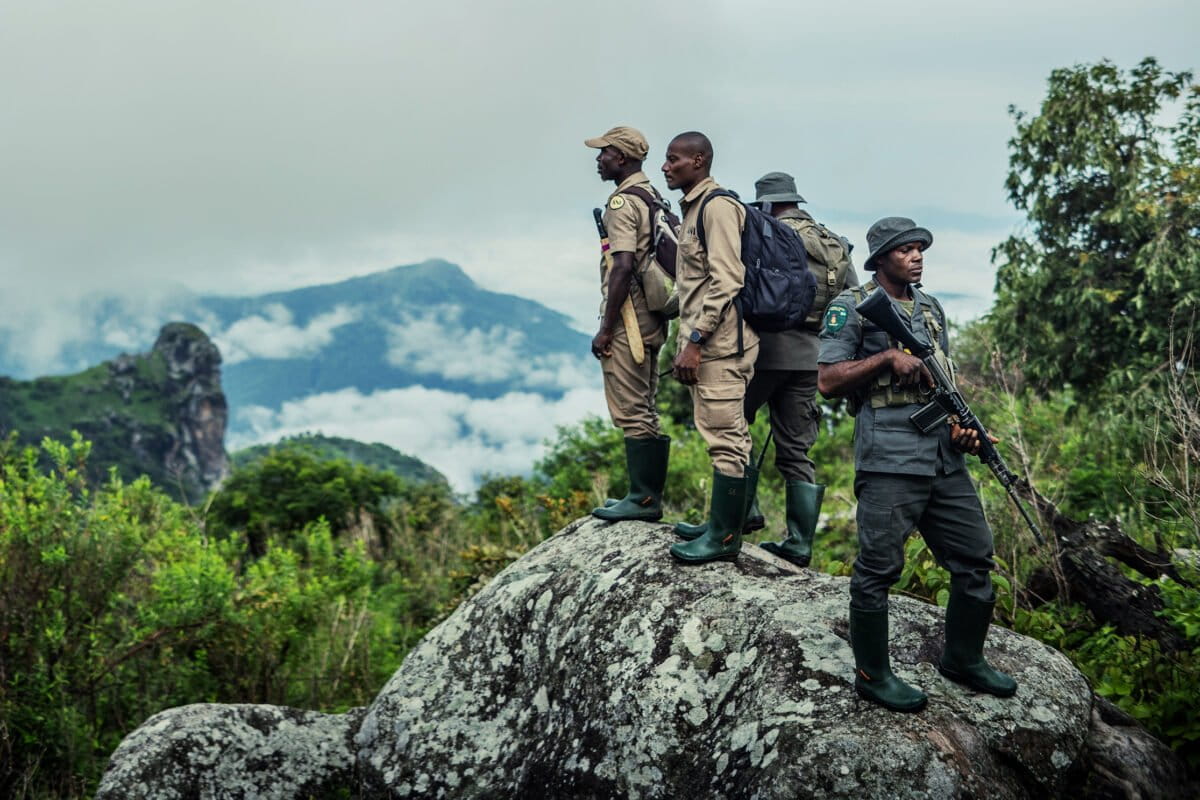
GASHAKA GUMTI NATIONAL PARK, Nigeria — Here in Nigeria’s largest protected wilderness area lies one of the last strongholds of the Nigeria–Cameroon chimpanzee (Pan troglodytes ellioti), the world’s rarest chimpanzee subspecies. For nearly a decade, however, this population has lived largely out of sight.
Once a leading hub for field research in West Africa, Gashaka fell silent in the late 2010s when insecurity in the area forced scientists to withdraw. “By 2018, all research had stopped,” says conservationist Elisha Emmanuel. When the researchers left, so did the rangers who protected the park. Without them, Gashaka became vulnerable to poachers and bandits, and its research stations slid into disrepair.
But a handful of local research assistants refused to leave. “It’s our bush,” says Maigari, who grew up in nearby Gashaka village. “If they want to kill me, they will kill me because the chimps are my friends.”
A turning point came later that year when the Nigerian government signed a co‑management agreement with the Africa Nature Investors Foundation (ANI), a local nonprofit. Since then, more than 180 rangers have been hired and trained to protect the forest. “This has really brought security to the park, which now gives us the opportunity to restart research,” Emmanuel says. For field assistants like Maigari, that stability means a chance to return to what they know best: tracking and monitoring chimpanzees in the wild.
The first step in Gashaka’s scientific revival is an ambitious camera‑trap survey. Using a newly acquired helicopter, researchers have deployed cameras across the 600,000‑hectare (1.48‑million‑acre) park, reaching remote forest basins, ridges and other rugged terrain that had remained inaccessible for years. Early results are encouraging: new groups of chimpanzees have been recorded, including several carrying infants.
The Nigeria–Cameroon chimpanzee remains vanishingly rare , only 3,500 to 9,000 individuals are thought to survive across a fragmented range stretching from southeastern Nigeria to western Cameroon. Gashaka Gumti may now hold one of the subspecies’ most important remaining populations.
With previously unknown groups rediscovered and new research bases planned, Gashaka is again becoming a center for primate conservation and a symbol of resilience. “The presence of Maigari and the other field assistants really gave the park hope of existing again,” Emmanuel says. “I celebrate them as heroes.”
Mongabay’s Video Team wants to cover questions and topics that matter to you. Are there any inspiring people, urgent issues, or local stories that you’d like us to cover? We want to hear from you. Be a part of our reporting process—get in touch with us here!
Banner image: Rangers at Gashaka Gumti National Park, Nigeria.
Orangutans rescued undergo re-training to return to the wild
Notice: Transcripts are machine and human generated and lightly edited for accuracy. They may contain errors.
Nigeria torn apart by war.
The group is fighting to overthrow the government
and impose Islamic law.
The raids by Boko Haram
have frightened tourists,
that once flocked to national parks.
I am living in Gashaka village.
I was born in Gashaka village.
My father lived here,
my grandfather, my great great-grandfather.
It’s a very old village.
My father was a hunter.
I learned the
bush from him.
I am a field assistant.
Doing the job with chimps and other primates.
No one in Gashaka can track chimps
as well as I can.
No one!
I’m a bushman.
Seriously
bushman.
In 2018, all research was abandoned in the park,
all the researchers left.
You see this place, Kwano?
This was a beautiful place.
Now you see the rooms,
our office is completely coming down.
It’s falling down.
The thing is
rotted.
I started working with Maigari in 2015.
when I asked him what happens
if the whole project folds up,
and he said something that really melted my heart,
which was, “this is our land.
Even if the project packs up today,
I won’t stop coming to Kwano.
From 2018 up to here
nobody.
Only us.
Like staff, researcher field assistants.
They still
visit Kwano,
follow the primates,
follow the baboons, follow the chimps.
And it became more or less like a lifestyle to him.
That he does it even without
money involved, without payment,
without being placed on any form of incentive.
We used to come up here with no rangers.
No rangers?
We used to visit there in order to prevent the poachers
from killing our chimpanzees and other things.
We were told not to come here or Boko Haram will kidnap us.
But we would still come.
Back then the rangers didn’t have guns like this.
Yes, back then they didn’t have those guns.
So they were all afraid.
When you had the old gun did you go to the bush?
No!
When we used to have the old gun
we would have a sword as well.
That is why there was so much poaching happening!
Because the rangers don’t have the good guns,
they would just patrol with a stick.
They used to come in and kill the chimps and take them back?
We used to find them in the bush sometimes.
We found about 10 of them once,
but only managed to arrest one.
They had killed about 20 monkeys.
20?
Actually 24.
In the past 50 years alone,
50 years alone, we’ve lost 70% of our wildlife in Nigeria.
Nigeria plays a significant role in the illegal wildlife trade,
both as a source and transit hub.
Due to porous borders and weak law enforcement,
the country has become a hotspot
for wildlife trafficking.
One of the worst threats
on chimpanzee is the hunting for traditional beliefs.
This really created hunting pressure on the park.
They kill whatever they see,
it’s a big threat to the wildlife.
The presence of Maigari and the other field assistants
gave the park, the hope of
existing again.
I celebrate them as heroes.
It’s our village,
it’s our country, it’s our bush.
That’s why I’m always going.
If they want to kill me, they will kill me,
because the chimp is my friend.
I was afraid when you went to the bush without the rangers.
I was afraid I would lose you.
It would hurt if you weren’t around.
Now that we go in with guns how do you feel?
I feel better.
There are no problems?
There are no problems.
But, even now with rangers
something could still happen to you.
What do you think will happen?
I might get shot?
Or something else?
You could get caught in an attack.
Because I’m not trained?
Exactly.
In the last five years,
over 180 rangers have been recruited.
Their presence have really gone a long way in sending messages
to those who do the illegal activities
to stay away from the park.
This has really brought security
to the park,
which now gives us the opportunity
to restart,
the research activities,
not just in Kwano, but across the park.
So the next thing we
need to do is to check the cameras
and set the dates.
We’ve begun
the first camera survey within the park.
After ten years,
of the park being abandoned,
I was happy when we checked
some of the cameras we have retrieved and found chimps in
Yeah Kwano.
Yeah. And even Madem Valley
This time around we need to extend our deployment
further away from any of these cluster.
Okay.
Going to the extreme.
In fact, one of the highest point in Nigeria which is the Gangirwal.
Chappal Waddi.
If you are coming down that valley
there are a lot of chimps there.
So we need to get the point.
I have the point.
Okay. Well, that’s interesting.
With the forest there, I’m sure we have some chimps.
And I will be happy we can get them on camera.
The chopper is ready for us.
What a helicopter have allowed us to do
is given us the access to explore
and cover more ground.
Even up to 100km within the park,
it’s been made possible with the helicopter.
It’s possible some of this area,
we are the first people to visit
With the helicopter, it has helped us to really identify
where there is a lot of threats, where there is a lot of pressure,
when it comes to human activities.
Seeing these in the sky of course
breaks my heart.
That’s a poachers camp there.
That is an active poachers camp.
I think he has some meat drying there.
His bags are still there,
which means he is somewhere around.
Aside poaching activities,
we’ve been able to pick up
the grazing activities as well, mining.
Recently we found a new mining site
even farther in the north.
But we do have a helicopter now, of course,
It means more work.
One of the last
camera trap deployment is the highlands.
It’s one of those areas that still holds a great number of chimps.
The highland is one of the most
beautiful place found within the park.
There is a possibility that we may likely have
new species that are just endemic to the Highlands.
With the understanding
of where these iconic species exist
within the park, that have really help us
to push for their protection.
Most especially in terms of the habitat
requirements.
I’ve seen troops with their babies.
6 or 7 with babies.
That’s a great population.
Whoa!
Did you see the tools?
Yeah. Look at it.
Collecting honey.
Oh my goodness.
Interesting. Did you see these chimps?
Three of them are having babies.
Yeah. Wow.
No, this is this is great news for me
that the population is gradually growing.
The difference is that before, when I tracked the chimps,
I used to hear gunshots,
but honestly, now I don’t.
I’d like the researchers to come back now,
if possible,
and continue tracking the chimps.