

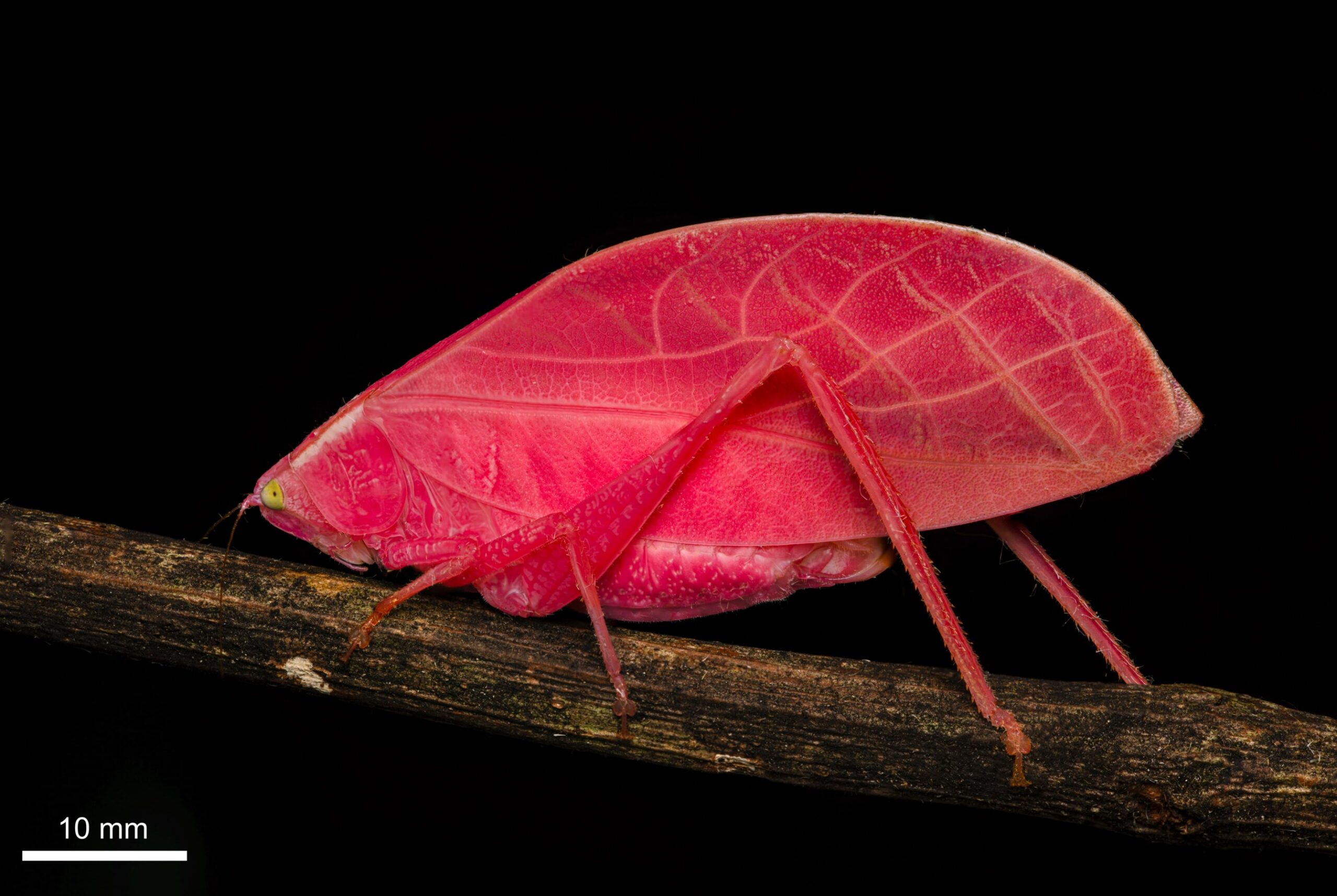
In March 2025, biologist Benito Wainwright and his colleagues were searching for katydids — leaf-mimicking insects related to crickets and grasshoppers — in the rainforest of Barro Colorado Island in Panama, when they came across an unexpected sight: a hot-pink katydid individual of the species Arota festae.
The researchers captured the katydid and raised her in captivity. Photographing her daily for 14 days, they chronicled her changing color from hot pink to a pastel pink and finally green, the researchers report in a recent study.
A. festae, found in Panama, Colombia and Suriname, are typically light green in color, resembling early-growth vegetation, the authors write. The discovery of the hot-pink katydid is very rare, Wainwright told Mongabay by email.
“I’ve spent a total of 8 months in the tropics and have only ever found one, and my collaborators who have spent 2+ years on BCI [Barro Colorado Island] have never seen one,” said Wainwright, from the University of St Andrews in Scotland. “We do most of our sampling around research station lights so it could be that these immature pink adults are hiding in places we’re not looking. The green morphs are pretty common though so, at least on BCI, the pink morph is a real abnormality.”
Jeffrey Cole, an expert in katydid evolution, who wasn’t affiliated with the study, told Mongabay in an email: “The observation of this katydid changing colors within a single life stage is remarkable, as it is the first demonstration of this capability in a katydid.”
The authors note that pink coloration in katydids has historically been considered disadvantageous for camouflage because it makes the individuals conspicuous to predators. However, they hypothesize that pink in the case of A. festae might actually be an advantage.
Many rainforest plant species have delayed greening, in which their leaves are pink or red when young, before turning green. On Barro Colorado, one-third of the plant species exhibit delayed greening, the authors write. For many of these species, the change from pink to green leaves happens over two weeks, the same duration it took the katydid to transform from hot pink to green. The researchers propose that the hot-pink A. festae individuals may be mimicking delayed greening in surrounding plants.
However, Cole said this hypothesis “is tenuous,” especially with a sample size of just one individual. “We need to know if young adults routinely start out pink and change to green, or if this is rare or a fluke,” he said. “Is this strategy employed more during seasons when new growth is abundant, pink, and transitioning to green? Does color change in the katydids and the plants proceed at similar paces?”
Banner image: Hot pink individual of Arota festae. Image courtesy of Benito Wainwright.
