

- Several recent Mongabay features have shared the emotional strain that conservationists are under from increasing environmental degradation, job losses, moral injury, and a sense of isolation.
- Young people working in conservation face these issues and even more challenges since they’re just beginning their careers, but as young conservationists pushing for optimism in the sector write in a new commentary, there are many avenues for building hope and positivity.
- “Conservation Optimism as a philosophy is rooted in celebrating all successes, no matter the size or scope, and sharing stories of hope which are essential in sustaining our minds, bodies and motivations,” they write.
- This article is a commentary. The views expressed are those of the authors, not necessarily of Mongabay.
Several recent articles at Mongabay regarding mental health in the conservation sector provide a much-needed overview of an issue not talked about enough: that conservationists face a mental health crisis, an “epidemic of suffering” that is nestled within a complex biodiversity crisis. We are in a profession in which loss is a normal, everyday occurrence. The foundation of this sector lies in the passion of conservationists working tirelessly to understand, document and mitigate biodiversity and its loss.
With that passion comes a job profile that is marked by exploitative practices, low wages and a general lack of support for dealing with mental well-being. Coupled with few benefits and a front-row seat to biodiversity loss and de-prioritization of conservation actions, a pertinent question arises: Is there a reason for hope?
As young conservationists starting out in the field, following “conservation optimism” as a philosophy, we think so!
Language matters
Conservation is marred by a language of crisis. This might not be the root of the mental health crisis in the field, but it is a major contributor. Hope is a delicate word to use in a field riddled with anxiety and despair. Its power, nonetheless, can be an enabling force for rebalancing the discourse around conservation and what it can achieve. How then do we hope, realistically?
As young professionals enter the conservation workforce, there is a need to equip them with the mindset, and the tools, to deal with biodiversity loss and the grief that it precipitates, before anxiety and despair set in. And equally important is maintaining this mindset in the long term when faced with difficult and repeated challenges.
Young people come into this field with sheer determination, enthusiasm and feelings of responsibility and kinship toward the world and its biodiversity. We draw inspiration and resilience from nature itself, appreciating the fact that it rebounds and rejuvenates. But we also bring a sense of realism and understanding of the declining state of — and systemic challenges to — the natural world, which represents both our professional mission and personal passion. The constant drumbeat of nature’s decline in the media and public discourse underlines this sense of loss.
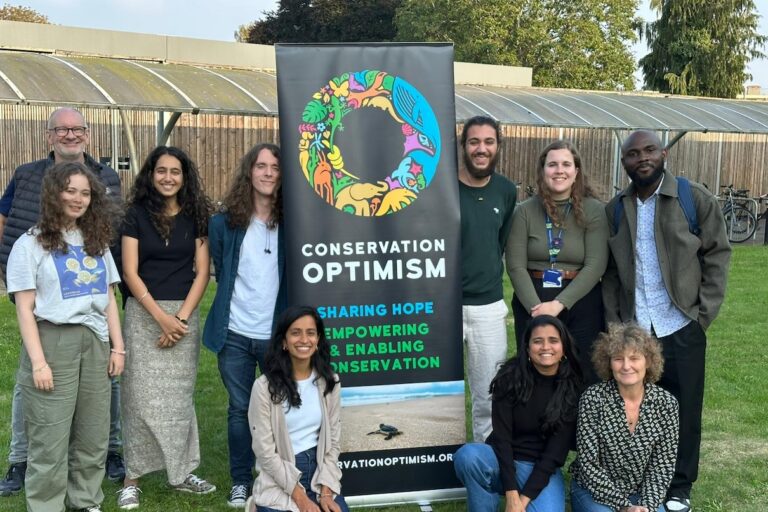
We are members of the Conservation Optimism movement, which aims to challenge the discourse of doom and support professional conservationists, from a place of realism but also hope. In 2024, a group of young professionals from Conservation Optimism carried out a set of interviews, crystallized in a blog series (Europe , Asia , Africa , Americas and the Caribbean). These gave space to the voices of more than 100 young people across 30 countries, and highlighted fresh ideas, out-of-the-box thinking, and a focus on agency. The interviewees found inspiration in their own experiences of conservation efforts making a difference, the growing influence of young professionals when invited to the table, and the power of collective action. Although still early in their careers, they have all been able to remain optimistic by finding hope in action, progress, and the belief and firsthand observation that positive change is achievable.
Language plays a powerful role in how young conservationists experience this work. The words we use to describe the state of the natural world, and our place within it, can either reinforce a sense of helplessness or create space for agency. For those of us still early in our careers, who are still finding our place in this field, this distinction matters deeply.
Many of us experience a growing sense of disconnection, overwhelm, and emotional fatigue in the face of constant ecological decline. Repeated exposure to negative framing can lead to a form of psychological shutdown. At the same time, witnessing young conservationists openly express that they have lost hope makes it even more urgent to create structures that sustain emotional resilience. Importantly, ecological recovery does exist, but often remains undercommunicated, despite the power to reframe what is possible.
In this state, concern for nature loss becomes harder to translate into action or hope. However, what’s consistently observed is that storytelling, nature reconnection, and engagement can reopen that pathway between hope, awareness and agency — framing conservation not only through loss but also through effort, progress, and possibility — and these can be an anchor.
These practices allow conservationists to recognize that our contributions, however small they may seem, are part of a larger movement toward change. This shift in language does not ignore the scale of the crisis, but it helps prevent apathy by making impact feel tangible and ongoing.
Conservation Optimism as a philosophy is rooted in celebrating all successes, no matter the size or scope, and sharing stories of hope, which are essential in sustaining our minds, bodies and motivations. It is not about “blind optimism” or glossing over challenges that are not to be ignored, but optimistic realism to inspire and drive action, rather than apathy.
Framing challenges not as unsolvable crises, but as opportunities for action, impact and creativity, and recognizing progress and potential, alongside what is still left to do, drives emotional and physical resilience. In this way, optimism becomes less of an abstract idea and more of a practical tool, one that supports resilience, sustains motivation, and enables young conservationists to continue showing up to do the work. It becomes a deliberate practice of making pathways to action visible, accessible, and emotionally sustaining for the next generation.
Young professionals are at a career stage in which our scope of work and sphere of influence is rapidly changing, often transitioning from a local university or community group to something bigger (citywide, regional, national, or even international). And with this, our threshold for what we consider not only a success, but a success worth sharing and talking about, may also change.
Despite our changing influence, those previous actions — whether organizing a community litter-pick in a local green space, or being a part of awareness campaigns in high schools and colleges — remain as important as ever. It is essential that any and all actions for nature, regardless of scale and scope, continue to be discussed and shared, whether among colleagues and friends, or wider afield in social media, blogs or articles.
At the same time, reasons for hope in the field — from a sighting of a rare or threatened species, to news of the recovery of a population or the saving of a much-loved local natural area, all the way up to large-scale conservation policy changes — need to be celebrated as such.
Sharing successes in no way diminishes the systemic challenges the sector faces, but rather highlights and recognizes those trying and even succeeding in turning the tide of nature’s decline, wherever they are and however they are able to contribute.
Qazi Hammad Mueen studies rare, threatened and understudied vertebrates in the northwestern Himalayas, Türkiye and Borneo. Taras Bains is a conservation professional working on natural world heritage, conservation communications, environmental education, protected areas and community-based conservation. Maria Hashmi is a science communicator and National Geographic Young Explorer who uses hands-on education and storytelling to foster interest in the natural world. Erfan Firouzi is a conservationist and youth leader whose work centers on natural history, public communication and ethical conservation leadership.
See related coverage:
We can navigate conservation’s ‘epidemic of suffering’ by building a culture of care (commentary)
‘An epidemic of suffering’: Why are conservationists breaking down?
