

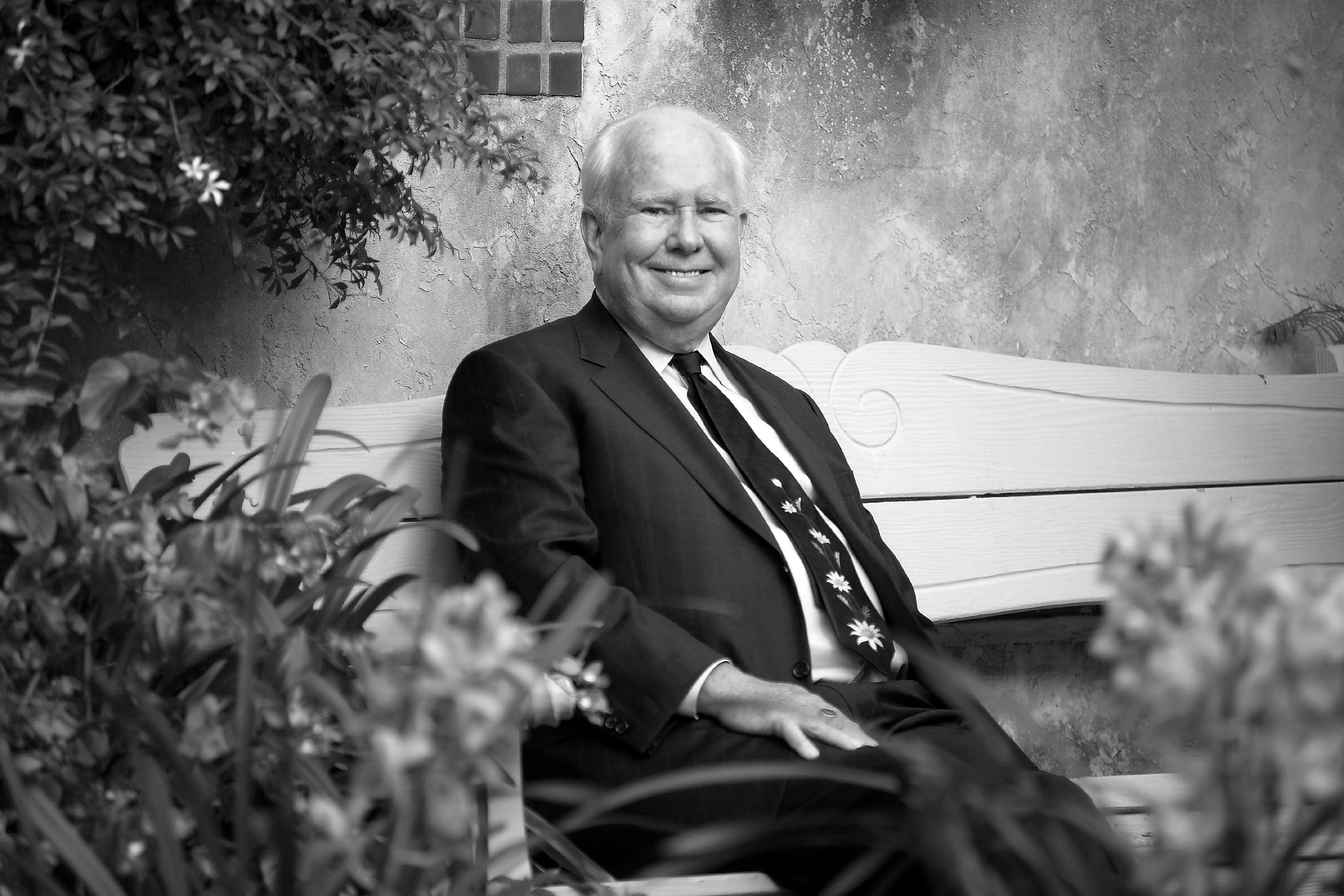
- Peter Raven was one of the most influential botanists of the 20th century, helping to shape modern understanding of biodiversity and coevolution.
- As director of the Missouri Botanical Garden for nearly four decades, he transformed it into a global center for research, conservation, and education.
- He was an early and persistent voice warning that human activity—through habitat loss, consumption, and population growth—was driving a mass loss of species.
- His work combined science and public engagement, emphasizing that understanding the natural world carries an obligation to sustain it.
Life on Earth is often described as a web, but for much of modern science it was catalogued as a ledger: names, specimens, distributions, relationships drawn in careful lines. Over the course of the 20th century, that ledger gave way to a more connected view. Plants and animals were no longer just entries in a system , they were participants in it, shaping one another across deep time. The implications of that shift were not merely scientific. They pointed, more directly than before, to the role of a single species—our own—in altering the terms of that participation.
Few scientists did more to define that transition, or to explain its consequences, than Peter Raven.
Peter Hamilton Raven, who died last night, aged 89, was among the most influential botanists of the past century. Over a career that spanned more than six decades, he combined taxonomy, evolutionary biology and conservation into a coherent body of work: to understand the diversity of life, and to argue for its preservation with a clarity that was unusual among scientists of his generation.
He began with curiosity rather than doctrine. Born in Shanghai in 1936 to American parents, he spent his childhood in California after his family returned in the late 1930s. As a boy in San Francisco, he collected insects and then plants, drawn to the order that botany seemed to offer. The ranges of species were mapped , their forms could be compared. It was, as he later described, a kind of game, one in which discovery remained possible even for the young.
At the University of California, Berkeley, and later at UCLA, that game became a discipline. His doctoral work focused on the evening primrose family, Onagraceae, a group that would remain a thread through his scientific life. By then, his interests were already widening. Plants, he came to see, could not be understood in isolation. Their forms, distributions and genetic patterns were responses to pressures exerted by other organisms and by the environment itself.
This insight found its most influential expression in a 1964 paper co-authored with Paul Ehrlich, “Butterflies and Plants: A Study in Coevolution.” The idea that species could drive each other’s evolution was not entirely new, but Raven and Ehrlich gave it a structure and a vocabulary that reshaped evolutionary biology. Coevolution, as they described it, explained not only the defenses of plants and the counter-adaptations of insects, but also broader ecological relationships. It suggested that disruption in one part of the system could affect others in ways that were not always apparent.
Raven took up a post at Stanford in his early thirties. At 35, he was appointed director of the Missouri Botanical Garden, an institution that would define the rest of his career. When he arrived in 1971, the garden was respected but provincial. Over nearly four decades, he transformed it into a global center for botanical research, building networks that extended across Latin America, Africa, Asia and other regions.
His approach to leadership was expansive but practical. He saw institutions not as repositories but as platforms: places from which to coordinate research, train scientists, expand public understanding of science, and influence policy. Under his direction, the garden became involved in major international projects, including the Flora of China, a vast collaborative effort that catalogued more than 31,000 species. Such undertakings required diplomacy as much as science. Raven worked across political divides, helping to build scientific partnerships between countries that had little else in common.
At the same time, he remained a prolific scholar. He authored or co-authored hundreds of papers and several widely used textbooks, including Biology of Plants, which introduced generations of students to the field. His work ranged from taxonomy and biogeography to evolutionary theory, but it was unified by a concern with how diversity arises and is maintained.
By the late 1960s, that concern had taken on a sharper edge. Raven became convinced that the scale of human impact on the natural world had been underestimated. Population growth, rising consumption, the steady conversion of natural habitats, and the spread of industrial technologies were, he argued, driving a loss of biodiversity that rivalled the great extinctions of the geological past.
He was not given to rhetorical excess, but his assessments were direct. Drawing on fossil records and contemporary data, he pointed to waves of extinction following human expansion into new regions, from the disappearance of large mammals in North America to the loss of endemic birds on Pacific islands. The pattern, he suggested, was consistent: human arrival was often followed by rapid ecological change.
Raven did not present this as an argument for retreat from development. His emphasis was on sustainability, a term that he helped to popularize but treated with caution. It was, he noted, easy to invoke and difficult to define. What mattered was not the word itself but the practical question it implied: whether human societies could manage their use of resources in a way that allowed other species—and future generations—to persist.
His answers were pragmatic. Protected areas were essential but insufficient. Conservation had to extend into agricultural landscapes and cities, and it had to address the conditions of the world’s poor as well as the consumption patterns of the rich. Education, especially of children, was a recurring theme. Interest in nature, he believed, was not automatic , it had to be cultivated.
Raven’s public role expanded accordingly. He served as president of several scientific organizations, including the American Association for the Advancement of Science (AAAS), and as home secretary of the National Academy of Sciences. He advised governments, participated in international panels and spoke frequently to non-specialist audiences. In 2001 he received the National Medal of Science, the highest scientific honor in the United States.
Recognition came in many forms. Time magazine once described him as a “Hero for the Planet,” a label he neither sought nor entirely rejected. He was aware of the tension between advocacy and objectivity, and he navigated it by insisting on the role of science as a provider of evidence rather than prescriptions. Science could describe the consequences of actions, he argued , decisions about what to do remained political.
Those who worked with him often remarked on his capacity for collaboration. He was, by his own account, an extrovert, someone who drew energy from communication and from working with others. This trait shaped both his scientific work and his institutional achievements. Large, multi-author projects and international partnerships were, for him, not a departure from earlier modes of science but a continuation of how the field had evolved.
In later years, he reflected more openly on the course of his life. His memoir, Driven by Nature, traced a path from childhood collecting in California to global advocacy for sustainability. The narrative was not uncritical. He acknowledged the demands of his career and the costs they imposed, even as he emphasized the role of colleagues, students and collaborators in his work.
What emerges from these reflections is a consistent theme: the idea that knowledge carries obligations. To understand the interconnectedness of life is, in his view, to recognize the consequences of disrupting it. Yet he resisted fatalism. Even as he documented accelerating rates of extinction, he maintained that there was still time to act, and that action would be most effective if it combined scientific insight with social and economic change.
Raven’s influence can be measured in citations, institutions and policies, but also in how biology came to be practiced. The study of plants, once seen as largely descriptive, became under his influence part of a broader inquiry into systems and interactions. Conservation, once peripheral, moved closer to the center of biological thought.
He did not claim to have resolved the tensions inherent in that shift. The balance between development and preservation, between human needs and those of other species, remains unsettled. What he offered instead was a framework for thinking about those tensions, grounded in evidence and attentive to complexity.
In one of his lectures, he described biodiversity as “the whole business”—the sum of organisms, their variations and the communities they form. It was a plain phrase for a concept of considerable scope. By the end of his life, it had become clear that he had spent much of it trying to explain what that “business” entails, and what might be lost if it is allowed to diminish.
Header image: Peter H. Raven at the Missouri Botanical Garden. Photo by M. Jacob.
Biodiversity extinction crisis looms says renowned biologist
