

The routes taken by migratory birds, known as flyways, often cross vast expanses of ocean. Six of these marine flyways have now been formally recognized by the U.N.’s Convention on Migratory Species, at the suggestion of scientists who published their findings on these flyways in the British Ecological Society’s Journal of Applied Ecology. Tammy Davies, a co-author of the paper and marine science coordinator at BirdLife International, joins the Mongabay Newscast this week to discuss the conservation potential of the six flyways, and what the formal recognition by CMS does and doesn’t do.
“It’s a fantastic communication tool for highlighting these amazing journeys that the seabirds undertake and the fact that multiple people, stakeholders, and countries need to come together and everyone can do their bit,” Davies says.
She notes that 151 bird species rely on these migratory routes, which connect 1,300 key biodiversity areas that the birds regularly use. Having nations focus on protecting these areas, and reducing bycatch from fishing, are just some of the ways countries can coordinate conservation efforts along these routes. But this effort requires shared responsibility across the 54 nations that these flyways bisect. The flyways provide a formal mechanism for nations to do this, Davies says.
“They’re facing threats throughout their life cycle,” she says. “You really need like a coordinated approach to address all of these threats when the seabirds are either breeding on land or when they’re out at sea.”
Conservation goals and even some of the tools used to protect seabirds using the marine flyways framework intersect with the interests and goals of other global treaties, such as the high seas treaty (or Biodiversity Beyond National Jurisdiction, BBNJ) and the Kunming-Montreal Agreement, under the U.N. Convention on Biological Diversity, Davies says. This overlap in goals could be an incentive for cooperation in a world where international agreements often come down to political will.
“The most obvious overlapping interest is around the area-based management tools … because the BBNJ treaty sets out a mechanism to be able to do that for areas beyond national jurisdiction. And it also recognizes that there needs to be connectivity.”
Mike DiGirolamo is the host & producer for the Mongabay Newscast based in Sydney. Find him on LinkedIn and Bluesky.
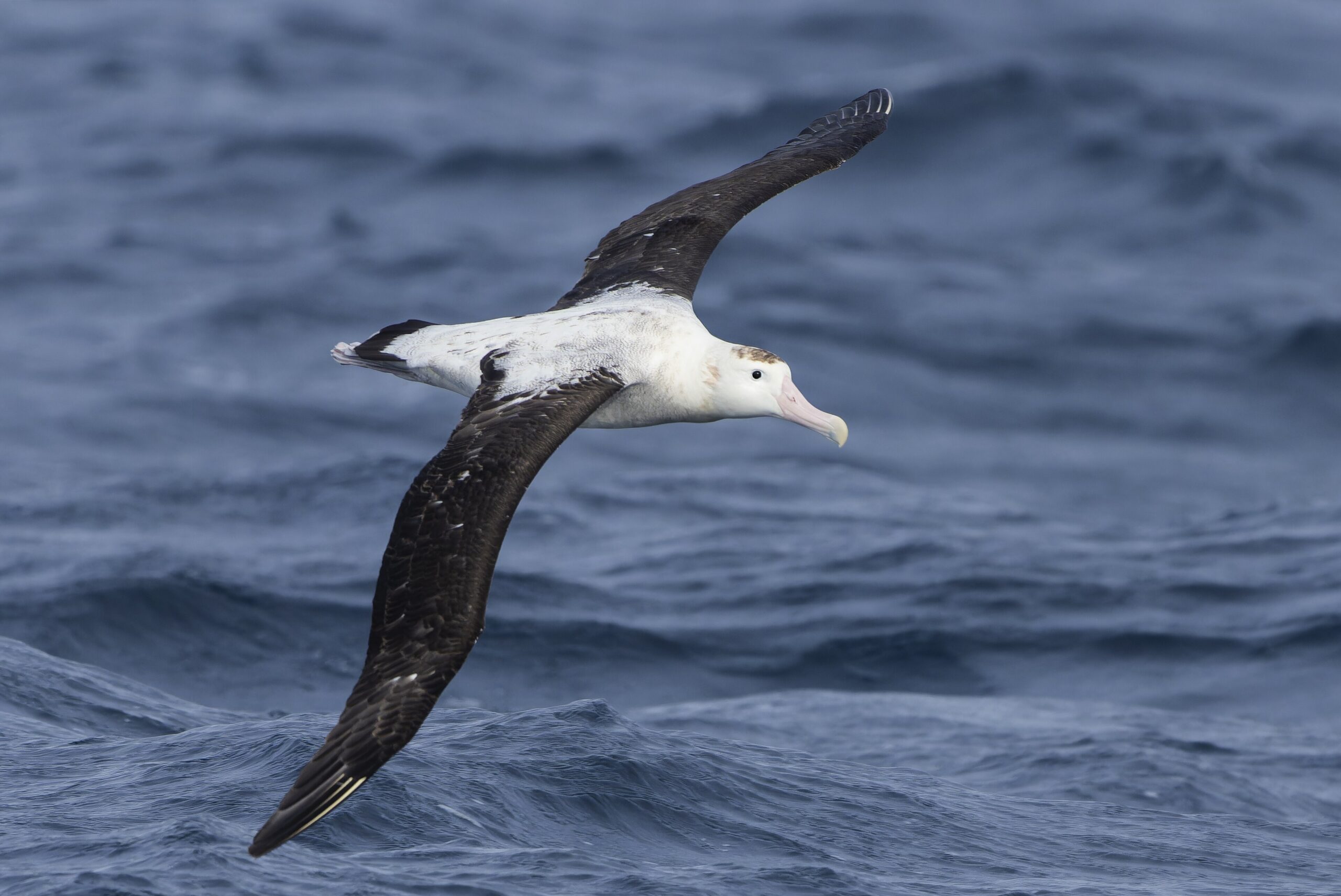
Banner image: Antipodean albatross (Diomedea antipodensis antipodensis) offshore from Dunedin, Otago, Aotearoa New Zealand. Image by Oscar Thomas via Wikimedia Commons (CC BY-SA 4.0).
Notice: Transcripts are machine and human generated and lightly edited for accuracy. They may contain errors.
Tammy Davies: Flyways are just the broad routes that any birds travel between their breeding and non-breeding grounds. So multiple species are traveling these routes, and flyways had already been identified for land and waterbirds, so terrestrial flyways. But what we did in this paper, that was led by Joanne Morton and contributed to by a whole range of scientific researchers, was to use seabird tracking data, so small devices that record the location and time of where birds are, and use a really large compilation of that to identify where the birds are traveling at sea. So multiple species at multiple times. And we identified marine flyways, which are these broad routes within the ocean, at an ocean-basin scale. We identified six routes, so almost one per ocean basin except for two in the Indian Ocean, and these really describe, or are a great tool for communicating, the broad routes that many of the long-distance migratory seabirds travel.
Mike DiGirolamo: Welcome to the Mongabay Newscast. I’m your host, Mike DiGirolamo, bringing you weekly conversations with experts, authors, scientists, and activists working on the front lines of conservation, shining a light on some of the most pressing issues facing our planet, and holding people in power to account. This podcast is edited on Gadigal Land. Today on the newscast, we speak with Tammy Davies, the Marine Science Coordinator at the organization BirdLife International, and a co-author on a recent policy paper in the Journal of Applied Ecology from the British Ecological Society. This paper identifies six critical marine flyways that migratory birds use to cross oceans, and it suggests formal recognition under the Convention on Migratory Species. This is important because half of all seabirds are declining, so coordinated international efforts to conserve them through formal recognition of these flyways are a way to do that, the authors of this paper argue. In this conversation, Davies reiterates that the Convention on Migratory Species did formally adopt the resolution on marine flyways at the group’s Conference of the Parties just this past March. So we discuss what this means and what it does not, how birds use these marine flyways, the policy implications of this formal recognition, and how it overlaps with other international agreements and treaties such as the Biodiversity Beyond National Jurisdiction Agreement and the Kunming-Montreal Global Biodiversity Framework. Hi Tammy. Welcome to the Mongabay Newscast.
Tammy: Thank you. Great to be here.
Mike: So before we get into it, let’s first set some context for our listeners. Half of seabirds are declining. This is obviously not a great situation. Can you tell us why seabirds are declining and the difficulty in addressing the scale of this problem?
Tammy: Yeah, so seabirds are a really diverse group of birds. They depend on the ocean, but obviously they breed on land, so they span these different realms and they face threats when they’re in both of these areas. They typically face threats from invasive species whilst they’re nesting on land, and these can be things like rats or cats or mice. They eat the eggs or the chicks, or even start attacking the adults while they’re breeding. And then when the birds are out at sea, they also face threats from fisheries, so being accidentally caught in fisheries or losing their food resources due to overfishing. So really they’re facing threats throughout their lifecycle, which is why they’re one of the most threatened groups of birds. And yeah, in order to be able to address these threats, you really need a coordinated approach to address all of these threats when the seabirds are either breeding on land or when they’re out at sea.
Mike: And so I guess this is where the concept of the marine flyways comes in. So can you tell our listeners what marine flyways are, and what are the six that this paper has identified, and how are birds using them?
Tammy: Yeah, so flyways are just the broad routes that any birds kind of travel between their breeding and non-breeding grounds. So multiple species are traveling these routes, and flyways had already been identified for land and waterbirds, so terrestrial flyways. But what we did in this paper, that was led by Joanne Morton and contributed to by a whole range of scientific researchers, was to use seabird tracking data, so small devices that record the location and time of where birds are, and use a really large compilation of that to identify where the birds are traveling at sea. So multiple species at multiple times. And we identified marine flyways, which are these broad routes within the ocean, at an ocean-basin scale. We identified six routes, so almost one per ocean basin except for two in the Indian Ocean. And these really describe, or are a great tool for communicating, the broad route that many of the long-distance migratory seabirds travel. There’s already flyway work for existing seabirds, which are obviously traveling more of the coastal route, but these are for all the oceanic pelagic seabirds which are crossing entire ocean basins, so some of the bigger seabirds like your albatrosses and your petrels, or even smaller seabirds like the Arctic tern, which breeds up in the Arctic and travels all the way across the Atlantic Ocean down to Antarctica. It is the longest migration on Earth.
Mike: And how long did it take for you to get all this data and compile it?
Tammy: Yeah, it’s a really time-intensive process. But BirdLife hosts the seabird tracking database, and this is a collaborative platform where researchers who are studying seabirds and collecting tracking data can share their data with this platform while still maintaining ownership. So it was data that had been shared with this platform that was requested and used for the analysis. So BirdLife wasn’t collecting all the data ourselves, but then the power of this analysis is bringing together all this different data from all these different regions and putting it into one place for a really large global synthesis. So that’s really the power of the data. It had been collected over many years and by many different people. And then the database also facilitates these kinds of analyses because the data needs to be standardized in order to be uploaded to the database. So yeah, it underpins a lot of our work that we do on the marine program, and one of the more recent global analyses that we’ve done is the identification of marine flyways.
Mike: Hello listeners, and thank you for tuning in. As I always like to mention, Mongabay is a nonprofit news organization. We do rely on funding from listeners and readers like you. So if you’d like to support us, go to patreon.com/mongabay to become a monthly sponsor of the Mongabay Newscast. If you’d like to donate directly to Mongabay, you can do so on our landing page. If you want to learn more about marine flyways, please see the links in the show notes to read our related report.
Mike: So I have read that there are about 54 countries that these flyways intersect the jurisdiction of, and notably some countries have multiple flyways touching them because of things like overseas territories. I believe that France has touchpoints in all six flyways. What are the policy implications of this? What is it exactly that these flyways help potentially facilitate in terms of conservation?
Tammy: Yeah, so these flyways, and how they’ve worked for the existing flyways of the coastal and terrestrial flyways, act as a kind of framework for bringing together stakeholders who need to work together and for then setting priorities for what needs to happen within that flyway. So whether that could be identifying sites that need protection, looking at research gaps, capacity building, or just understanding more about threats and then addressing specific threats within that flyway, it just sets it and makes it more of a manageable framework for different stakeholders to come together around. And what’s been found with some of the existing flyways is that when this kind of approach has been implemented over the long term, it has had successful outcomes for migratory species. So we’ve seen improved outcomes for some of the migratory raptors when this transboundary conservation action has happened over the long term. So with the marine flyways, it would hopefully operate in exactly the same way, and it will bring together the relevant stakeholders per ocean basin. They’re taking a really broad-scale approach to conservation, so taking a kind of step back and then looking at what’s needed at the ocean-basin scale for these migratory birds within that area. So are all the colonies being protected, and if so, when are they facing threats? Whether it’s at sea, and is there complementary action that needs to happen to help mitigate the threat during that particular life stage so that the work doesn’t get undermined when you’re busy protecting their breeding colony, for example. So it’s really a way to frame and bring everyone together and help set priorities to start planning for conservation in a more coordinated way.
Mike: I’m going to come back to that in a little bit. I want to talk first about the actual ecological aspects of these flyways. So I’m reading that a majority of the 151 bird species identified use a single flyway. So my question here is, are some of these flyways more significant than others? And if so, which ones, and what kind of complications does that present?
Tammy: I think, yeah, I’m not sure if any are more significant than others. There are certain areas that have higher densities of seabirds, so there are huge densities of seabirds around the Southern Ocean, and so the Pacific flyway also has a lot of birds compared to, for example, the Atlantic Ocean. But I think a lot of the similarities, the similarities that need to be addressed in the flyways, are around the threats, because it’s the same threats that are facing multiple birds. So I’m not sure I would say any flyway is particularly better than one or the other. And really what it needs is champions to take it forward, and then to advocate and to start implementing this kind of framework at an ocean-basin scale.
Mike: So the paper identifies about 1,300 Key Biodiversity Areas. What can you tell me about these areas and the nations that would be tasked with protecting them? What are some of the implications of these Key Biodiversity Areas? What kind of geopolitical implications are we looking at here from these?
Tammy: So Key Biodiversity Areas are areas of significance for biodiversity, and they’re assessed against a global quantitative set of criteria. And they are the largest sites of importance for conservation. So the sites that we pulled out were the sites that are important for the migratory species that have been identified as using the marine flyways. And mainly it’s to demonstrate that there’s already a lot of information there for conservation to start happening. So you can identify a Key Biodiversity Area for a seabird, maybe an important breeding colony if you’ve got a really large proportion of the population breeding within a country. You can also identify these sites at sea when these birds are foraging. So you start to piece these things together. And the idea is that you don’t need to protect the entirety of an ocean basin, but what you do want to look at is areas that are particularly important for a species, so where a species is spending a large part of its time or where it’s important for it to be able to complete a stage of its lifecycle, so raise a chick, for example. And it’s those kinds of areas that you want to protect. And then you want to make sure that you’re protecting those areas throughout the lifecycle of the species. And because these species travel such vast distances, these areas can be spread at an ocean-basin scale. So really it’s trying to target where conservation action needs to happen. And this can either be through protection, so marine protected areas at sea, or it could be looking at what threats are within that area and then looking to mitigate those threats.
Mike: So you suggest formal recognition of these flyways under the Convention on Migratory Species. Can you tell me what that would do exactly?
Tammy: Yeah, so the Convention on Migratory Species actually had its Conference of the Parties about two weeks ago, at least about two weeks ago, and the resolution on marine flyways was formally adopted. So this is really exciting news. This is what we really hoped would happen, and this provides formal recognition under this convention of the marine flyways as a framework. So it sets the marine flyways at the same level as the other existing flyways, so it establishes it as a program of work under the Convention on Migratory Species. What that helps to do is then bring contracting parties of the Convention on Migratory Species together, and gives them a mandate really to start working on the marine flyways and starting to look at implementation and next steps. Yeah, so we’re really happy that went through.
Mike: What are the limitations of this framework and the formal recognition of the flyways, basically what has not been solved? What challenges still exist? Because as we know, under other international agreements that have to do with conservation, there are myriad challenges and geopolitical gridlock. So I’m sure that there is probably some of that here as well, I would assume. Can you describe it for me?
Tammy: Yeah, sure. I think with all conservation issues, a lot of it comes down to geopolitics and political will. So the same is true here. And so what you really need is country champions to take a lead on this and to invest in this as well, and provide resources to get this kind of framework up and running, bringing people together and getting the science and data together for action. And that’s a challenge. We have a variety of other global issues happening at the same time, and I think marine conservation tends not to get as much political attention as some other issues. Often it’s out of sight, out of mind. It’s not seen as relevant to as many people. So that’s always a challenge, trying to keep this at the top of the agenda, because the ocean is hugely important. It sustains fisheries for billions, it helps support our climate, so it’s really something that should be seeing much more investment.
Mike: I know this might be a sticky question, but are there any particular nations or jurisdictions that you see as potentially having more potential for influence in any particular flyway? Because you’ve identified country champions as something that is a necessity here, so are there any nations that would be in a position to have more influence than others?
Tammy: It would need to be a country who is a contracting party to the Convention on Migratory Species, of which there are many. Australia has been a big champion so far. They really supported the resolution and championed that going through at the latest Convention on Migratory Species Conference of the Parties, the COP. And we’d like to see countries maybe like France, who has a stake in all of the marine flyways, they would be an obvious champion for the ocean. And they have also been championing various marine causes, such as a moratorium on deep-sea mining, and playing quite a loud voice at the international level as well. But it would be great to see multiple contracting parties to CMS as champions within each flyway, so it’s not just on one country, but that you’ve got multiple countries coming together to champion this.
Mike: And so have any government officials or other scientists that work for government labs, policymakers, responded to this paper? Has anything happened as an impact of the release of the study other than the recognition, which you’ve just described?
Tammy: Yeah, a huge number of scientists were involved in the original identification through sharing their data and also co-authoring the paper. And a lot of those researchers are also really well recognized at national level, so often national advisers as well, or government scientists. So I feel like there’s already a strong scientific basis linked to national governments there, from which we’ve built. And then the resolution that went forward and was adopted at the CMS COP, the Convention on Migratory Species Conference of the Parties, that was then really the government level, and then all contracting parties there signed off on that. So that’s a big signal. Yeah, so we just hope that it builds from this. There’s lots of stuff happening at the minute with the ocean, with the new Biodiversity Beyond National Jurisdiction agreement, so the high seas treaty as it’s called, and that’s getting a lot of political attention, and the first Conference of the Parties will be in January next year. So we just hope to keep building on this and the ocean momentum, to get more people excited about this and connectivity and why it needs to be considered.
Mike: Yeah, I would like to ask you about the potential overlap between this and the BBNJ because it seems like there could be some. Can you outline what the overlapping interests of these two agreements would be?
Tammy: Yeah, so I think the most obvious overlapping interest is around the area-based management tools, which is more either spatial measures, so these could be marine protected areas or other effective conservation measures. Because the BBNJ treaty sets out a mechanism to be able to do that for areas beyond national jurisdiction, and it also recognizes that there needs to be connectivity. They need to be ecologically coherent and connected. And that’s also very much mirrored in what the marine flyways are looking at, that you need to consider connectivity. So I think there are some really strong parallels there, and bringing that in across both.
Mike: And are there any other international agreements that have significant overlap with the marine flyways and could help, or potentially be interdependent on, the marine flyways agreement or the Convention on Migratory Species?
Tammy: Yeah, so another agreement is the Convention on Biological Diversity, and the global targets established under that agreement, including protecting 30 percent of the ocean by 2030, which is a deadline that is fast approaching. And this target also recognizes that sites need to be connected. So again, those are super similar across all of those. So the Convention on Migratory Species, BBNJ, and also the Convention on Biological Diversity are all really synergistic, really, to try to achieve the same goal. And seabirds, with the amount of data that we have on them to be able to identify important areas, including in ABNJ, areas beyond national jurisdiction, are a really great tool for helping to identify areas that would be worth protecting to help achieve these global targets.
Mike: And what’s next for your team? How do you plan to continue taking this work forward? What are not just the next steps for this concept or the Convention on Migratory Species, but also for you and your team?
Tammy: Yeah, so for me and my team, I guess there are various different strands. One, we have more of the policy work, so making sure that we’re speaking about marine flyways at the right places and getting more governments on board to keep this moving. Also, working with our BirdLife partners, of which there are 123 around the world, national organizations, and seeing how their work that they’re currently doing with seabirds could fit in within this flyway, and getting them also coordinating with their governments and with other BirdLife partners. So actual action on the ground. We have a global flyway summit coming up for the BirdLife partnership in October this year, which will be a really great place to bring everyone together to see where we’re at with actions and where we might be able to go. And then on my team as well, we’ll be looking at more science work, so identifying further Key Biodiversity Areas, particularly in the high seas, from seabird tracking data. That’s something that we’re starting at the minute. And then also starting a global analysis to look at really high-risk areas of bycatch for species, identifying where these are and what kind of fleets are responsible. So putting all this stuff together really starts to move the marine flyway framework together under the overarching framework of a flyway and what needs to happen.
Mike: I was going to mention that the threat of the bycatch seems like one that would require a lot of intensive research and work because of the nature of fishing on the high seas in general, and much of it being hard to track and being quite opaque. How does your team plan to deal with those challenges?
Tammy: Yeah, it’s a good point. It is really challenging to deal with. BirdLife has worked with the regional fisheries management organizations for almost the last 25 years, for a really long time, and has seen the introduction of legally binding recommendations on seabird bycatch. So these are legally binding measures that contracting parties to the RFMOs need to abide by to help reduce seabird bycatch. But the main issue there is with compliance and data reporting. So that’s a challenge. And also our marine program and partner RSPB have set up the Albatross Task Force. And this task force works in ports doing port-based outreach, so working with fishermen when they come back to port to show them and teach them about mitigation measures and safe handling of seabirds to help. So working really at the grassroots level and also at the regional level of the fisheries organizations, and then as well at the international level with these other agreements. So like a three-pronged approach. But yeah, you’re right, it is really challenging and it can be sometimes hard to see a change. But there are lots of opportunities arising now with more electronic monitoring and different data that are going to start improving the transparency of some of these operations on the high seas, which will ultimately benefit seabirds.
Mike: Is there anything else about this study that we haven’t talked about that you really think is worth highlighting?
Tammy: The main point is really that it’s a fantastic communication tool for highlighting these amazing journeys that the seabirds undertake, and the fact that multiple people and stakeholders and countries need to come together. And everyone can do their bit within one country, as long as everyone’s coordinating and doing their bits in different areas. And through that, that’s how you can make a real difference for conservation.
Mike: Tammy Davies, it has been a pleasure speaking with you. Where would you direct listeners to learn more about your work?
Tammy: Yeah, I’ve also really enjoyed the conversation. I think some of our main resources would be just the BirdLife webpage, or the seabird tracking database, which is seabirdtracking.org. And we’ve got a few case studies and other things on the website so you can read a little bit more about the database there. We also have a newsletter as well that you can sign up to, to find out more about our seabird tracking work.
Mike: All right, Tammy Davies, thank you so much for joining me today.
Tammy: Thank you very much. Great to speak with you.
Mike: If you want to read related reporting on marine flyways, please see the links in the show notes. As always, if you’re enjoying the Mongabay Newscast or any of our podcast content and you want to help us out, we encourage you to spread the word about the work we’re doing by telling a friend and leaving a review. Word of mouth is one of the best ways to help expand our reach, but you can also support us by becoming a monthly sponsor through our Patreon page at patreon.com/mongabay. We are a nonprofit news outlet, so even pledging just a dollar per month really makes a big difference and helps us offset production costs. So if you’re a fan of our audio reports from Nature’s Frontline, go to patreon.com/mongabay to learn more and support the Mongabay Newscast. You can also read our news and inspiration from Nature’s Frontline at mongabay.com, or you can follow us on social media. Find Mongabay on LinkedIn at Mongabay News, and on Instagram, Threads, Bluesky, Mastodon, Facebook, and TikTok, where our handle is @Mongabay, or on YouTube at Mongabay TV. Thank you as always for listening.