

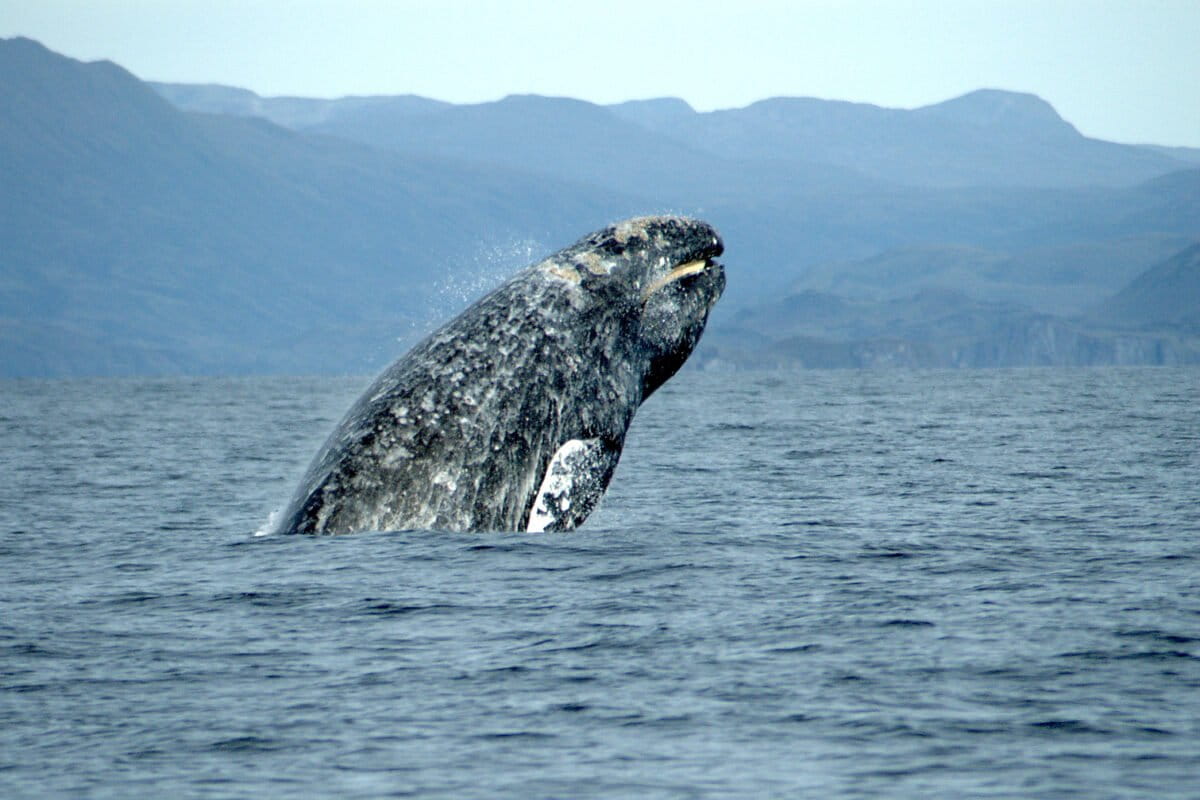
Gray whales have one of the longest known migrations of any mammal — from the Arctic near Alaska, to the lagoons of Baja Mexico, where they mate and give birth. This annual migration, longer than 19,000 kilometers (12,000 miles), has been altered by climate change, with profound consequences for the 15-meter (50-foot) mammals. Since 2016, the population has declined by more than 50%.
Historically gray whales (Eschrichtius robustus) were not known to enter San Francisco Bay on their migration. But using photo surveys, researchers recorded 114 individual whales in the area between 2018 and 2025.
Researchers found 70 gray whale carcasses in the area and matched 21 of them to the individuals previously identified, meaning at least 18% of the identified whales were confirmed dead in the area. However, the true mortality could be higher, as some dead whales could have gone undetected.
“The minimum mortality rate of 18% observed in San Francisco seems to be unique in terms of the intensity of mortality, though gray whales face threats and die across their entire migratory route,” Josephine Slaathaug, first author of a study documenting the findings and a gray whale researcher at Sonoma State University in the U.S., told Mongabay by email.
Ship strikes are a major factor: 30 of the dead whales were hit by boats, illustrating the dangers of expanding their range into an urban area like San Francisco Bay.
Other whales apparently died of malnutrition, potentially explaining why they entered the bay to begin with. Climate change is disrupting the Arctic food web, Slaathaug said. “As the Arctic warms, ice melt impacts the invertebrate species that carry high nutritional value for these whales.”
Gray whales are coastal bottom feeders, using their baleen plates to filter tiny invertebrates from the seafloor, or benthic layer. Earlier-than-usual ice melt means that phytoplankton bloom earlier and are eaten before they can fall to the seafloor to feed benthic invertebrates, which are gray whale food. Collapsing benthic invertebrate populations can lead to malnourished whales that need to find food on their migration route.
San Francisco Bay may be an emergency pit stop for such whales. “Research is ongoing to determine what these whales may be feeding on, or attempting to feed on, in San Francisco Bay,” Slaathaug said.
Researchers are working to prevent human-caused gray whale deaths, including by boat strike. “There are education initiatives ongoing with the maritime community in San Francisco Bay, led by the Marine Mammal Center, but stricter conservation strategies such as mandatory slow speed zones may be necessary if the pattern of mortality continues,” Slaathaug said.
Rachel Rhodes, a marine biologist not affiliated with the study, told The New York Times that
San Francisco Bay is “such a uniquely complex and busy waterway. Then you add whales into the mix, and there’s just not a lot of room to coexist.”
Banner image: A gray whale breaching. Image by Merrill Gosho/NOA via Wikimedia Commons (Public domain).