

- Researchers say baobabs face a potential new threat from the mango stem borer, a beetle long known to devastate other trees.
- The warning comes from research in Oman, where scientists found the pest had killed six baobabs and severely infested a dozen more in a small valley population.
- Authorities there are fighting the infestation with pesticides, light traps and manual removal of larvae from the trees.
- Scientists note that similar infestations have not yet been recorded in other countries where baobabs grow.
A couple of years ago, Sarah Venter wrote an article gently picking apart alarm over the specter of Africa’s iconic baobabs dying off due to climate change. Her review found that while a number of famously large and ancient trees had indeed collapsed in worsening conditions, Adansonia digitata were generally proving resilient. When she heard about fears that a new pest was killing worrying numbers of baobabs in Oman, she set off to investigate, at the invitation of Oman’s Environmental Authority.
There are eight species of baobab, members of the genus Adansonia. A. digitata is widely distributed across East, West and Southern Africa , one species is restricted to northwestern Australia , and the other six are found only in Madagascar, believed to be the center of origin for this striking family of trees that stand majestically on barrel-like trunks and can live for well over a thousand years. Three of Madagascar’s baobab species are threatened — A. grandidieri and A. suarezensis are listed as endangered on the IUCN Red List, and A. perrieri is critically endangered — by logging, charcoal production, wildfires, and mining of the forests they’re found in.
Historical records and genetic research suggest baobabs reached Oman, on the Arabian Peninsula, centuries ago as part of the circulation of valuable plants between northeastern Africa, the Persian Gulf and South Asia by nomadic and fishing communities on the Indian Ocean.
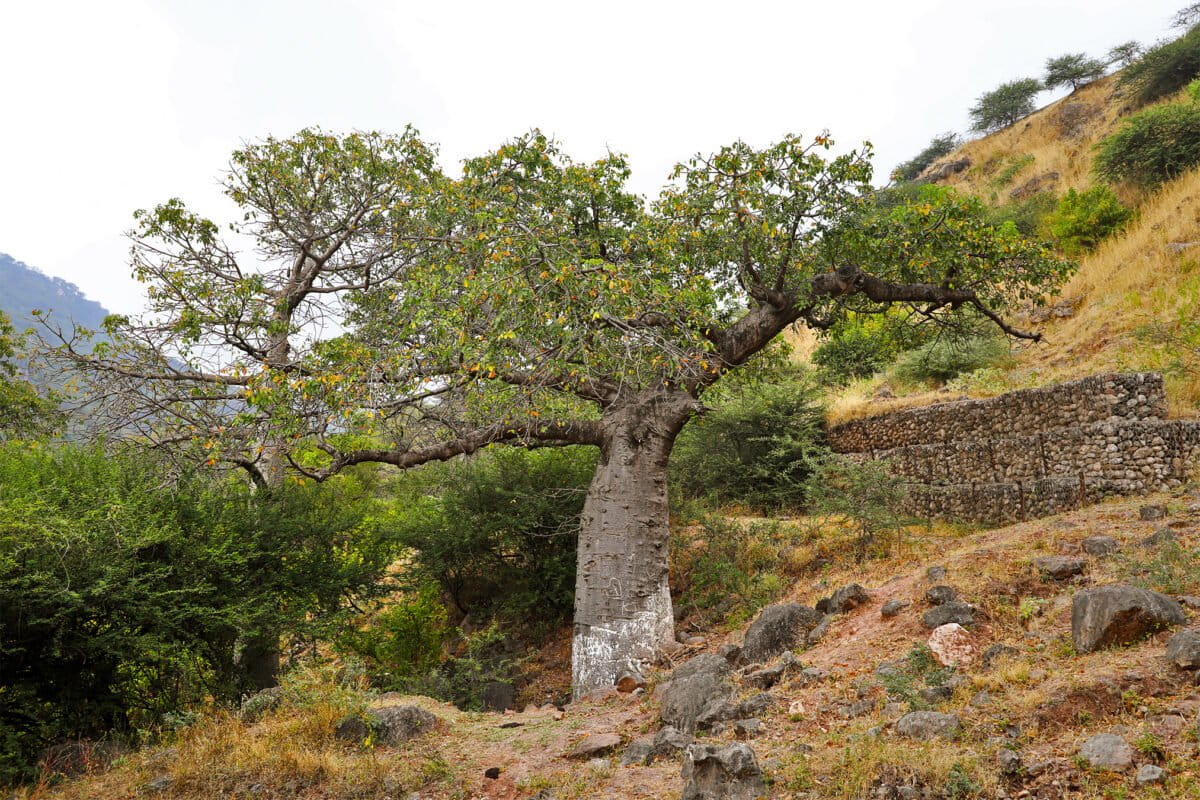
It was the health of about 100 baobabs growing in a semiarid valley, Wadi Hinna, that drew Venter’s attention. She and two colleagues examined the damaged tissue of 90 trees. In a recently published study, they reported six of the trees had died and 12 others were fighting for their lives against the larvae of the mango stem borer, a beetle well-known across Asia for devastating infestations of mango, fig and other trees.
In the 1990s, government agencies in Oman reported Batocera rufomaculata, newly arrived in the region, had killed large numbers of frankincense (Boswellia sacra) and wild fig trees (Ficus palmata). They also noted the beetles were affecting an isolated population of baobabs in the country’s west. But it was only in 2021 that they registered a baobab tree dying from the beetles’ attacks. Since then, dozens more have been infected and six more have died.
“The mango stem borer is different [from other beetle species] , it produces many hundreds of larvae which spend months eating the wood of the baobab tree until it finally falls over under its own weight and dies,” Venter told Mongabay.
Female mango stem borers use their mandibles to cut into the bark of a tree, then lay eggs in the cuts. These soon hatch into larvae that, according to Venter’s study, spend nearly a year gnawing zigzag feeding tunnels through the moist fibrous tissues of a baobab’s trunk.
“This population of baobabs in Oman is the first that the beetle may have come across, other than perhaps in Madagascar and other African islands [of Mauritius and Réunion], where we are uncertain whether the beetle is affecting baobabs,” she said.
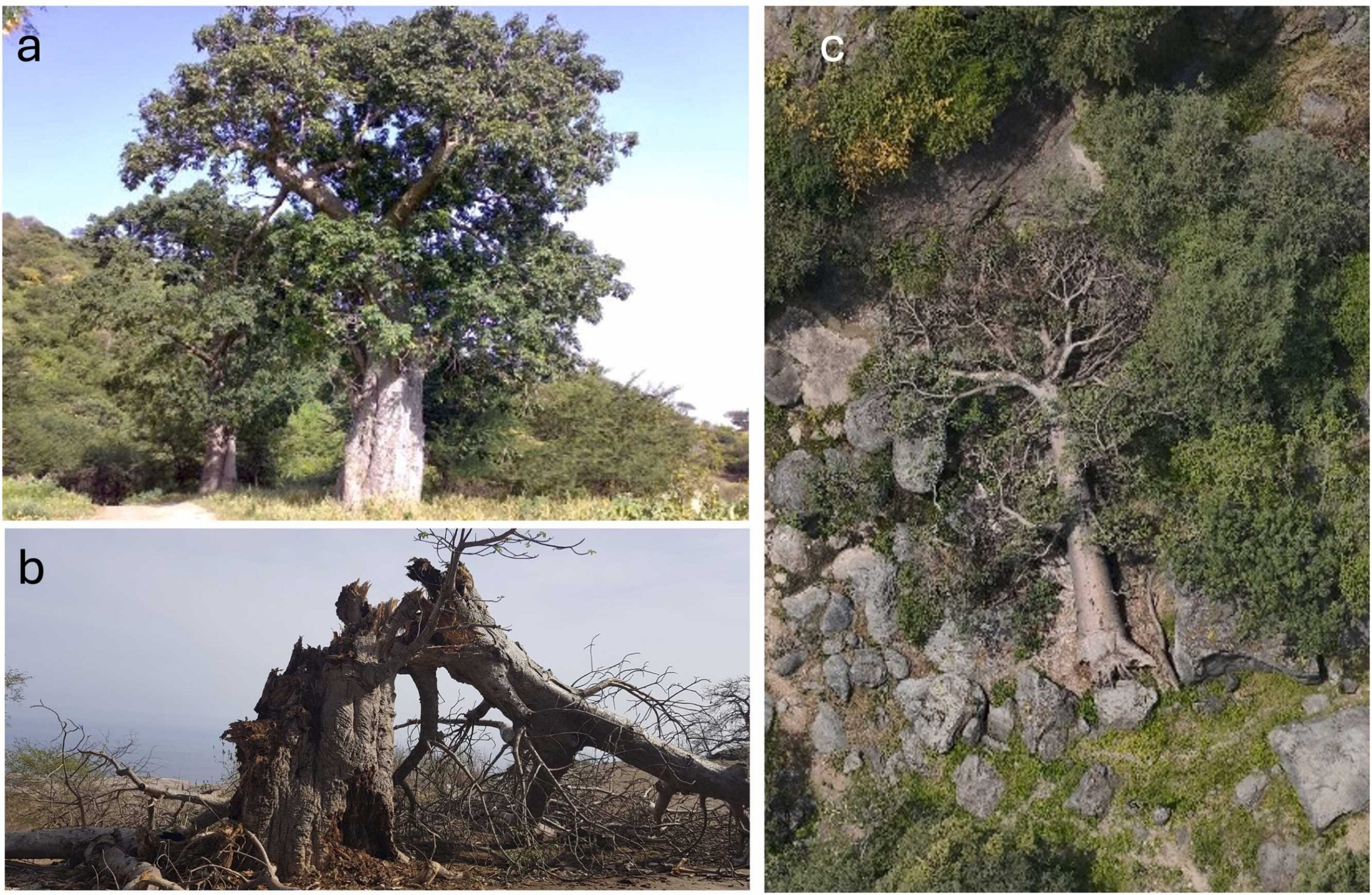
Omani government agencies launched an intensive program to protect their trees. Borrowing methods used by mango farmers to protect their orchards, they’re applying a pesticide to the baobabs, and setting out lights at night to attract and trap the insects. They’re even using wire hooks to scoop the destructive larvae out of the trees’ trunks one at a time.
These methods appear to be working to save the trees and to stop infestation from spreading, the study says. But while such labor-intensive control measures are feasible for a small, isolated population, they would be difficult to implement in a larger landscape with thousands of baobabs.
“We need to ensure biosecurity protocols for live plants at all ports of entry into Africa,” Venter said. “The larva of the mango stem borer usually lives in live wood so it is important that travelers must never bring live ornamental and agricultural plants from elsewhere in the world back into Africa without proper quarantine.”
She added that “Most travelers do not realize that the flower, fruit or cutting they bring back home from their holidays can harbor very dangerous pests.”
Patrick Maundu, an ethnobotanist in Kenya who wasn’t involved in Venter’s study, said it will be important to understand why the mango stem borer is killing Omani baobabs, but not — as far as anyone knows — doing the same to those in Madagascar, Réunion and Mauritius, where the insect has also been reported.
“Maybe the Oman baobabs are stressed, being a bit outside the natural range of the species? Maybe the food choices [for the beetles] in Oman are limited?” he told Mongabay in an email.
Banner image: A baobab in Wadi Hinna, 2023. Image by Francesco Bini via Wikimedia Commons (CC BY-SA 4.0).
They survived centuries of elephant onslaught. Now climate change is killing these iconic baobabs
Citations:
Venter, S. M., & Witkowski, E. T. (2024). Baobabs as symbols of resilience. Nature Plants, 10(5), 732-735. doi:10.1038/s41477-024-01681-4
Wan, J. N., Wang, S. W., Leitch, A. R., Leitch, I. J., Jian, J. B., Wu, Z. Y., … Wang, Q. F. (2024). The rise of baobab trees in Madagascar. Nature, 629(8014), 1091-1099. doi:10.1038/s41586-024-07447-4
Bell, K. L., Rangan, H., Kull, C. A., & Murphy, D. J. (2015). The history of introduction of the African baobab (Adansonia digitata, Malvaceae: Bombacoideae) in the Indian subcontinent. Royal Society Open Science, 2(9), 150370. doi:10.1098/rsos.150370
Venter, S. M., Akaak, A. S., & Akaak, M. M. (2026). A new pest threatens Africa’s iconic baobab trees. Global Ecology and Conservation, 66, e04108. doi:10.1016/j.gecco.2026.e04108
Feedback: Use this form to send a message to the author of this post. If you want to post a public comment, you can do that at the bottom of the page.
