

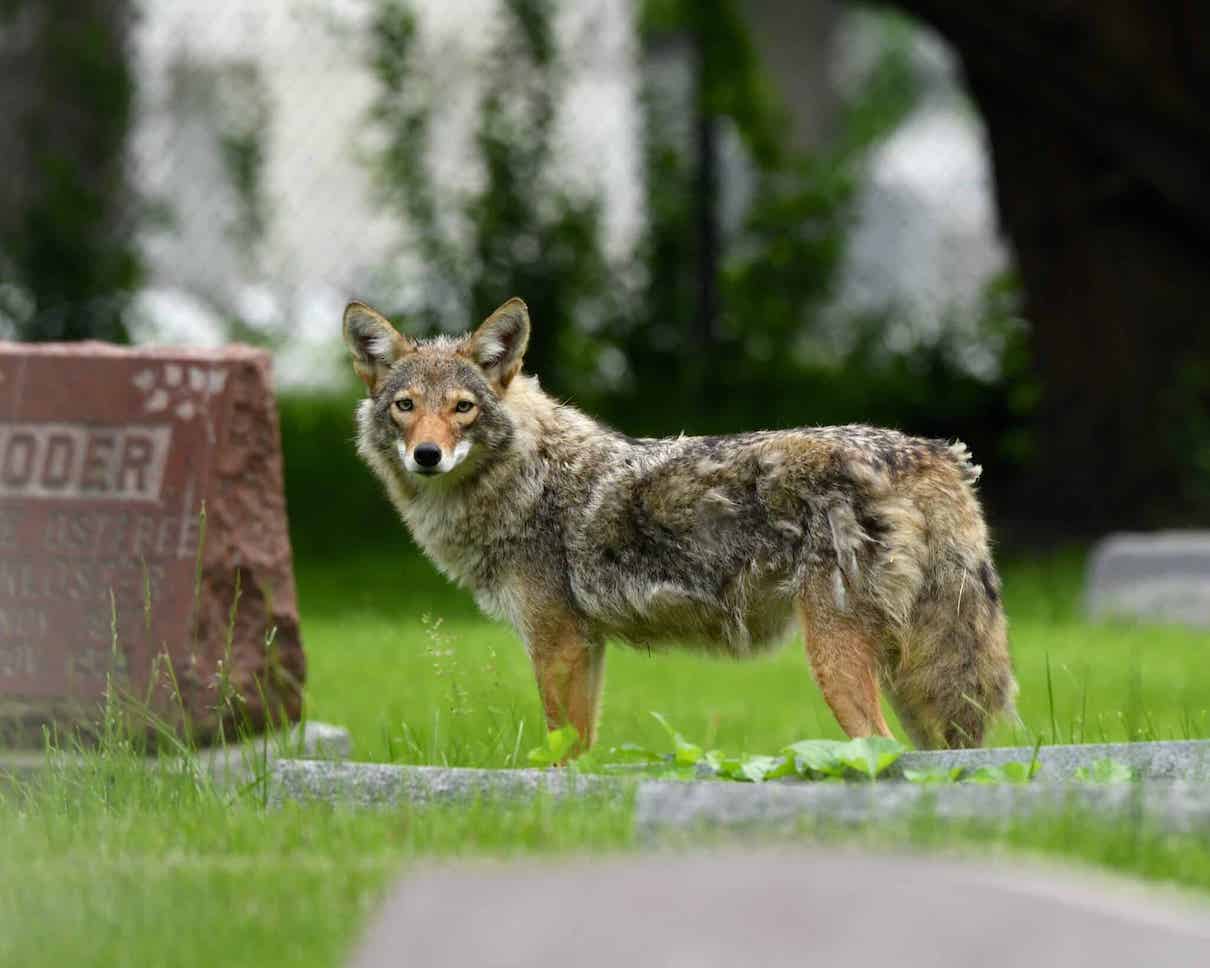
Coyotes are now present in almost every major urban-metropolitan area in the United States, yet conflicts between the canines and humans are exceptionally low. Between 1960 and 2006, only 146 documented coyote attacks on humans occurred in the U.S. and Canada. Yet there are 4.5 million dog attacks on humans annually in the U.S. alone.
Despite the low number of conflicts with coyotes, nearly one coyote is killed every minute in the United States on average, according to the nonprofit organization Project Coyote. Camilla Fox, the group’s founder and executive director, joins this week’s podcast to discuss the myths and misconceptions around coyotes (Canis latrans), why they’re largely peaceful and critical for ecosystem health, and how humans can coexist better with the growing urban population of coyotes.
“For a lot of people … who grow up in urban areas, a coyote is the first predator they’ve ever experienced in their lives,” she explains. “But … if you can arm yourself with knowledge and educate yourself about this animal, you’ll come to see not only their ecological role, but also what an amazing animal” it is.
Coyotes mostly eat rodents and are critical for regulating rodent populations, Fox explains. Depending on location, they also help regulate the abundance of mesopredators such as raccoons and skunks. This, in turn, helps protect existing biodiversity, such as birds (which are declining across the U.S.).
“By having the presence of a coyote in the landscape, they will help, through competitive exclusion, to keep these mesocarnivore populations in balance and thereby actually help bird diversity and abundance,” Fox says.
However, she says the U.S. government still sanctions the killing of almost 70,000 coyotes each year (as well as 1.75 million animals in total). Furthermore, the existence of unregulated legal “killing contests” threatens the coyote as well as other predators and mammals in the U.S. These contests don’t help regulate coyote populations or protect livestock, 70 conservation scientists say in a letter penned by Project Coyote.
“There is no legitimate wildlife management purpose behind these contests,” Fox says.
Fox and 60-plus national and state organizations have successfully advocated to get killing contests banned in 10 states, she explains. Federal legislation was once considered to ban the practice nationwide, but has since been tabled.
“We hope to reintroduce that bill under a future more favorable administration. So it’s an ongoing campaign.”
Mike DiGirolamo is the host & producer for the Mongabay Newscast based in Sydney. Find him on LinkedIn and Bluesky.
Banner Image: A coyote in Chicago. Image courtesy of Cook County Coyote Project.
Langley, R. L., & Kearney, G. D. (2025). Animal-related fatalities in the United States (2018-2023). Environmental Health Insights, 19. doi:10.1177/11786302251355353
White, L. A., & Gehrt, S. D. (2009). Coyote attacks on humans in the United States and Canada. Human Dimensions of Wildlife, 14(6), 419-432. doi:10.1080/10871200903055326
Whitley, C. T., Bowers, M. M., & Grantz, H. (2023). Urban human–coyote conflicts: Assessing friendliness as an indicator of coexistence. Animals, 13(18), 2903. doi:10.3390/ani13182903
Notice: Transcripts are machine and human generated and lightly edited for accuracy. They may contain errors.
Camilla Fox: They are such an amazing animal, and I think when people come to learn a bit more about them, there is a great degree of, I would say, respect and sometimes awe for how amazingly adaptable, intelligent, and resilient this animal has proven to be. So with that, I will also say that for a lot of people, and particularly people who grow up in urban areas, a coyote is the first predator they have ever experienced in their lives, and that might be a little unsettling. We fully acknowledge that there can be a place of fear in that first experience. But then again, if you can arm yourself with knowledge and educate yourself about this animal, you will come to see not only their ecological role, but also what an amazing animal they are.
Mike DiGirolamo: Welcome to the Mongabay Newscast. I am your host, Mike DiGirolamo, bringing you weekly conversations with experts, authors, scientists, and activists working on the front lines of conservation, shining a light on some of the most pressing issues facing our planet, and holding people in power to account. This podcast is edited on Gadigal Land. Today on the newscast we speak with Camilla Fox, the founder and executive director of Project Coyote, an organization that advocates for and educates about coexistence and protection of coyotes based in North America. Fox joins me to talk about the rise in coyote populations in the United States. Referred to as America’s song dog, they are now present in almost every major urban area in the country. However, about one coyote is killed in the United States every single minute, and they are also perhaps the primary target of legalized killing contests, which target the carnivore as well as other mammals in the United States. Fox outlines the science behind why these contests do not meaningfully manage coyote populations. It actually exacerbates the problems they purport to solve. She explains the important role coyotes play as predators, dispels common myths and misconceptions about them, and she also outlines how humans can better coexist with them. Camilla Fox, thank you so much for joining us today. Welcome to the Mongabay Newscast.
Camilla: Thank you. Glad to be here.
Mike: So there was just recently the third annual Coyote Awareness Week, this March, I believe. Can you tell us about this? It is a relatively recent annual awareness event that I think was started by Project Coyote. Can you tell us about it? Why was it started, and what does it seek to accomplish?
Camilla: Yeah, so we basically pivoted on National Coyote Day. We decided, what a great opportunity to just create a Coyote Awareness Week. There is so much to share about coyotes in North America and their amazing lives. So our aim is basically to spread awareness about coyotes and ideally appreciation. We offer a pledge that people can sign, a downloadable toolkit that talks all about coexistence, particularly in urban areas, and then we also encourage other organizations that advocate on behalf of wildlife to join. So this last year we increased our participation on all those fronts, from pledges to people downloading our toolkit to organizations engaging across North America. So it is spreading, and really it is oriented towards that goal of spreading awareness and appreciation for our native song dogs.
Mike: And speaking of which, they are now in almost every major US city, and this has been studied for quite a while now. And as far back as 2006, I believe, scientists were beginning to notice how they were thriving in urban centers. Can you describe the rise in coyote populations in US cities and what is behind it?
Camilla: Sure. So it actually goes back quite a while to the point where we were extirpating their greatest competitor, and that is the gray wolf in North America. This hearkens back to the beginning of the 19th century, when the US government started getting involved in subsidized predator control. At the time, this was known as the Bureau of Biological Survey, and this entity was tasked with essentially predator eradication. Wolves were a major target because wolves were viewed as a threat to livestock and to game species that humans were hunting for food. So there was a very intentional predator eradication effort that is ongoing today, and I am sure we will talk about that. But essentially, once wolves were largely extirpated from their historical range in North America, this opened up a vacant niche, and that niche was a perfect place for coyotes to fill. So both the extirpation of wolves and then also habitat fragmentation and development led to the spread of coyotes because they were more adaptable than wolves, and so they could exist in these fragmented landscapes. So essentially, the species that was largely relegated to the Southwest, once their greatest competitor, the gray wolf, was extirpated and we saw major land development and conversion, coyotes expanded across North America. And as you said, now they exist in every US state with the exception of Hawaii, and pretty much every urban area.
Mike: There was a study I came across that noted that access to nature was not key to their survival, which I found really interesting. Specifically in Chicago, where there are about 4,000 coyotes living, areas of dense human population were linked to longer coyote lifespans. Can you talk about this? Does this track with your understanding?
Camilla: I think you also have to look at the landscapes within Chicago, and here where I am in San Francisco, and where we see the coyotes navigating these urban landscapes. What you often see is a dense urban area surrounded by checkered green spaces. And so those green spaces often function as refuges where these coyotes can raise their families, and they can exploit, if you will, the urban areas for food and other resources. So it is a perfect landscape for an incredibly intelligent, adaptable, and resilient wild carnivore who generally wants to have nothing to do with humans. That is some of the other amazing research that has come out of Chicago. They have been researching the urban coyotes there for upwards of more than 30 years. They have found that while people are coexisting with this wild carnivore, there are relatively very few conflicts. And so that just shows that coyotes are able to coexist with us and tolerate us and largely stay out of conflict with humans and take advantage of what urban centers offer.
Mike: Yeah, that is really interesting because as you have noted on the Project Coyote website, and as is widely known, about one coyote is killed every minute. And I found that really shocking. So let us talk about this. What causes that? How is it that one coyote is killed every single minute?
Camilla: This goes back to the historical predator persecution that I alluded to, or spoke of, before. Really, since European colonists stepped foot on this continent, wild predators have been viewed as a threat. And to even trace back a little bit further, when we look at the first encounter with coyotes, and that was Lewis and Clark encountering a coyote in the Iowa-Nebraska area, they viewed this animal as a prairie wolf. It was a new species to them, and this is around the same time that efforts to eradicate gray wolves were already underway. So once this new carnivore was discovered and the wolf eradication efforts were shown to be quite successful with a variety of lethal tools, the coyote became the next target. This begins in the late 1800s, and then the intense predator persecution was underway for much of the 19th and 20th centuries. So essentially our federal government has been waging war on coyotes under an agency now known as USDA Wildlife Services. This was an agency originally, I mentioned, the Bureau of Biological Survey. It started under that name. Then it morphed into the US Fish and Wildlife Service. Then the agency separated and became what was known as Animal Damage Control. And it was actually in 1931 that the US government funded and passed the Animal Damage Control Act. And this essentially authorized the Secretary of Agriculture to promulgate any method deemed necessary to control predators, and coyotes became the central target of this endeavor. Since the early 1900s, they have been killed by the millions, and currently this federal agency, again it is called USDA Wildlife Services, kills upward of between 60,000 and 70,000 coyotes every year. In addition to that, coyotes are not protected pretty much in any state, so they can be killed 24/7 in unlimited numbers. This translates to hunters and trappers killing them for their fur, for recreation and entertainment with killing contests and bounties, and then ranchers and farmers also kill quite a few. So we estimate that at least half a million coyotes are killed every year, and that comes to between one and two coyotes every minute in the US alone.
Mike: You mentioned the killing contests, and we are going to get to that in a second, but the first thing I want to address is, what are some of the top pieces of advice you have for Americans on how to better coexist with coyotes?
Camilla: I would say in some ways it is dependent on where you live, but let us say you are in an urban landscape. I think first and foremost is coming to understand and educate yourself about this wild carnivore, who really is our urban wild neighbor in most urban and suburban landscapes. And once you come to understand a little bit about their behavior and ecology, I think a lot of people start to have a great deal of respect and appreciation, and sometimes awe, at this amazing animal, their adaptability, their resilience. So education, as far as self-education, and then with that it becomes clear that there are things that we can do to mitigate negative encounters. What we do know through science is that most conflicts stem from either intentional or unintentional feeding of coyotes and other wild animals. So looking at ways not to feed them, intentionally or unintentionally. Also, conflicts arise with off-leash dogs. So better protecting our domestic animals, be that dogs or cats or backyard domestic animals, farm animals. So really it is a matter of recognizing that feeding and protection of domestic animals are the best ways that we can mitigate most conflicts, educating ourselves, and then with that comes also an awareness of the life cycle of coyotes. And what we know as an organization is that there is often a flow of negative encounters and conflicts. Right now we are close to pupping season, and coyotes will be giving birth in April generally in most areas. And we often see an uptick in conflicts after coyotes’ pups are born. And this is often because the parents, who are generally a bonded pair, are trying to protect their young at their den site. So when there are off-leash dogs that come up to that area, the coyote parents can be more protective of their young. So that is why we work with communities to sometimes put up signs in these den-site areas, even coordinating buffer zones around den sites for the time period when the young will be raised, allowing them to essentially raise their families in peace. So those are just some ways. But I will also say that coming to our website and seeing all the tools and coexistence tips that we have, a plethora of on our website, is a great way to start.
Mike: I think it is important to discuss the misconceptions and myths surrounding coyotes because I feel like a lot of misunderstanding and conflict can happen from some of these myths. So what are some of the biggest pieces of misinformation about coyotes that you want to dispel?
Camilla: I think first and foremost, often we see a misunderstanding of coyote behavior. So when we see an action that might be curiosity, we view that as perhaps bold or aggressive. So for example, when you are walking on a trail and you see a coyote, what might feel like a stare-down is just expressing curiosity toward you and perhaps your dog, if you are walking a dog. Coyotes are very similar to dogs genetically, and so there is that instant curiosity to check you out and check out your dog. So I would say misinterpretation of coyote behavior and intentions is probably first and foremost, and a misunderstanding about the dangers of coyotes because in truth, through research and science, we know that coyotes are not an animal that causes a lot of harm to humans. They may take a free-roaming cat. There can be occasional conflicts with dogs, but in general they are not the big bad villain that they are often painted out to be in the media. So we are spending a lot of our time trying to counter some of that misinformation and those myths, just to show that this is actually an animal who generally does not want to have much to do with humans. They might demonstrate some curiosity and interest when we are out on the trail and in nature, but the best thing we can do is appreciate them from a distance and certainly not attract them in any way.
Mike: And what would you say are some of the most important ecological contributions of coyotes? What do they do? I know that they help regulate, for instance, rodent populations, but what are some of the important roles they play in our ecosystem?
Camilla: Yeah, so depending upon the ecosystem, coyotes may be the top apex predator where the larger carnivores, the wolves, the mountain lions, may not exist. So they can be a top predator. They can also be what is known as a mesocarnivore, or mesopredator, a mid-level carnivore when those other larger carnivores are within the ecosystem, and they play different ecological roles. As you mentioned, they can play that role of helping to control rodent populations. We know through science that one coyote in one year can eat upwards of 1,800 rodents. They can also help to keep rabbit populations in check. Through something called competitive exclusion, they can keep mesocarnivores like raccoons and skunks and foxes in check. So essentially, these mesocarnivores, the foxes, the raccoons, and the skunks, can in greater numbers have a negative impact on ground-nesting and songbird populations. So essentially by having the presence of a coyote in the landscape, they will help through competitive exclusion to keep these mesocarnivore populations in balance and thereby actually help bird diversity and abundance. Sometimes these ecological roles, what we call free ecosystem services, are not always considered either by the public because they are not aware, or by urban community government, who might be in a place where they are not understanding the coyote population and the role that they play. And that is where the education and what we provide does come into play, so that everyone can understand that there is often a really important ecological role that coyotes play.
Mike: So there was a letter that your organization shared that was signed by I think about 70 conservation scientists and academics urging the prohibition of quote unquote killing contests, which commonly target coyotes. So can you summarize what killing contests are and why these scientists are urging that they be prohibited?
Camilla: Absolutely. So a killing contest is essentially a competitive event that provides prizes or other kinds of inducements for the person or team that kills the most of a targeted species, or the largest, sometimes even the smallest, sometimes the most females. As you mentioned, coyotes are often targeted, but we also see bobcats, foxes, raccoons, squirrels, even marmots, wolves in some places, mountain lions in some places, a whole variety of species. Bobcats, for example, in Texas as well. So a whole variety of species who virtually have no protections under state or federal law and can be killed 24/7 in unlimited numbers with almost any means imaginable. And the killing contests are just one method that is sometimes used. It has been shown not to be effective in any way. So that letter that you referenced, with 70-plus scientists who signed on, that Project Coyote generated, we produced that letter to make the argument at the state level when we were tackling these horrible killing contests that there is no legitimate wildlife management purpose behind these contests. Some contest sponsors claim that they are necessary to reduce populations of predators, whether that is coyotes or bobcats or other targeted species, that they are necessary to boost ungulate species, these are the species that some people hunt for game, or that they reduce conflicts with livestock. So that letter basically countered all of those arguments with science and with peer-reviewed science. And we have used that letter in many of our campaigns to ban killing contests, because that is what we really believe we need to show, to demonstrate that the science, in addition to the ethics, does not justify these horrific killing contests. I will share that we have successfully, with the coalition that we built, we co-founded the National Coalition to End Wildlife Killing Contests that is now comprised of 60-plus national and state organizations. Together coalition members have banned killing contests in 10 states. We have several that are considering bans now, and in previous administrations we have also had federal legislation that would have banned killing contests on public lands, on more than 500 million acres of public lands. We hope to reintroduce that bill under a future, more favorable administration. So it is an ongoing campaign, but it is one that I believe is very winnable. Just like cockfighting and dogfighting have been banned across the US and really were a state-by-state effort, I do believe that we will ultimately ban the horrible blood sport of wildlife killing contests.
Mike: Let us dig into what I think is the central argument of killing contests, which is that people seem to think they are helping reduce conflict and helping protect livestock and things like that. What does the science say? Why do these killing contests not actually help protect livestock?
Camilla: Killing contests are inherently indiscriminate. So what that means is that generally, most often, these contests are taking place over, let us say, a weekend, and there is a registration. These people are going out often in teams and, again, they are being rewarded for the team that comes back after that weekend having killed the most of the targeted species. And sometimes it is a plethora of species that are targeted in one killing contest, sometimes just coyotes or just bobcats. So there is incentive to go out and blast as many as you can. And the indiscriminate nature of that killing basically contravenes any kind of notion of target specificity for an animal that has caused real damage. So if you are a livestock producer, the only, aside from nonlethal methods, which is what Project Coyote advocates for, if you are going to try to take out an offending animal, you want target specificity. You want to make sure that you are actually going after the animal that caused the problem. And killing contests, by their very nature, are indiscriminate, and they are just literally going out and often depleting a local ecosystem of the targeted species. For example, with bobcats, we know from huge bobcat killing contests in Texas that the bobcat population can be greatly depleted in a given area after a killing contest. But again, whether the target is bobcats or coyotes, you are not going after a specific offending animal. And we know through science that can often lead to increased conflict, particularly for species like coyotes that can rebound very quickly in the face of persecution. And we know through decades of research with coyotes that something called compensatory reproduction is at play when they are under persecution, under assault. So they can rebound biologically when they are killed through things like killing contests or intense predator management. That can just exacerbate the situation for livestock protection, and real conflicts can increase.
Mike: You edited a book on the impacts of trapping in the United States, and the book is, I think it is 20 years old at this point, but I was quite shocked to learn that today in 2026 steel-jaw traps are still legal in most US states. But they are banned in about 100 countries and the entirety of the European Union. These are supposedly used on coyotes. So leaving aside the fact that these are a threat to humans because they are also indiscriminate, how is it that they are still legal in most states in the US? And what can you tell us about the harm that they cause?
Camilla: I will say that the agency I mentioned earlier, USDA Wildlife Services, is the agency in the US that uses the most of these leghold traps. So they are the biggest promoter and defender of this device. And as you mentioned, more than 80 countries have banned leghold traps, including the entire European Union, and most of these bans came into effect because these countries recognized the cruelty, something that Charles Darwin wrote about, and the indiscriminate nature of leghold traps. There has been decades of research demonstrating that, depending upon where they are set and the targeted species, multiple different nontarget species can be killed. And that has included endangered species, including bald eagles, gray wolves, multiple species captured in these traps. Currently there are about seven states that have banned leghold traps. There has at different times been federal legislation to ban this device. Unfortunately, that has not moved forward, again because we have a very entrenched agency, USDA Wildlife Services, that is very resistant to change, to looking at alternative methods. In addition to leghold traps, they continue to use the horrible neck snare, which is another very cruel and inherently indiscriminate device. So leghold traps are a big problem. But I also truly believe that when people are given a chance to weigh in on things like the appropriateness of leghold traps and poisons, we know when given a choice through ballot measures that most Americans do not support these cruel devices and they want them banned. So I do believe at some point we will, as a nation, decide that leghold traps have no place in predator management in the US.
Mike: You mentioned that there is a federal agency that promotes these traps. I find that really quite shocking. What is the argument they are using to promote these steel-jaw traps? And just for reference for the audience, the things I am talking about are literally like the jaws, like a Venus flytrap, that spread out on the ground and then there is a device in the middle that when you step on it closes the trap really tightly on the appendage that has been placed in the middle of it, just to give you a visual. Sorry. But Camilla, back to the question, how is it that these are being promoted?
Camilla: I believe it is because we have an agency that is really stuck in the dark ages. When you look at that agency that, as I mentioned, started as the Bureau of Biological Survey and then has morphed into today’s iteration now euphemistically called Wildlife Services, it is mired in viewing its stakeholder as big ag, as agriculture. This realm has really relied on arcane tools. So as I mentioned, leghold traps are just one of many arcane tools. There are also the snares. There is also Compound 1080 and sodium cyanide. Strychnine was a poison previously heavily used for predator control. Now the two poisons that are used by this agency are Compound 1080 and sodium cyanide. So all of these devices are simply arcane and really have very little justification when you look at the research that has pointed out that their efficacy, ethics aside, animal welfare aside, animal suffering aside, their efficacy is very questionable. So in answer to your question, I do believe it is entrenchment, and it is a real resistance to change. That said, I will also say that through more than a decade of pressure by wildlife conservationists and advocates, there are small changes that we are seeing at this agency, USDA Wildlife Services, that again is the biggest user of leghold traps and these other devices. So we are seeing more money, though it is small, and efforts being put into nonlethal methods. Again, this is because of decades of pressure by conservationists that have shown that ecologically and ethically, one cannot defend reliance on these arcane methods, including leghold traps.
Mike: So I want to talk a bit more about human-wildlife conflict, which is on the rise in the United States, not just from coyotes. There are a variety of factors here that have contributed to this. One is drought, which is a growing problem with climate change. In my research for this conversation, I found that the general consensus from conservation professionals is that there is not enough public awareness and public-awareness campaigns to help people be more proactive about preventing conflict. Much of these campaigns are not localized. So does that square with your knowledge, and do you have anything to add to that?
Camilla: Absolutely. I would say what we have learned is that human-wildlife conflicts are contextual. So one solution here may not be exactly replicable over here to be effective. That said too, we also know that models can be scaled up. We just have to look at how we tailor that model to meet the context of the situation. So for example, Project Coyote has a variety of toolkits and provides a plethora of resources around human-wildlife conflicts specific to the context. So we have our Ranching and Farming with Wildlife program that is more oriented toward rural communities. And then we have our Coyote Friendly Communities program that is oriented more toward urban and suburban communities. There is some overlap in some of the tools and the approaches, but there are also some very distinct differences. So I think the greatest thing that we have learned, and there is a huge amount of science and just wonderful work being done on human-wildlife conflicts internationally and groups working together on it, the thing I would probably say, when you talk to conservation groups about this, is that there is unanimous agreement that human-wildlife conflicts are contextual and therefore demand a very contextual approach.
Mike: Is there anything else about coyotes that we have not discussed that you really want people to know?
Camilla: I would just say that they are such an amazing animal, and I think when people come to learn a bit more about them, there is a great degree of, I would say, respect and sometimes awe for how amazingly adaptable, intelligent, and resilient this animal has proven to be. So with that, I will also say that for a lot of people, and particularly people who grow up in urban areas, a coyote is the first predator they have ever experienced in their lives, and that might be a little unsettling. We fully acknowledge that there can be a place of fear in that first experience. But then again, if you can arm yourself with knowledge and educate yourself about this animal, you will come to see not only their ecological role, but also what an amazing animal they are. And if you have the gift of experiencing coyote vocalizations and their barks and yips and calls, it is an amazing experience. In fact, one of our ambassadors, Dan Flores, who is a bestselling author who wrote Coyote America, what he writes about coyotes and their history on this continent is just quite remarkable. He gets into the history with Native American tribes and Native American folk stories. It really is, when you come to look at the animal that is really our emblematic species, in addition to bald eagles, I would say, the coyote is really that animal. Many Native American tribes across North America saw the coyote as a deity, as a creator, and as an animal that could teach us about human nature, good and bad. It is really quite amazing to dig into the history of this animal, the history within Native American stories that have been passed along. Again, Dan Flores, in his beautiful book Coyote America, goes into this, and he actually just released a new edition of that. So I encourage your listeners to check that book out and learn all about our Native American song dogs.
Mike: There is one last question I have, and it is something I think about a lot, especially for urban-dwelling folks like ourselves. I sometimes find it difficult to communicate with people who view wildlife as irritating, and it is really hard to break through the barrier with those people and try to get them to empathize with local wildlife. For instance, here in Sydney it would be the ibis. A lot of people refer to this animal as the bin chicken. And it has not always been here. It came here in the 1970s and ’80s because of droughts that were further afield, and so it migrated into the city. And yeah, I get it. They can be annoying and they spread trash and sometimes their droppings can present a health problem. But at the same time, I struggle to understand how to connect with people and to try to dissipate that irritation, as it were. So do you have any advice, any thoughts, on how we can communicate with people who view wildlife as something to be feared or something that is an irritant?
Camilla: I will say I always try to find common ground with an individual. I have found that that has worked well for me, for the organization. I think in general for humans, even as someone is experiencing an animal or a situation or whatever it might be in what feels like a wholly different way, I feel like somewhere in there is something to be found that could be a little bit of common ground, or even acknowledgment of whatever they are saying, and then an offering of a personal experience with that animal, whether it is the ibis, whether it is the coyote. Certainly for me, I like to share beautiful stories, beautiful anecdotal experiences. Obviously the education that I have talked about, which, if someone takes just a little bit of time to watch that video or listen to that podcast or read that article and just come to learn about this animal, ibis, coyote, raccoon, whatever it might be, that urban animal, there might be some level of appreciation. I will also say, just pivoting back to coyotes on this, that we try to demonstrate how similar coyotes are to dogs. We live in a country that, like so many others, just absolutely spends billions and loves our beloved domestic canines. Our dogs, for many people, are their children. For myself, my dog is certainly my child. So showing that continuity, that similarity, there are so many similarities between coyotes and dogs in their behaviors, certainly in their genetics. They are close enough that coyotes and dogs do occasionally interbreed. We see this in the Southeast. We see a whole canid soup, both wolves and coyotes and dogs that have interbred. Most of the eastern coyotes actually have some degree of dog genes, some degree of wolf genes. So if we can bring in an animal that a lot of people relate to, like their domestic dogs, I think we can create that bridge to foster their appreciation and hopefully at some point respect for their close cousins, the wild coyote.
Mike: Camilla, where would you like to direct listeners to learn more about your work or Project Coyote?
Camilla: projectcoyote.org. We have a whole plethora of resources and information about coyotes and also the other wild carnivores who we work to protect and to foster appreciation and respect for. So check us out at Project Coyote, but also we are on all social media channels. We have a big following on Instagram and Facebook, Twitter, TikTok, so you can find us there as well. And then join our e-team. People can get our e-newsletters, our e-alerts, and our fascinating blogs, our educational webinars, so that is also right on our homepage, projectcoyote.org.
Mike: Camilla Fox, thank you so much for speaking with me today. It has been a pleasure.
Camilla: Likewise. Thanks for having me.
Mike: If you want to read more reporting on coyotes and other carnivores in North America, please see the links in the show notes. And if you are enjoying the Mongabay Newscast and you want to help us out, we encourage you to spread the word about the work we are doing by telling a friend and leaving a review. Word of mouth is one of the best ways to help expand our reach. But as I mentioned earlier, you can also support us by becoming a monthly sponsor at our Patreon page at patreon.com/mongabay. Mongabay is a nonprofit news outlet, so when you pledge just a dollar per month, you are making a very big difference in helping us offset production costs. So if you are a fan of our audio reports from Nature’s Frontline, go to patreon.com/mongabay to learn more and support the Mongabay Newscast. But you can also read our news and inspiration from Nature’s Frontline at mongabay.com, or you can follow us on social media. Find Mongabay on LinkedIn at Mongabay News, and on Instagram, Threads, Bluesky, Mastodon, Facebook, and TikTok, where our handle is @Mongabay, or on YouTube at Mongabay TV. Thank you as always for listening.