

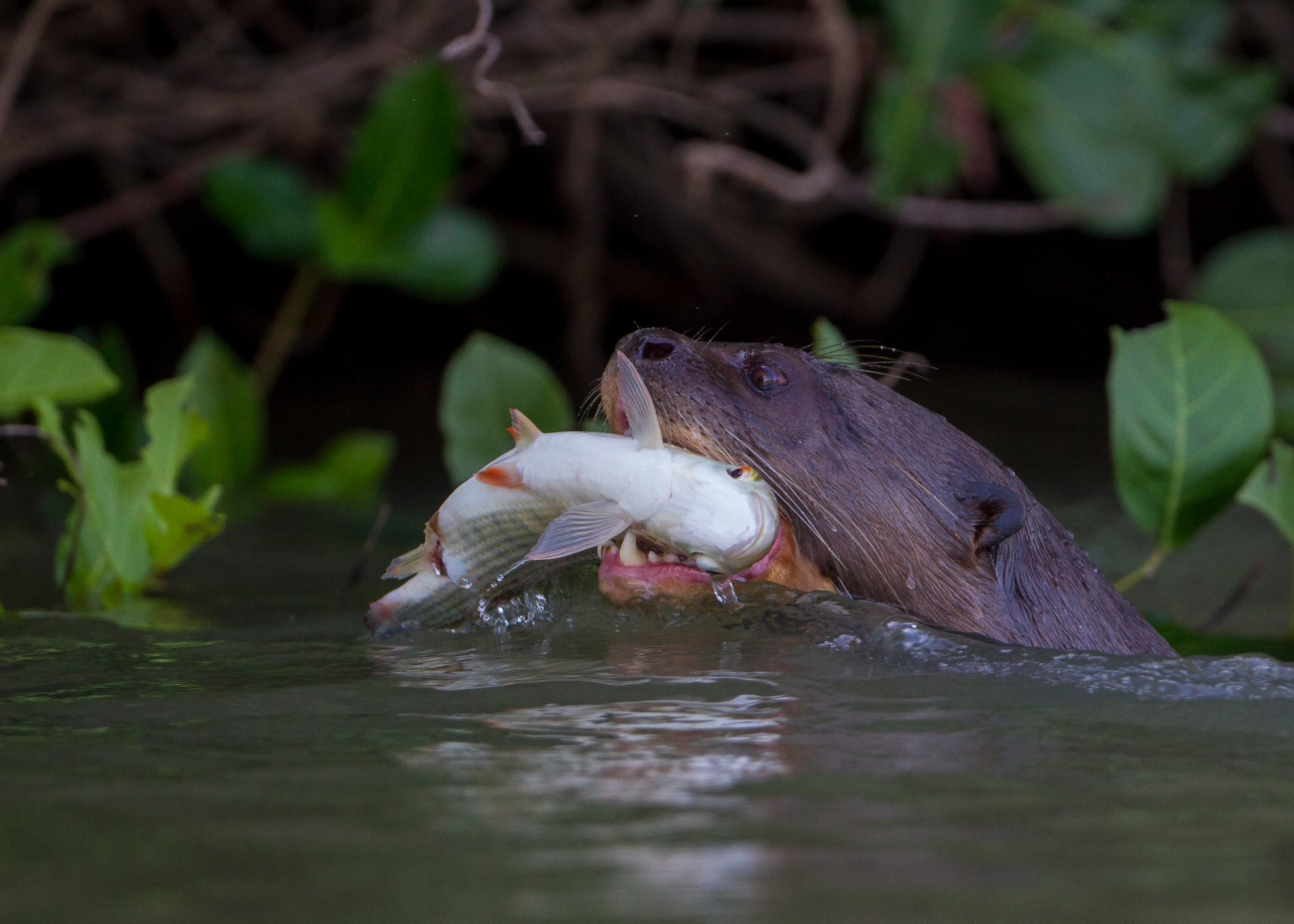
- The giant otter was added to the list of animals needing protection under the UN Convention on Migratory Species, paving the way for international conservation actions.
- Studies reveal that their population decreased by 50% over the past 25 years as their habitat disappears and fragments and growing pollution fouls rivers.
- The new listing should promote cooperation between countries to protect the species as well as Amazon and Pantanal aquatic ecosystems, which are the otter’s strongholds.
With evidence that the giant river otter is in an increasingly perilous state, delegates to the United Nations Convention on the Conservation of Migratory Species (CMS) listed it as an animal requiring urgent conservation action at its March 2026 meeting in Campo Grande, Brazil.
The giant otter (Pteronura brasiliensis), endemic to tropical river systems in South America, once lived east of the Andes mountains from northern Venezuela to Argentina, a territory covering 9,021,590 square kilometers (3,483,255 square miles). The proposal advocating for stronger protection, submitted by France, noted that it was listed as endangered on the IUCN Red List in 2021, though it is extinct in Uruguay and Argentina, is critically endangered in Paraguay and Ecuador and vulnerable in Brazil.
The same document mentions a 50% decline in the giant otter population over the last 25 years. Individuals’ size has also been reduced, indicating a decrease in pups’ survival rates. Using climate projections such as reduced rainfall due to climate change, specialists point out that the downward trend in the species’ population will continue for a few decades.
Illegal hunting for their fur wiped them out in large parts of their range , many populations never recovered, according to a 2025 report published by the Wildlife Conservation Society, a U.S.-based nonprofit.
Although commercial hunting is no longer a serious threat, these otters still face serious challenges. Conflict continues, with local people competing for the fish that otters eat. Their habitat continues to disappear, frequently converted to farmland and cities. Rivers are dammed and mines leak mercury and sediment into waters , rivers are increasingly polluted. Meanwhile, climate change-driven catastrophes, especially extreme drought and wildfire, are hitting hard.
Biologists predict a continued downward trend in otter numbers, which could drop by 50% over the next 25 years without intervention, according to biologist Caroline Leuchtenberger, who coordinates the IUCN Otter Specialist Group and founded the Giant Otter Project.
A video of a giant otter feeding in the Brazilian Pantanal. Video by Sharon Guynup.
The largest otter in the world
The ariranha — as it’s known in Brazil — is the largest of the world’s 13 otter species. Its name comes from the Indigenous Tupi-Guarani word ari’raña, which means “water jaguar.” It once inhabited river basins across South American, but it’s now mostly restricted to the Amazon River and Pantanal wetland biomes.
This territorial, semi-aquatic animal is an athletic swimmer that lives in social groups, anywhere from two to 16 members, and builds its dens on riverbanks. With its sharp claws and teeth, the giant otter is an apex predator that feeds largely on fish. It’s known for its skittish behavior and loud, shrill calls.
As an apex predator, it feeds on fish, and only the jaguar (Panthera onca) sits higher on the food chain. It plays a crucial role in maintaining the balance of the aquatic ecosystems and is an indicator species for environmental health.
“We often say that the giant otter is the sentinel of the rivers, as its presence means that ecosystems are healthy,” Leuchtenberger said.
In the map above, on the left, the historical distribution of the giant otter in South America , in the map on the right, in red, the areas where it’s extinct. Source: “Assessing an aquatic icon: a range-wide priority setting exercise for the giant otter (Pteronura brasiliensis).”
She explained that the species doesn’t undertake a classic migration – that is, moving with the seasons to find food or a mate. However, the extent of its territories along rivers in the Amazon and Pantanal warrants transnational actions, Leuchtenberger said.
When water connections allow, this excellent, acrobatic swimmer and diver easily travels between countries through transboundary rivers. Therefore, loss of connectivity between river basins is a major threat.
Protecting the otter and the waterways it calls home will reverberate throughout its freshwater habitat. “All other species that depend on the integrity of these rivers will benefit from a greater effort towards conservation of giant otters,” Leuchtenberger said.
Harmonious coexistence between humans and giant otter populations is not yet a reality in many parts of the Amazon and the Pantanal, Leuchtenberger said. “The giant otter is not an invisible animal. When it’s around, it’s always noticed,” and its presence isn’t always welcome. Many people still see them as aggressive animals, and fishers have long considered them to be a fierce competitor.
Expanding work with the communities living near the giant otter’s habitat is likely to be one of the main challenges ahead. As part of its conservation initiatives, the Giant Otter Project fosters coexistence through environmental education and follows social media to understand the common sentiment towards the species.
In places like Brazil’s Pantanal, the influx of ecotourism dollars may blunt resentment, as the giant otters are a must-see animal for the mostly international visitors who are drawn by the jaguars (Panthera onca) that are easily visible on riverbanks during the dry season.
A French proposal with wide support
France proposed adding the giant otter to the approximately 1,200 species listed under the Convention because the animals lives in its overseas territory of French Guiana. The proposal was also supported by Brazil, Peru, Bolivia, Panama, Ecuador, Paraguay, the European Union, Senegal and Venezuela, and was approved without opposition.
In all, 40 species or populations of migratory birds, terrestrial animals and aquatic wildlife were added to the list or had protections upgraded. The 47-year-old treaty includes 133 “contacting parties” plus another 28 nations that participate in some way.
Under the Convention on Conservation of Migratory Species framework, a species can be listed on its appendices to initiate coordinated conservation actions. Appendix I covers endangered or critically endangered species that require strong action from member states. Appendix II, in turn, encourages cooperation between countries to adopt joint measures for conservation.
Because of its dangerously threatened status, the giant otter was included on both appendices. The next step will be creating an action plan, coordinated among countries, which must be approved at a future COP. The next meeting is scheduled to take place in Germany in 2029.
“Listing the giant otter on both Appendix I and Appendix II of CMS will send a clear signal that urgent, coordinated international action is needed to conserve this species and the freshwater ecosystems it depends on,” said Susan Lieberman, vice president for international policy at the Wildlife Conservation Society.
The Government of Brazil, as host of this recent meeting, will be responsible for moving implementation of these protections forward.
“We protect species that may never remain within our borders, said João Paulo Capobianco, COP15 chair and executive secretary of Brazil’s Ministry of the Environment and Climate Change. “We invest in a natural heritage we do not own but are all responsible for. In doing so, we give concrete meaning to global solidarity.”
The English version of this story was edited by Sharon Guynup.
Banner image: Giant otter fishing in a river in the Pantanal. Image: © Grégoire Dubois.
Citations:
Rosas Ribeiro, Patricia & Rosas, Fernando & Zuanon, Jansen. (2012). Conflict between Fishermen and Giant Otters Pteronura brasiliensis in Western Brazilian Amazon. Biotropica. 44. 437-444. 10.1111/j.1744-7429.2011.00828.x. DOI:10.5597/lajam00356
Wallace, Robert & Reinaga, Ariel & Ayala, Guido & Bowler, Mark & Buschiazzo, Martin & Martino, Sebastian & Groenendijk, Jessica & Hoops, Hauke & Marmontel, Miriam & Michalski, Fernanda & Mujica, Oscar & Pérez, Karen & Recharte, Maribel & Rheingantz, Marcelo & Trujillo, Fernando & Zapata-Ríos, Galo & Choque, Leydi & Cardona, María & Bentti, Salvador & Zambrana, Veronica. (2025). Identifying spatial conservation priorities for the giant otter (Pteronura brasiliensis). Latin American Journal of Aquatic Mammals. 10.5597/lajam00356. DOI:10.1111/j.1744-7429.2011.00828.x
Wallace, Robert & Reinaga, Ariel & Groenendijk, Jessica & Leuchtenberger, Caroline & Hoops, Hauke & Choque, Leydi & Ayala, Guido & Bowler, Mark & Marmontel, Miriam & Michalski, Fernanda & Mujica, Oscar & Pérez, Karen & Recharte, Maribel & Rheingantz, Marcelo & Roopsind, Indranee & Trujillo, Fernando & Zapata-Ríos, Galo & Pilar, María & Cardona, Becerra & Damme, Paul. (2025). ASSESSING AN AQUATIC ICON: A RANGE WIDE PRIORITY SETTING EXERCISE FOR THE GIANT OTTER (Pteronura brasiliensis). 10.19121/2024.Report.51079. DOI:10.19121/2024.Report.51079
