

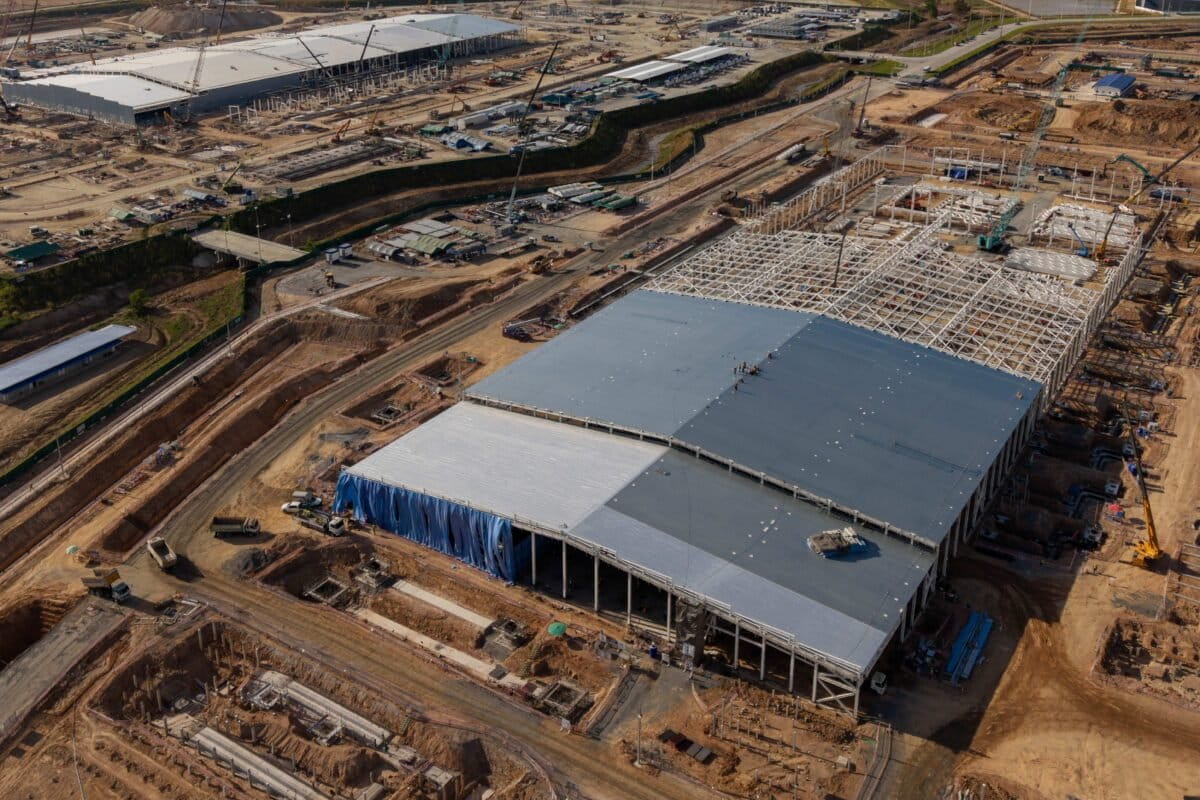
Thailand’s massive surge in data center development is prompting concerns about water shortages and pollution in already stressed regions.
Mongabay’s Gerry Flynn reports that more than 70 data center-related projects are planned or underway, driven by global demand for AI and supported by government tax incentives. These projects are concentrated in the country’s Eastern Economic Corridor (EEC), a special economic zone aimed at expanding the region’s petrochemical, auto and electronics hubs while attracting future tech industries.
Some residents said water scarcity was their primary concern. Data centers require enormous amounts of water for cooling — one planned facility is expected to require 3.3 million cubic meters (116.5 million cubic feet) of water annually, roughly equivalent to the consumption of nearly 37,000 residents, according to Mongabay’s calculations based on a study on water in the EEC area.
Such water demands put tech giants like Google and Microsoft in direct competition with local farmers and fishers who are already struggling with water shortages. Water levels in reservoirs, like Chonburi province’s Khlong Luang reservoir, are already dropping, leading to fears that further industrial development will leave residents without running water.
Beyond water shortages, observers warn of additional hidden environmental costs. Cooling systems often use chemicals, such as chlorine, to prevent bacterial growth, which can contaminate local waterways and harm ecosystems, including crab farms.
Thailand’s electricity grid is heavily dependent on fossil fuels, roughly 85% from gas and coal, so increased electricity demand from data centers risks driving up carbon emissions and air pollution.
Locals and activists interviewed by Mongabay said they were excluded from the decision-making of these projects. Pudit Thamphayun, head of the subdistrict where a 0.2-gigawatt hyperscale facility is being constructed, said there has not been an environmental impact assessment (EIA). “As head of the subdistrict, these things all pass through me — I’ve not seen it,” he said.
Somnuck Jongmeewasin, research director at the NGO EEC Watch said the development of the EEC should have been accompanied by a strategic environmental assessment to account for the broader impacts of such large-scale development programs.
“The EEC policy started in the wrong direction,” Somnuck said, adding that, because there was no strategic environmental assessment, “we don’t even know [whether the resources are available].”
Thailand’s Office of National Water Resources told Mongabay it had “implemented a comprehensive water management strategy to support urban development and industrial growth without compromising the water supply for agriculture or public consumption.”
Sarayuth, a biochemist turned crab farmer, notes that while data centers are “better” than traditional factories, they intensify the struggle for survival for agricultural communities. “You have to understand, this is my home and I’m telling you, it’s already broken,” he said. “It can’t get much worse here.”
Read the full story here.
Banner Image: A data center under construction in Chonburi province, Thailand, that locals say is being built to host Google and TikTok servers, December 2025. Image by Andy Ball for Mongabay.