

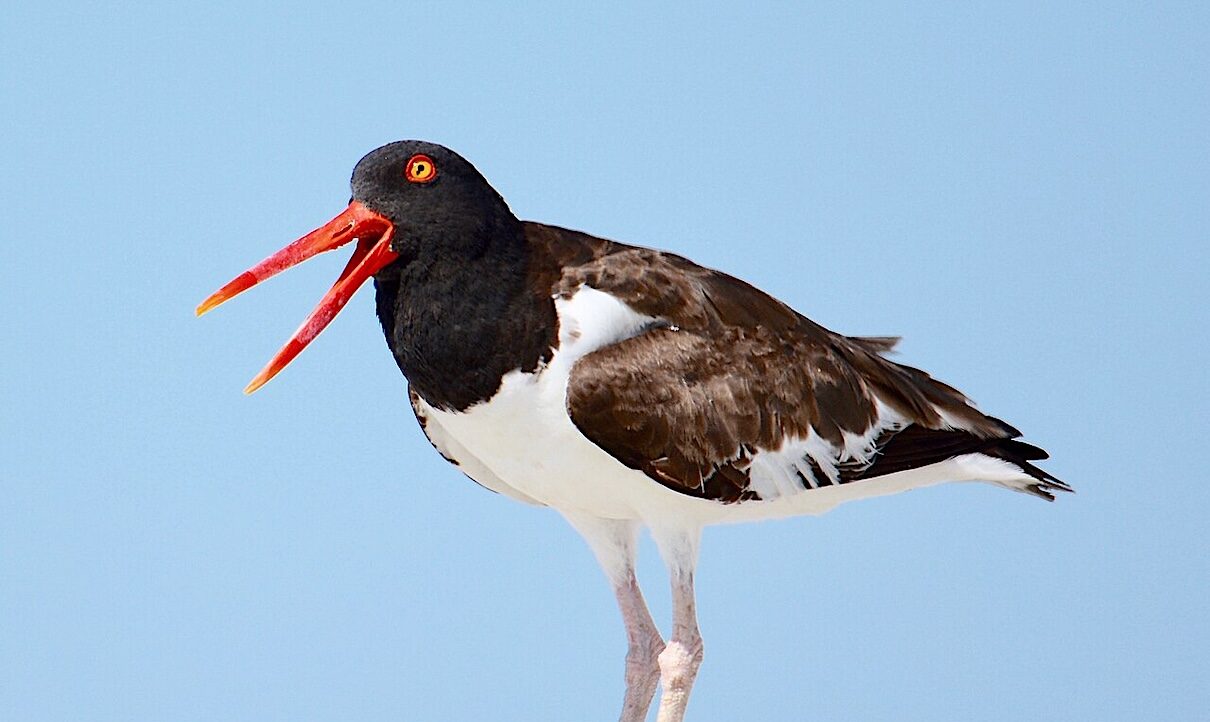
- Birds are struggling, with serious population declines that seem in some cases to be accelerating, which author Scott Weidensaul says in in his new book should serve as a warning that the systems on which they depend – and on which we all depend – are breaking down.
- But birds also serve as a handy, readily apparent barometer for when things are starting to go right, too, he argues, in a new interview at Mongabay.
- The bestselling author centers multiple promising efforts to revive species in “The Return of the Oystercatcher: Saving Birds to Save the Planet,” which W.W. Norton is publishing later this month.
Best-selling author Scott Weidensaul’s new book is a celebration of species recovery efforts led by scientists, conservationists, and Indigenous communities around the world, beginning with the successful rebound of the American oystercatcher (Haematopus palliatus), a large and charismatic shorebird which had been declining for decades, until people made a plan and the birds responded.
But it’s not just a book about oystercatchers, rather, the author centers multiple efforts to revive species in “The Return of the Oystercatcher: Saving Birds to Save the Planet,” across a range of geographies and in his signature style. In it, he travels the U.S. East Coast and Europe, bringing readers stories of hope from Massachusetts to Ukraine.
Mongabay caught up with Weidensaul just weeks before the book’s release on April 21, 2026. His responses have been lightly edited for clarity and brevity.
Mongabay: Your new book is about much more than birds, as you say in the intro, “a world that works for birds will work for all.” Can you explain?
Scott Weidensaul: Birds are at once among the most diverse group of vertebrates on the planet, and arguably the most widely distributed , except for the most remote parts of the central Antarctic plateau, you can’t find a square mile of land or ocean that is not at least seasonally inhabited by birds. Add to that their immense migrations, and you realize that birds are plugged into every ecosystem on Earth.
We know birds are struggling, with serious population declines that seem in some cases to be accelerating, which should serve as a warning that the systems on which they depend – on which we depend – are breaking down. But birds also serve as a handy, readily apparent barometer for when things are starting to go right. So, there’s a lot of enlightened self-interest in working to repair bird populations, because at the end of the day, we’re simply safeguarding our own future along with theirs. And all around the world, in ways large and small, people are turning the dial in the right direction for birds. And for us.
Mongabay: We regularly cover ecosystem restoration, species reintroductions, and other such conservation solutions at Mongabay, is there such a project discussed in your book you’d like to say more about?
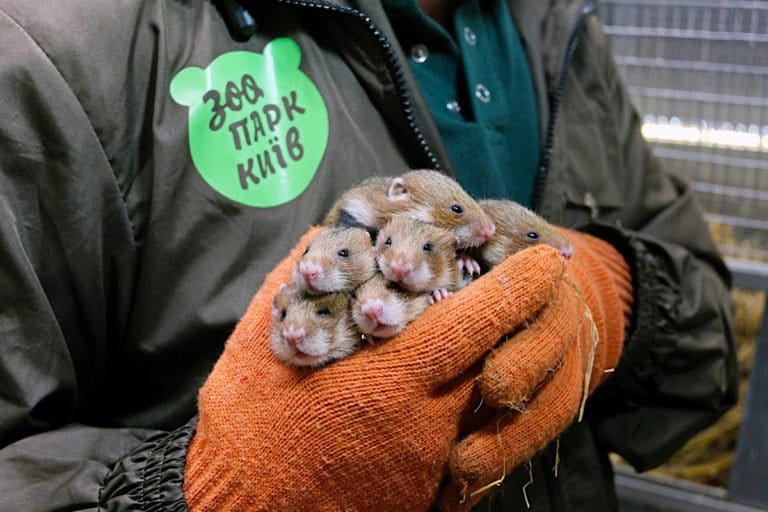
Scott Weidensaul: Doing conservation anywhere is hard work, but I was incredibly impressed with the fact that even in the face of the ongoing war in Ukraine, conservation efforts in the Danube River Delta – the largest wetland in Europe and one of the biggest in the world, shared between Romania, Moldova and Ukraine – is continuing.
While I was not able to visit the Ukrainian side of the border, I spent time in the Romanian portion of the delta, less than a mile across the river from Vylkove, Ukraine, where you can hear the air-raid sirens screaming in the middle of the night. Yet the conservationists from Rewilding Ukraine and Rewilding Romania keep pushing ahead with habitat restoration and the reintroduction of once-lost native species.
Mongabay: So, about the birds at the center of your new book, American oystercatchers, what explains their astounding rebound?
Scott Weidensaul: Shorebirds, as a group, are among the most rapidly declining of North America’s birds, especially those that use the Atlantic Flyway. There are a lot of reasons – human disturbance, habitat loss from development and sea-level rise, legal and illegal hunting on their wintering grounds in the Caribbean and South America, competition for nesting habitat in the Arctic from rapidly growing snow goose populations.
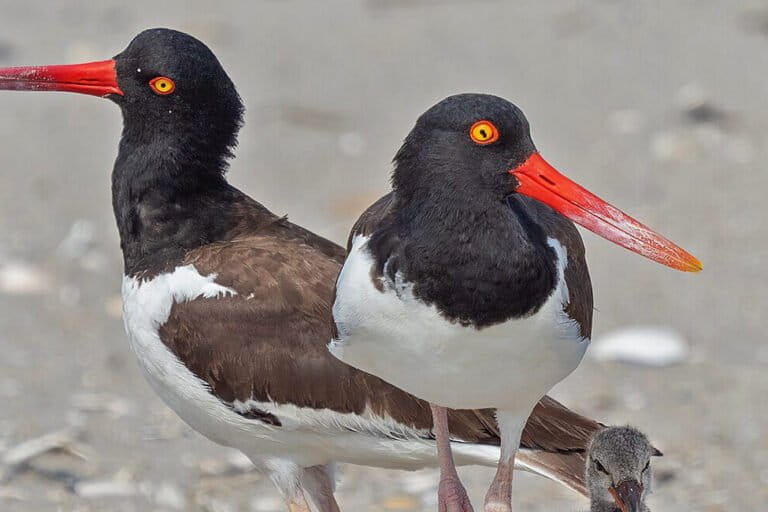
American oystercatchers, which are big, noisy, black-and-white shorebirds with knife-blade beaks the color of a carrot, were similarly declining year after year, decade after decade, despite some scattershot efforts to arrest the fall. But in 2008, scientists working with oystercatchers came together around a business plan for reversing the decline. They realized that if they could increase the productivity of each oystercatcher pair by an average of just half a chick per pair, per year, they could turn it around.
And they did, by reducing beach disturbance, controlling predators like feral cats, free-running dogs and wild mammals like foxes and raccoons that thrive on the trash people leave on the beaches. Instead of a projected further decline of 12% over the following decade, the project worked so well that oystercatcher numbers have increased 45% since 2008.
And even that good news is eclipsed by how well another Atlantic Coast shorebird, the piping plover, has fared. Since gaining federal Endangered Species Act protection in the 1980s – and with a lot of focused conservation effort – their numbers have increased 500% in Massachusetts, which now has 1,200 pairs, and remains the core of their range in the Northeast.
Mongabay: Was there any place you visited in covering topics for the book you’ve never been before that really inspired your thinking, or opened your eyes to something entirely new?
Scott Weidensaul: I think the story that really resonated the most with me, and which I find most inspiring, is the way that Indigenous communities in the boreal forest of Canada are asserting control over the stewardship of their own ancestral lands, in new partnerships with the Canadian and provincial and territorial governments. The scale is simply staggering – by the end of this decade, nearly 1 billion acres of the 1.5 billion acres of the Canadian boreal forest will be in some form of pledged or formalized conservation, almost all of it under Indigenous guidance. That’s obviously a win for social justice, but the boreal forest is also a bird factory of global significance, home to five billion individuals of more than 300 species of birds, many of which migrate there each spring from the tropics to breed.
I spent time seeing all this firsthand in the 6.5-million-acre Thaidene Nëné Indigenous Protected Area (IPA) on Great Slave Lake in the Northwest Territories, where the Łutsël K’é Dené First Nation – after fighting for generations to prevent a national park that would have barred them from hunting and fishing on their own lands – negotiated agreements with Parks Canada and the territorial government to permanently protect the land, under Indigenous supervision.
That, in turn, has helped spark similar IPAs across Canada, like the 12-million-acre Seal River Watershed IPA in northern Manitoba, which when finalized will protect an area the size of Nova Scotia, and one of the most pristine rivers remaining in the North that is home to an incredible density of nesting birds along with bears, wolverines, caribou, moose and many other species. What’s happening in Canada is one of the greatest conservation victories ever, as well as a belated recognition that the people best suited for carrying these landscapes into the future are the ones who, like the birds, have been there since time immemorial.
Mongabay: Your writing is deservedly bestselling and the science it contains is always shared with lyricism and power, to what do you credit your skills in science communication?
Scott Weidensaul: I’ve just always written from the heart. I love what I write about and I try to let the enthusiasm shine through. I was also very fortunate that I had a formative career phase when I was in my twenties, working as a reporter for a small but well-respected newspaper in eastern Pennsylvania, where I learned a lot about telling a story well from wonderful editors. Almost all of them are now gone, but I still hear their voices in my head when I’m writing.
Banner image: An American oystercatcher on the beach in Stone Harbor, New Jersey. Image by Iiii I I I accessed via Wikimedia Commons, Creative Commons Attribution-Share Alike 4.0 International license.
See related coverage:
How Namibia’s bird conservation projects build community resilience (commentary)
Marine flyways are the missing map we can use to boost seabird conservation (commentary)
Helicopter translocation brings isolated banteng to safer grounds in Cambodia
