

Perovskites hold a place of honor in the pantheon of much-heralded clean energy breakthroughs that have yet to actually arrive, alongside small modular nuclear reactors and solid-state batteries. In theory, these crystal structures could radically improve solar panels’ capabilities by absorbing wavelengths of light that conventional silicon cells can’t catch. But the stunning advances in R&D specimens have yet to infiltrate the cold, hard world of commercial solar manufacturing.
Startup Tandem PV is fighting to break that impasse with its new 65,000-square-foot perovskite factory in Fremont, California, the same Bay Area locale Tesla chose for large-scale electric vehicle manufacturing more than a decade ago. In an exclusive first look ahead of the facility’s April 21 grand opening, CEO Scott Wharton showed Canary Media via video chat how the automated factory line pumps out large panels of glass treated with a photovoltaic perovskite coating. Conventional silicon photovoltaic cells convert the sun’s rays to electricity with about 22% efficiency , layering them with Tandem’s perovskite glass in a “solar panel sandwich” lifts that efficiency to 30%, Wharton said.
That’s a huge jump for the solar industry: These paired, or “tandem,” solar plants could produce one-third more energy in the same physical footprint than regular solar panels on the market do today.
Tandem’s perovskite panels, which started rolling off the line in late January, are 60 times larger than what the company’s previous R&D line produced — but still one-quarter the size of large utility-scale solar panels.
“There’s only so much you can learn in the lab — then you have to build big things on bigger tools, otherwise you’re just not going to learn how to do that,” Wharton said. “And that’s the phase where we are at right now.”
To prove that performance, Tandem has agreements to sell panels to what Wharton called “a who’s who” of American solar developers for real-world testing in hot, cold, humid, and dry conditions around the country. Assuming field operations bear out Tandem’s claims of performance, the company expects to produce full-size perovskite panels starting in 2028 at a planned larger factory whose location has not been finalized.
A new kind of factory
Wharton kicked off the tour in the R&D lab, where technicians honed the company’s secret formula of perovskites and other chemicals on glass squares of 10 centimeters by 10 centimeters.
“The reason why we use this size is it’s big enough that it has all the failure modes of a very large panel, but it’s small enough that we can run lots of experiments, and it’s just not as expensive,” he explained.
The wet lab has an uncanny humanoid appearance: a row of beefy arms extends from elevated glass boxes, as if to firmly shake a row of hands. Those “arms” are actually gloves that workers use to slide their hands into the hermetically sealed enclosures to mix chemicals.
Which chemicals? “We don’t really share our formula, but they’re basically off-the-shelf stuff,” Wharton deflected.
The lab workers start by washing the glass for any impurities, and use a slot-die machine — commonly used to apply coatings to windowpanes and tempered glass — to deposit a 1-micron-thick layer of chemicals on the glass. Then, they place the glass in an annealing machine, which Wharton likened to a fancy hot plate, so that the perovskites crystallize properly.
Next door, in the dry lab, workers add additional layers of chemicals to transport electrons and protect the perovskite crystals. They do this through processes known as sputtering, evaporation, and atomic layer deposition. Afterward, they use a laser machine, about the height of an average person, to etch pinstripes in the glass, dividing it into thin strips that each function as cells.
The process differs entirely from silicon solar cell production. For instance, perovskites don’t need threads of silver to conduct electricity , thanks to the physical properties of perovskites themselves, electricity flows freely across their surface. They belong in the same family as thin-film solar, the alternative to conventional silicon that First Solar has been making in the U.S. for years, but few others have succeeded at.
The main event now happens across the hallway, where the pace ramps up considerably.
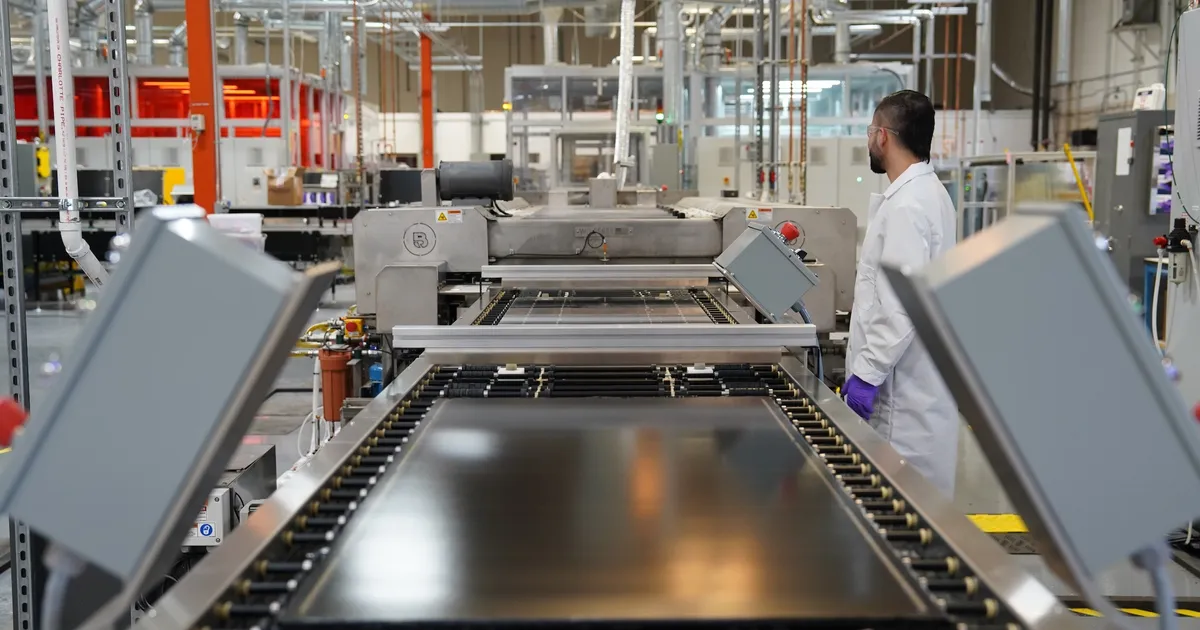
Instead of humans manually mixing the secret recipe ingredients, a series of robots combine the chemicals, wash and coat the much bigger glass panels, and roll them through the stations on an automated conveyor system. This automation not only allows for much faster production, Wharton noted, but also is far more precise than the work of human hands. Because of that, he hopes that the automated line, once fully calibrated, will churn out panels that perform even better than what his team produced in the lab.