

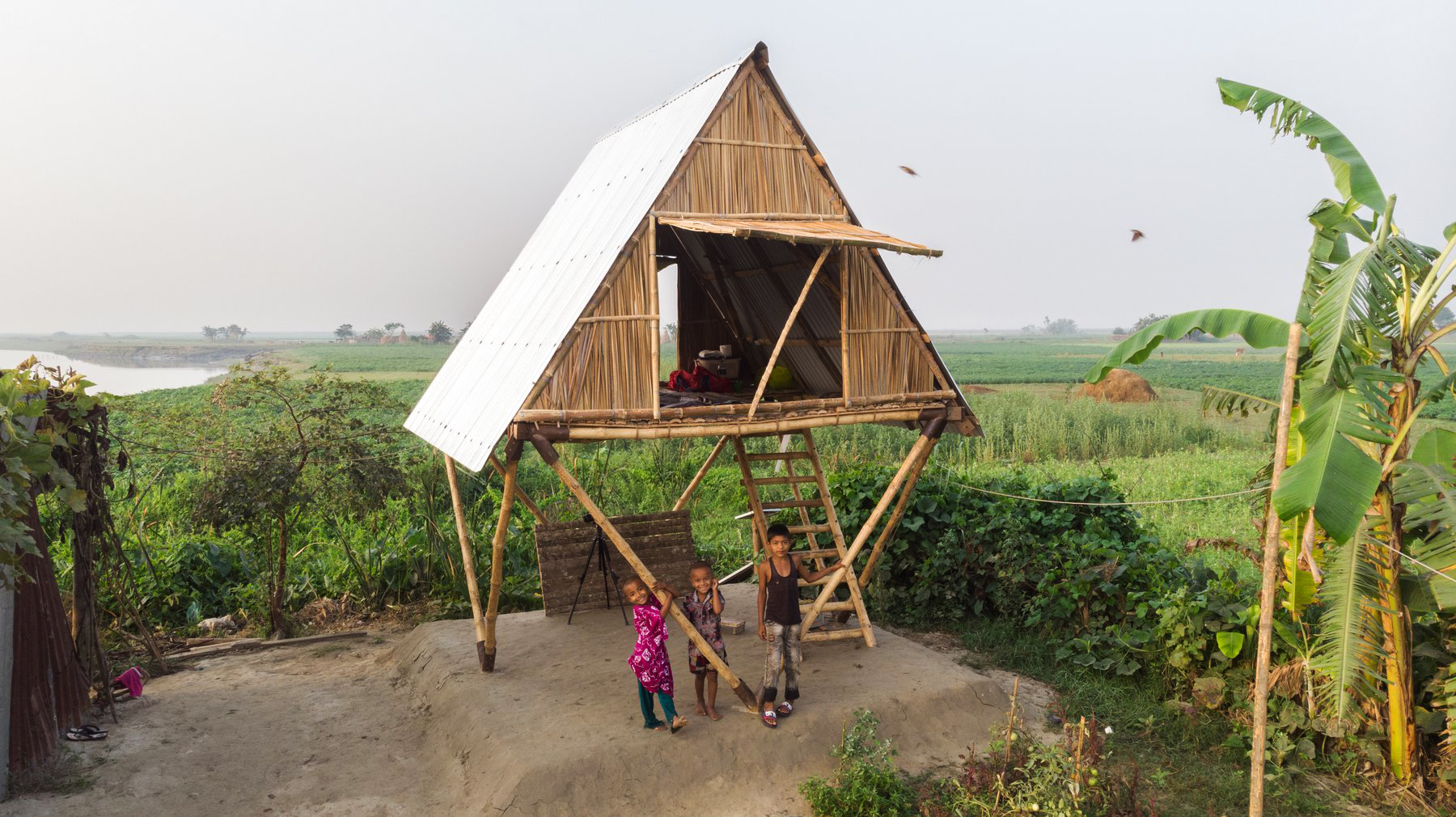
JAMUNA RIVER, Bangladesh — Bulbul has just married and moved into a small village in northeast Bangladesh, a region battered year after year by severe flooding. During the rainy season, water routinely invades homes, wipes out crops, and turns daily life into a struggle for survival. For families like Bulbul’s, rebuilding after each monsoon has become an exhausting cycle.
A group of architects from Dhaka is working with rural communities to break that cycle. Through hands-on workshops, they teach villagers how to build simple, flood-resistant tiny houses that safeguard families and food supplies when waters rise. As Bulbul prepares to build one of these homes, the film follows his transition into married life and a community learning to adapt and endure in the face of climate extremes.
Mongabay’s Video Team wants to cover questions and topics that matter to you. Are there any inspiring people, urgent issues, or local stories that you’d like us to cover? We want to hear from you. Be a part of our reporting process—get in touch with us here!
Banner image: Khudi Bari hause, Bangladesh. ©Asif Salmana.
Notice: Transcripts are machine and human generated and lightly edited for accuracy. They may contain errors.
I’m already nervous. It’s almost monsoon.
The condition of the sky gets very bad.
It looks like it’ll rain for sure.
I can buy seven or eight times more land here
because the land price is very low in char areas.
During the flood,
water enters our house.
Sometimes it comes up to our waist.
Last year, we faced a flood
and a khudi bari owner told me
“Son, if you have water in your house,
come and live with us.”
Now I’m getting a khudi bari.
I’m building my own house,
with my hard work,
without begging anyone.
Our idea was that
we want to transfer the knowledge
to local people.
So that they don’t need us anymore.
They can build it themselves.
From the very beginning when I started practicing,
one idea was how can I
create an architecture
which responds to the climate where I live.
Every season there is river erosion
because the river’s topography
it is constantly changing.
That’s why river erosion occurs
and farmers have to relocate.
Khudi baris offer two advantages.
During floods it can play a vital role.
During river erosion
it can be relocated easily.
They dismantle or move the house
when the chars or the sand beds are moving.
The more we speak with them
and get closer to them,
the better we understand them
and fulfill their needs.
In this char we stayed for almost six to seven months.
In this char of Jamalpur, we’ve built 18 houses.
That was in 2022.
Now five new houses are being built.
Villagers are building it themselves.
We are here just providing some materials.
The carpenter showed us, and we learned.
Now we can do it ourselves.
We had to buy the wood and bamboo
from the other side of the river.
It will take 14 or 15 days at best.
Within this month, the flood will be here.
We’re trying our best to finish it before the flood comes.
I feel great about this.