

” data-medium-file=”https://www.pv-magazine.com/wp-content/uploads/2026/04/1-s2.0-S019689042600350X-gr5-600×245.jpg” data-large-file=”https://climatevdo.com/wp-content/uploads/2026/04/The-Hydrogen-Stream-Levelized-cost-of-hydrogen-at-Mediterranean-ports.jpg” tabindex=”0″ role=”button”/>
PV capacity factor for the analyzed Mediterranean ports
Image: Energy Conversion and Management/ CC BY 4.0
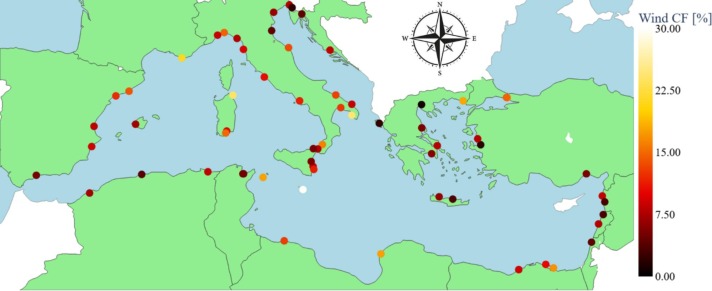
A group of researchers from the University of Naples Federico II in Italy has found that the levelised cost of hydrogen (LCOH) for the fuel being produced at Mediterranean ports could range from €5.7-8.6 ($6.5-10.1)/kg in fully renewable configurations to €2.5-13/kg in hybrid systems, depending on grid electricity prices and emission intensities. “Solar energy emerges as the most consistent resource, with capacity factors ranging from approximately 18% to 24%, while wind energy can outperform solar in specific locations, reaching values close to 30%,” said the researchers. The study is structured into three phases, starting with the collection and processing of geographic, infrastructural, and meteorological data for ports worldwide. Ports are characterised using GIS data, including location, logistics, economic relevance, and renewable resource availability such as solar, wind, and wave energy. Weather datasets like ERA5 and CMEMS are used to generate location-specific renewable energy profiles. In the second phase, energy production from photovoltaic systems, wind turbines, and wave energy converters is modelled based on local conditions. The generated electricity powers electrolysers for hydrogen production, supported by battery storage systems to manage fluctuations. Two operational strategies are considered: fully renewable-based hydrogen production and grid-supported fixed-load electrolysis. The third phase evaluates techno-economic and environmental performance using indicators like levelised cost and emissions of hydrogen. The results show that renewable energy performance varies significantly across Mediterranean ports, with solar energy consistently reliable while wind and wave are more location-dependent. Capacity factors reveal that solar exceeds 15% everywhere, whereas wind and especially wave can be very low, limiting their feasibility. Solar energy is the most consistently viable source across Mediterranean ports, with capacity factors ranging 18.1% – 24.4%,” the scientists said. “Wind energy can outperform solar in specific locations but is highly site-dependent.” Their findings are available in the study “The role of Mediterranean ports in the energy transition: assessment of hydrogen production potential,” published in Energy Conversion and Management.
This content is protected by copyright and may not be reused. If you want to cooperate with us and would like to reuse some of our content, please contact: editors@pv-magazine.com.
Popular content