

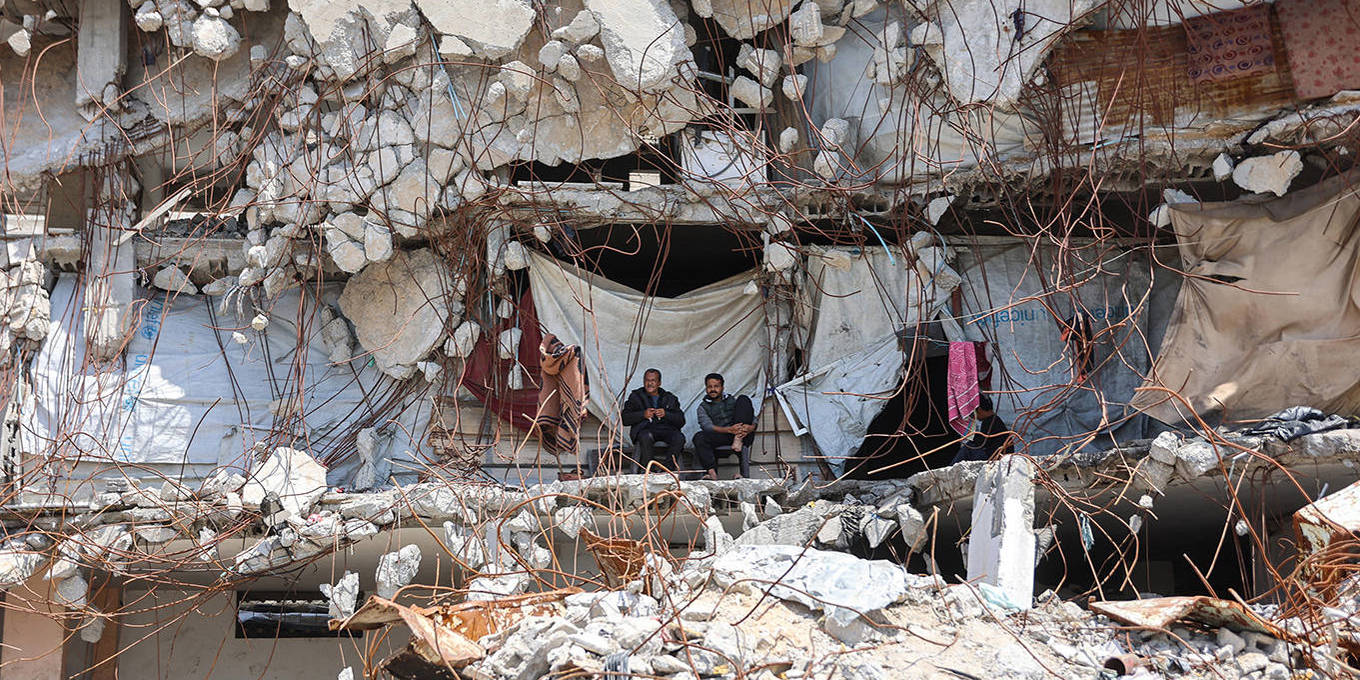
Violent conflicts have reached levels not seen since World War II, even as global poverty has fallen to historic lows, challenging long-held assumptions about the relationship between development and peace. This outcome calls for a reassessment of the theory of change that underpins development aid.
BRAZZAVILLE—In 1949, US President Harry S. Truman laid out a bold vision that would shape global policy for generations. Poverty, he argued, was not merely a humanitarian concern but a threat to peace itself, and development was the remedy.
The logic was compelling in its simplicity: raise living standards, and the risk of conflict would diminish. Over the years, the linear model that cast development as the pathway to stability became the intellectual foundation of international aid.
Today, however, the world looks very different. Violent conflict has reached levels not seen since World War II, even as extreme poverty has fallen to historic lows. Taken together, these trends suggest it is time to reassess the linear development model and its underlying logic.
Conventional wisdom, as articulated in the United Nations 2030 Agenda, holds that conflict undermines development, while poverty and inequality fuel conflict. This framing implies that progress on one front reinforces the other, enabling policymakers to present development aid as both a moral imperative and a strategic investment that promotes a virtuous cycle of prosperity and peace.
But that view has always rested more on assumption than evidence. While a growing body of empirical research has documented the devastating effects of conflict on economic output, human capital, and institutional capacity, the link between development and peace has proven far harder to establish.
How strong is the causal relationship between development and geopolitical stability? My recent research offers a sobering answer and reveals a striking asymmetry. When conflict erupts, its effects on development are profound and long-lasting. The average time it takes for the damage to diminish by half—what economists call its “half-life”—is nearly eight years.
By contrast, development’s pacifying effects are fleeting. Across multiple dimensions, the impact of improved development outcomes on conflict has a half-life of roughly 13 months. Within two years, any measurable reduction in conflict intensity has effectively disappeared.
This asymmetry reflects the scale of the damage armed conflicts cause. War does not simply disrupt livelihoods and public services , it wipes out assets that took generations to build: physical infrastructure, human capital, functioning institutions, and the basic social trust that makes collective action possible. Development interventions work differently. Cash transfers, clinics, and irrigation systems can improve lives and ease grievances, but they rarely transform the underlying political conditions that sustain violence, let alone on a global scale.
The policy implications are far-reaching. If development yields only short-lived reductions in violence, then the case for development aid as a tool of conflict prevention is weaker than often assumed. That is an uncomfortable conclusion for institutions that have long justified aid budgets on security grounds.
To be sure, the argument that investing in development today helps avoid the far higher costs of war tomorrow is not entirely wrong. There is evidence that aid to conflict-affected areas can reduce violence, though the effects are often modest and not always statistically robust. But while development spending is justified on humanitarian and ethical grounds, regardless of the strategic implications, the evidence does not support the claim that sustained investment can reliably prevent or resolve armed conflicts.
What the evidence does show is the inverse: sustainable development depends on peace to a far greater extent than the Truman-era paradigm recognized. Preventing conflict yields enormous development gains, as each year without war preserves years of progress that would otherwise be lost. Investments in conflict prevention—including political settlements, power-sharing arrangements, and credible peace processes—are not substitutes for development spending but rather preconditions for it.
Consequently, we must rethink the theory of change that currently underpins development economics. In developing countries plagued by distrust, poor services, and recurring violence, political stability and state legitimacy must come first. Only after that foundation is in place can institutional reform and sustained development spending deliver tangible results.
None of this is meant to suggest that Truman was wrong to argue that poverty poses a threat to global peace. But the causal pathway is more complex, asymmetric, and contingent than the prevailing linear model assumed. While development can help sustain peace, it is far less effective at creating it.
Recognizing this distinction obviously does not mean abandoning the pursuit of development. Rather, it calls for an honest reckoning with the limitations of the current model and to lay the groundwork for a more realistic and effective approach to development policy.