

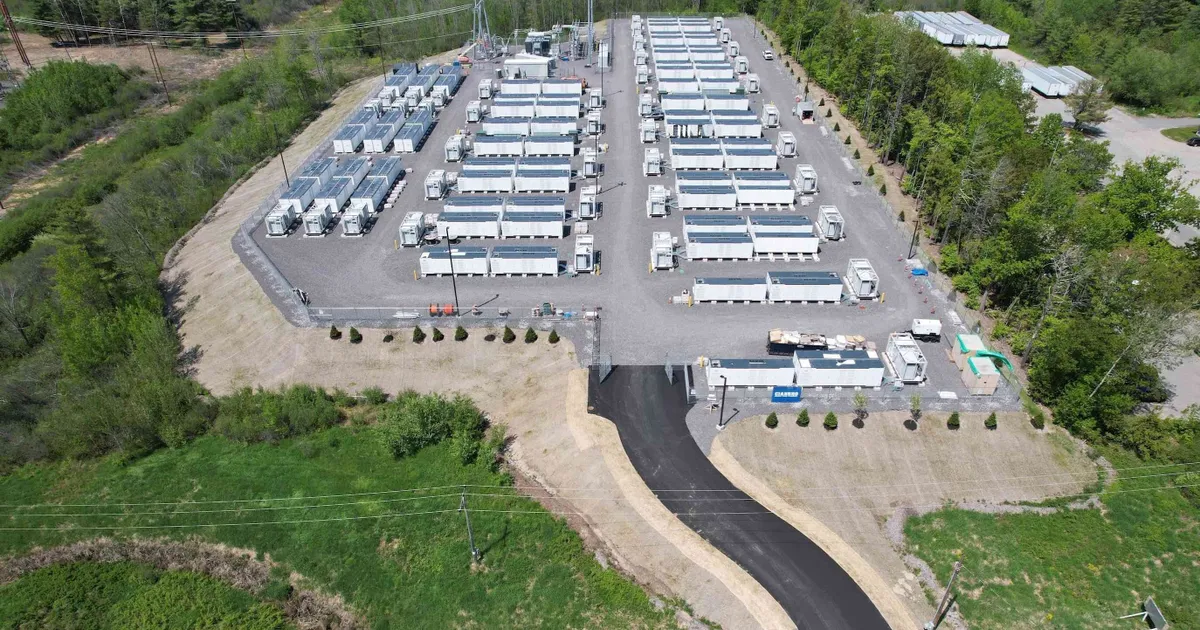
A massive new battery has entered service in southern Maine, providing a much-needed boost to the Northeast’s efforts to expand clean and affordable energy.
Developer Plus Power wrapped up its Cross Town Energy Storage project in late November, but publicly inaugurated it last week in a ceremony featuring Gov. Janet Mills, a Democrat, who has championed clean energy for the state and is currently running for Senate. Now, the small town of Gorham, nine miles inland from Portland, hosts a battery plant capable of injecting 175 megawatts for up to two hours, a bigger capacity than any other battery in New England.
“During Winter Storm Fern, we were 100% available and ready to contribute capacity with no emissions,” said Polly Shaw, chief external relations officer at Plus Power. “With a response capability of 250 milliseconds, there’s no faster asset that New England can rely on to help when they need capacity or grid services.”
New England states have issued a raft of energy storage targets in recent years, meant to complement their bevy of commitments to grid decarbonization. By 2030, Massachusetts aims to have 5 gigawatts, Connecticut 1 gigawatt, and Maine 400 megawatts. So far, however, it’s been slow going, even as storage has taken off in states like California and Texas. New England has managed to build just two battery installations with more than 100 megawatts: Plus Power’s Cross Town and its 150-megawatt Cranberry Point Energy Storage project, which came online in Massachusetts in June.
Plus Power has distinguished itself by entering into markets before they become saturated. For these two projects, the company won seven-year contracts in a 2021 forward capacity auction for the Independent System Operator New England, which runs wholesale power markets for the region’s six states. ISO-NE subsequently switched its capacity auctions to one-year awards — a move that complicates storage development in the region, as short-term contracts make it harder to attract project financing.
As it stands, Plus Power can claim the federal investment tax credit for 30% of the cost of the storage plant. Then it can earn revenue from the capacity contract and by bidding ancillary services in the wholesale market. Batteries can also arbitrage energy by buying when it’s cheap (typically when there’s an influx of renewable production) and selling when it’s expensive (typically when there’s increased reliance on gas-burning peaker plants).