


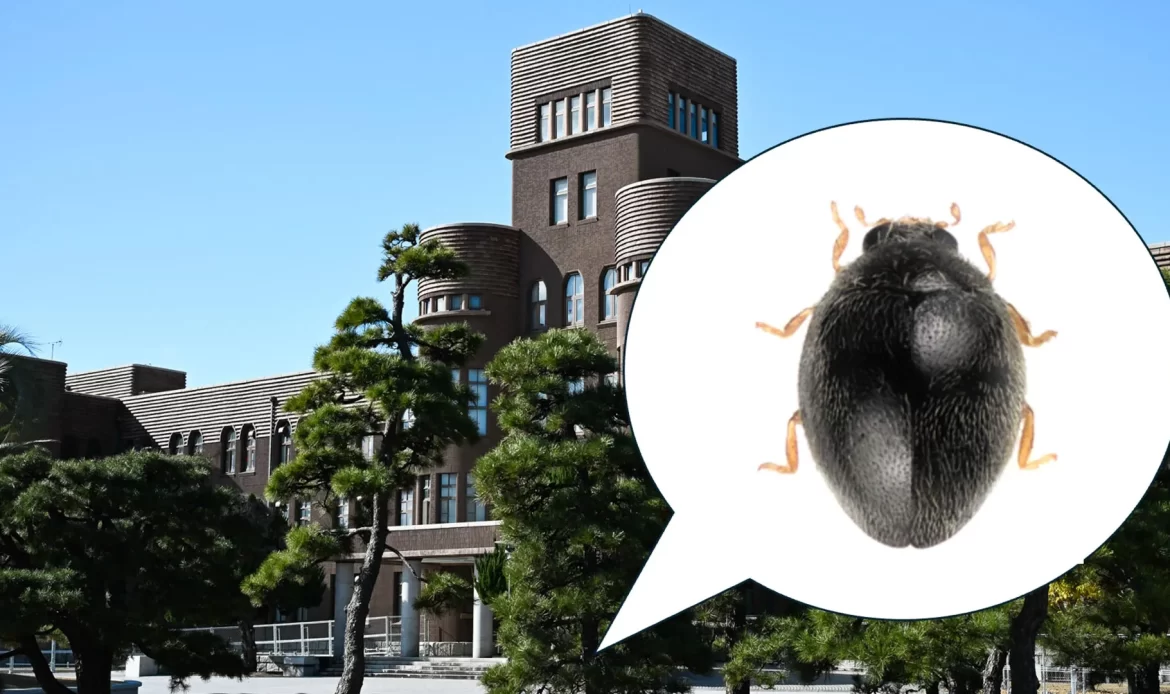
Scientists often travel to remote forests, mountains, and islands in search of undiscovered species. But in a surprising twist, researchers at Kyushu University found a previously unknown ladybird beetle living on a pine tree right on their own campus.
The newly identified species, named Parastethorus pinicola, was discovered at Kyushu University’s Hakozaki Satellite. The finding was reported in Acta Entomologica Musei Nationalis Pragae and emerged from a three-year project examining the classification of Stethorini, a group of tiny ladybird beetles that feed on spider mites. The study marks the first major review of this group in Japan in more than 50 years.
New Beetle Species Found on Campus
“I knew that this group of ladybirds often inhabits pine trees. Since there are Japanese black pines growing at the Hakozaki Satellite, I decided to look there, and that is where I found the new species,” explains Ryōta Seki, a PhD student at the Entomological Laboratory, Graduate School of Bioresource and Bioenvironment Sciences, and the first author of the study. “Normally, insect collectors do not pay much attention to pine trees, which is perhaps why scientists have overlooked this species for so long.”
The newly discovered insect is a tiny black beetle measuring just over one millimeter long. Its scientific name, Parastethorus pinicola, means “pine dweller,” reflecting the habitat where it was found.
Why These Tiny Ladybirds Are Hard to Identify
According to Seki, these insects have remained poorly studied because distinguishing one species from another is extremely challenging.
“Small black ladybirds like these have not been studied much because they are incredibly difficult to identify,” says Seki. “They are barely larger than a grain of sand, and they all look identical. You cannot tell the species apart without dissecting them and examining their reproductive organs under a microscope. Because of this difficulty, there were many misidentifications in past records.”
To clear up long-standing confusion, the research team carefully examined about 1,700 specimens. Their investigation revealed that the species commonly referred to in Japan as Stethorus japonicus is actually the same species as Stethorus siphonulus, which is found across a wide geographic range stretching from China to Southeast Asia.
Second New Species Discovered
The review produced another surprise. Researchers also identified a second previously unknown species from Hokkaido, which they named Stethorus takakoae.
Seki chose the name in honor of his grandmother, Takako Ōtsuki, recognizing the encouragement and support she has given him throughout his interest in entomology since childhood.
“Standardizing these names is important because it allows us to share data and research with other countries in Asia,” Seki notes. “It clarifies that this is a widespread species found from the tropics to temperate Japan.”
Hidden Biodiversity in Everyday Places
For Associate Professor Munetoshi Maruyama of the Kyushu University Museum, who supervised the project, the discovery serves as a reminder that much of nature remains unnoticed, even in familiar surroundings.
“People rarely notice such small insects. But as our study showed, even in a city or on a university campus, there are unknown species living right beside us,” says Maruyama. “These ‘minor’ insects support our ecosystems. I hope this discovery makes people interested in the diverse and fascinating world that exists unnoticed at our feet.”