

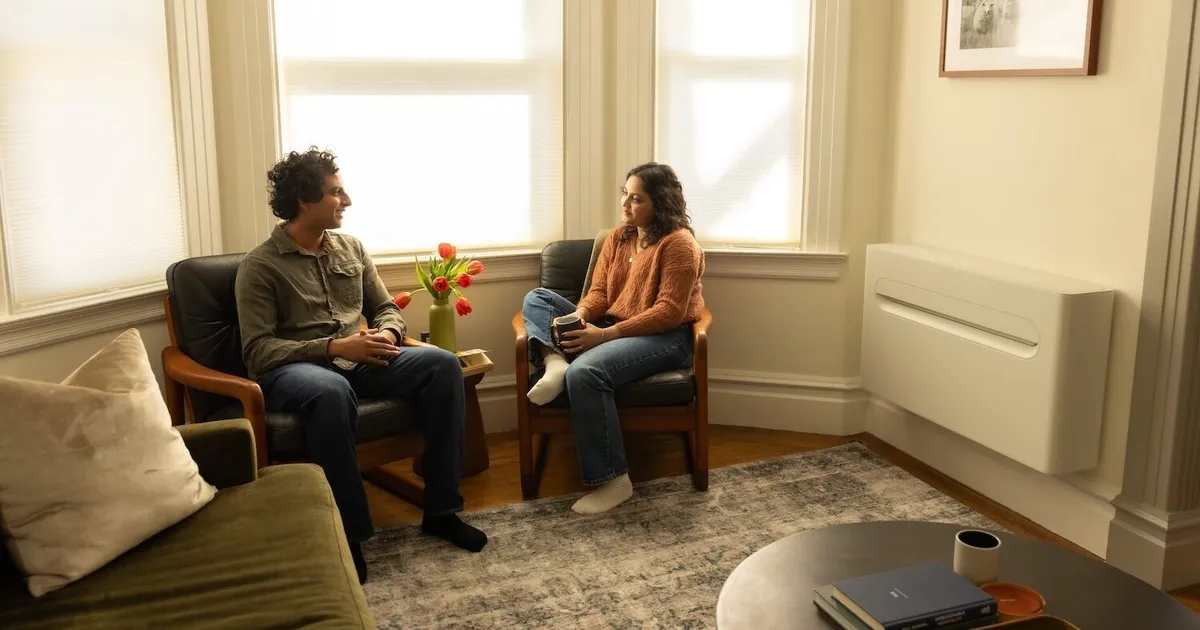
If the U.S. is going to decarbonize, tens of millions of homes across the nation will need to make the switch from fossil fuel furnaces and boilers to all-electric heat pumps. California alone has set a goal to deploy 6 million of the superefficient appliances by 2030.
But such retrofits can be complicated to navigate and cost thousands of dollars more than purchasing new fossil fuel equipment.
That has some companies looking to design heat pumps that are easier and cheaper to install. Today, one of those firms, San Francisco–based Merino Energy, announced the launch of its flagship product, the Merino Mono.
The Merino heat pump is a single-room system, as opposed to the popular ducted and ductless whole-home systems. A key feature is that, unlike whole-home heat pumps, the Mono doesn’t require a large outdoor unit to move heat into or out of living spaces. Instead, it’s installed through the exterior of a building, and the portion that would normally live outdoors is tucked into the unit itself.
Merino is offering its heat pumps for a flat rate of $3,800, which — unusually — includes the cost of professional installation. A certified contractor can get the system up and running in under an hour, according to the company.
“The price tag to do regular ductless is just way too high. This really drops the cost,” said Owen Krebs Grimsich, founder and CEO of 1–888-Heat-Pumps, an installation partner with Merino Energy.
Krebs Grimsich’s company will soon deploy Merino heat pumps at a 10-unit building. “If we were to have done ductless, we would have had to open up a whole bunch of walls and put these outdoor units in really funky places. And then we would’ve had to run the electrical in really weird ways, because you have to connect the indoor and outdoor units,” he said. But with the Merino heat pumps, “it just immediately became a very quick and easy project.”
The Mono was born of necessity, said Merino co-founder and CEO Mary-Ann Rau.
In 2023, Rau, a former firmware engineer at tech giant Apple and ductless heat-pump startup Quilt, tried to get a heat pump system installed at her 1906 Victorian home in San Francisco’s Bernal Heights neighborhood. But the complex job was quoted at $40,000. She couldn’t justify that price point, she said.
Soon after, Rau met up for coffee with her neighbor Brad Hall, a former hardware designer at financial platform Square and director of mechanical engineering at window heat-pump startup Gradient. His path to heat-pump ownership had dead-ended, too, thanks to high upfront costs and space constraints. So Rau and Hall decided to found Merino Energy in 2024 to create the product they both wanted.
Fast-forward to today. Each co-founder has at least one prototype Merino heat pump at home.
“We both are living on the product, which is how we know that it solves our pain points and validates that it can solve a lot of other homeowners’ pain points as well,” Rau said. She added that covering the majority of her home with the Mono would come out to less than half the $40,000 she was quoted for a ductless system.
The co-founders were largely inspired by an existing heat-pump design: packaged terminal heat pumps, Rau said. Commonly found in hotels and hospitals, these units combine all components in one container installed through a building’s wall.
Although this type of heat pump can cost less than $1,000 and is relatively simple to use in new construction, putting it in existing buildings typically requires cutting through load-bearing studs, Rau said. Contractors have to take special care to structurally reinforce the compromised wall, adding cost and complexity.