
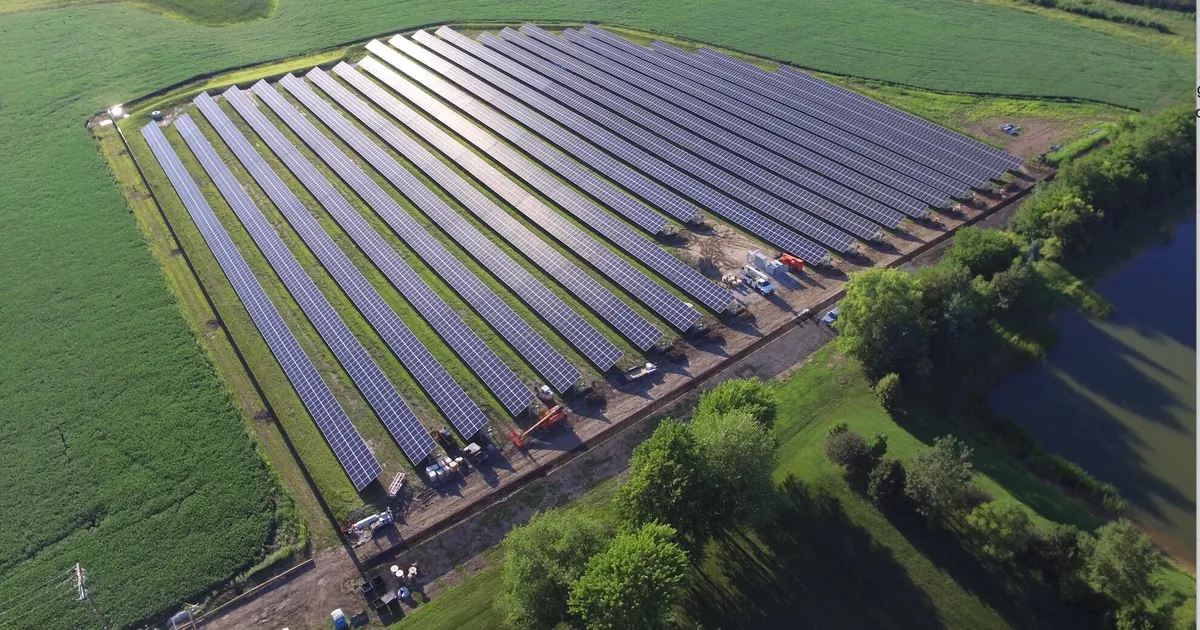
In western Illinois, ComEd is tapping a rarely used technique to fast-track community solar installations — working with, not against, environmental groups and solar project developers.
For years, utilities have explored the concept of flexible interconnection, in which solar projects are allowed to come online even when, by the books, there’s not enough space on the grid for these arrays. In return, these solar farms must promise to curtail output during the handful of hours each year when their production would overwhelm power lines and substations.
Flexible interconnection is a speedy way to get cheap new solar online without requiring utilities to spend even more on costly grid upgrades, which are a key driver of the nation’s fast-rising utility bills.
Since then, the utility has fast-tracked more than 50 megawatts of community solar projects using flexible interconnection, and more are likely to be approved before federal tax credits sunset in July.
That’s much faster than utilities in other states have been able to move on flexible interconnection, said Samantha Weaver, senior director of interconnection and grid integration policy at the Coalition for Community Solar Access, a trade group representing community solar developers. In fact, ComEd is “leading the country right now,” she said.
ComEd plans to accelerate that work, said Jessie Bauer, the utility’s senior manager of smart grid and innovation. “Our plan was to do 50 megawatts a year, and we’re hitting that cadence,” he said. “We’re proposing in our grid plan to go even faster, and do 100 megawatts a year, and get to 650 megawatts by 2031.”
ComEd was able to succeed where other utilities haven’t thanks to a nudge from regulators that spurred it to collaborate with solar developers and environmental groups.
Historically, utilities and solar developers have struggled to establish the basic mutual trust required to move a flexible interconnection program forward, Weaver said. Utilities are often skeptical that solar farms will reliably cut back as promised during those key hours of potential grid overload. Meanwhile, solar developers suspect utilities will force them offline more than is absolutely necessary.
Illinois’ flexible interconnection process didn’t go that way.
Instead, in 2024 ComEd collaborated with environmental groups represented by the consultancy Eclipse on a flexible interconnection plan. Then, the utility worked out mutually agreeable solutions with those groups, solar developers, and the nonprofit collaborative the Charged Initiative, in a series of workshops that resulted in a program design that gave each side enough of what they needed to move ahead.
Both the utility and solar developers had to make some compromises, Weaver said. But that effort bore its first fruit last November, when 27 megawatts of community solar was green-lit in a region where it would have been excluded by traditional processes. Another 25 megawatts of projects were approved in February.
This coordinated approach is now gaining some momentum in Maryland, Massachusetts, New York, and other states where community solar is struggling, said Nikhil Balakumar, Eclipse’s CEO and founder.
“Now, more than ever, especially in this climate, we need unprecedented collaboration,” Balakumar said. We can’t just slog it out and fight and litigate every little thing till the end of time. There has to be a new way forward.”
How ComEd’s flexible interconnection came to be
ComEd’s push into flexible interconnection was less a choice than a necessity.
Since 2016, Illinois has created and expanded programs that offer lucrative incentives to build community solar projects, which are generally limited to no larger than 5 megawatts. Households can subscribe directly to these projects, which often allow them to lock in cheaper, cleaner energy. The state’s programs are explicitly meant to reduce utility rates for low-income customers.
In Illinois, developers have flooded into the programs over the years, snapping up the most suitable land for community solar arrays.
This posed a problem for ComEd: Everyone wanted to build their solar arrays in the same relatively concentrated geographic area — the rural western reaches of its territory — where there simply wasn’t enough space on the grid.
“We quickly saw all that grid capacity evaporate with the community solar being connected,” Bauer said.
In a situation like this, the standard utility playbook is to require community solar developers to shell out for grid improvements. In western Illinois, that would mean multimillion-dollar system upgrades, he said — a cost that few solar developers can afford.
However, the grid actually does have the space to accommodate those solar farms — at least, most of the time.
Distribution grids are built to serve the times when electricity demand is at its highest. These peaks in demand are relatively rare, happening only during a handful of hours per day, or days per year. That means for the vast majority of the year, there’s unused capacity sitting there.
Flexible interconnection takes advantage of this fact — and helps developers and consumers avoid exorbitant grid upgrade costs as a result.
“If you can give up some of your energy during times of system constraints, you can interconnect much more affordably,” Bauer said.
But this is easier said than done. Utilities can’t perfectly predict how often demand will peak. They need flexibility to handle unexpected changes and respond to emergencies. A major storm or flood could knock out an entire substation for months, leaving other parts of the grid straining to supply power until it’s repaired.
That uncertainty constrains utilities from setting guaranteed limits on how often they’ll ask solar projects to curtail their generation. But for solar developers, “projects aren’t financeable if curtailment is unpredictable,” Weaver said. “We need certain details to be able to literally take to the bank.”
To resolve this conundrum, ComEd and solar developers collaborated on a compromise.