


The International Court of Justice, the world’s top court, ruled last year that government actions driving climate change are illegal and that states are required under international laws to reduce emissions, prevent harm, and collaborate to safeguard vulnerable populations.
—
The United Nations General Assembly on Thursday adopted a long-sought resolution validating a landmark 2025 ruling by the International Court of Justice (ICJ) on the obligations of states in respect of climate change.
The resolution, drawn up by the Pacific island nation of Vanuatu and several other countries, was adopted with 141 votes in favour, eight against and 28 abstentions. The United States was among the countries voting against it, alongside petrostates Saudi Arabia, Russia and Iran as well as Yemen, Israel, Belarus, and Liberia.
The ICJ, the world’s top court, delivered a historic advisory opinion on countries’ legal responsibilities regarding climate change. It ruled that government actions driving climate change are illegal and that states are required under international laws to reduce emissions, prevent harm, and collaborate to safeguard vulnerable populations. It also stressed that these obligations encompass the full range of activities resulting in greenhouse gas emissions, from fossil fuel usage to extraction, subsidies and regulatory oversight.
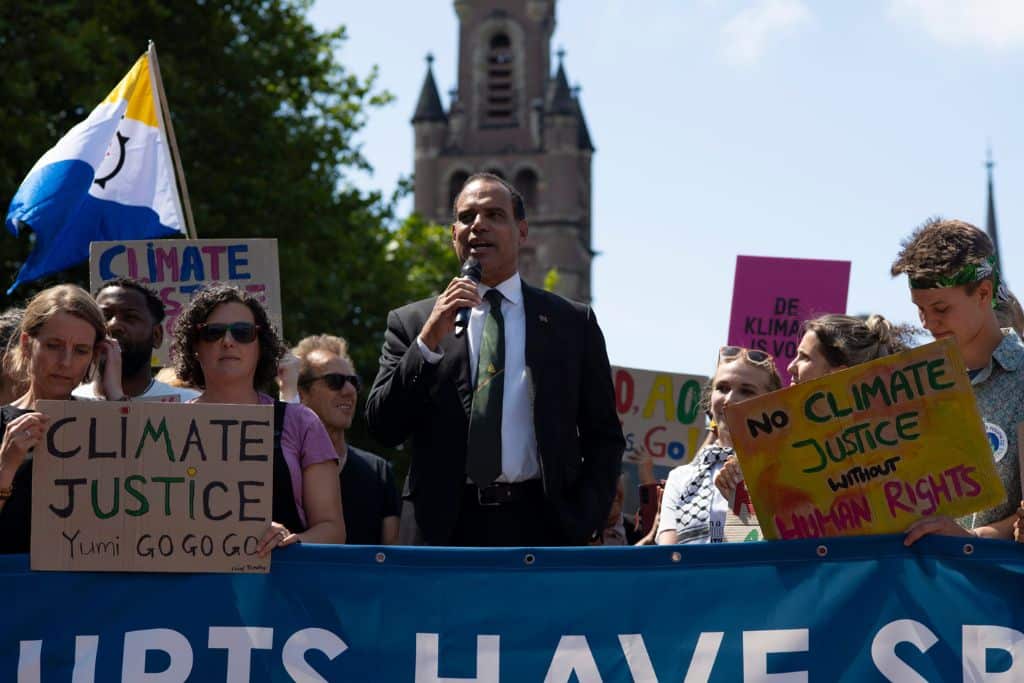
The resolution endorses and seeks to operationalize the court’s opinion, reaffirming binding legal obligations for climate cooperation among states and calling on all UN member states to comply with their respective obligations under international law and to take all possible steps to avoid causing significant damage to the climate and environment, including through transboundary emissions. It also calls on them to follow through on their existing climate pledges under the Paris Agreement, which binds countries to hold global temperature increases to “well below 2C” above pre-industrial levels, while pursuing efforts to limit the temperature increase to 1.5C.
In its ruling, the ICJ affirmed the 1.5C target to be the only relevant limit and recognized that the climate treaty establishes “stringent” mitigation obligations for states to protect the climate and other parts of the environment from anthropogenic greenhouse gas emissions.
It also dismissed an argument put forward by big polluters that national climate action plans submitted under the Paris Agreement, known as Nationally Determined Contributions (NDCs), are discretionary. Instead, the court affirmed that NDCs – which states are required to update every five years – must collectively be capable of realizing the objectives of the agreement.
Read more on the topic: World’s Top Court Lays Out Historic Protections For Climate-Impacted Nations in Landmark Ruling
Young activists from various climate change-battered Pacific Island nations organized under the Pacific Island Students Fighting Climate Change (PISFCC) and seeking climate justice and legal pathways to hold big polluters accountable for their actions were behind the initial, years-long global campaign for an advisory opinion on the responsibilities of states in relation to climate change. The same activists, with the support of Vanuatu, spent the past year campaigning for Thursday’s resolution.
The Pacific Islands are at the forefront of climate change, despite being responsible for less than 1% of total global greenhouse gas emissions. In its 2018 report, the Intergovernmental Panel on Climate Change confirmed that unless drastic action is taken globally to reduce greenhouse gas emissions, Pacific Island nations will cease to exist, threatened by a triple whammy of accelerating sea level rise, ocean warming and acidification.
Grounded in binding international law, the opinion sparked a chain reaction that accelerated climate litigation on a global scale, with judges beginning to reference it in their rulings.
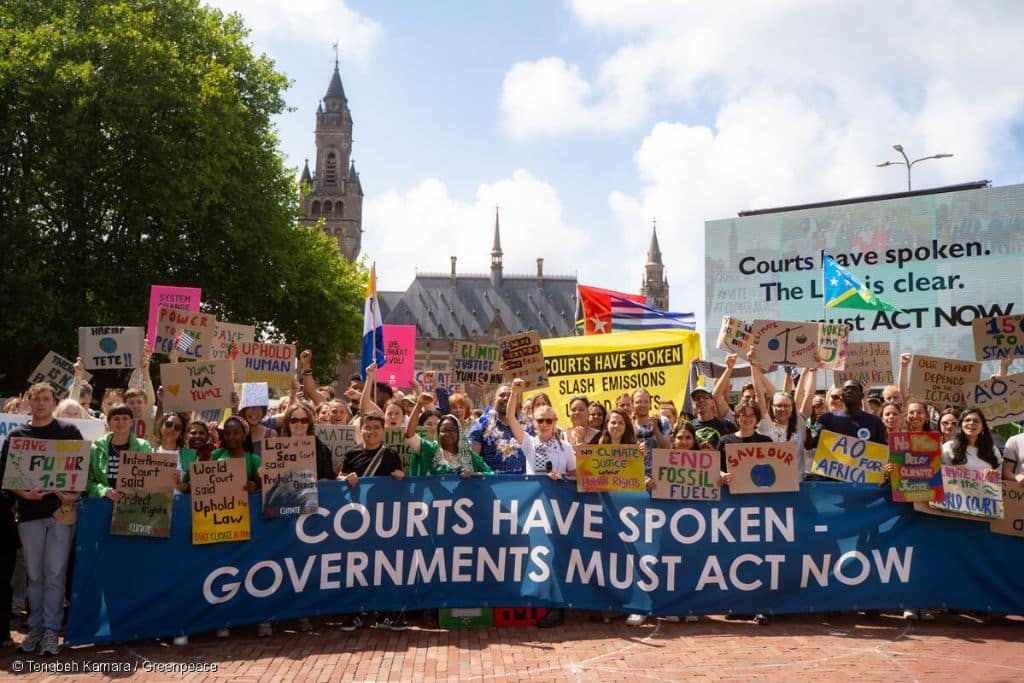
Reactions Pour In
In a social media post released after the General Assembly vote, UN Secretary General António Guterres said the resolution’s adoption is “a powerful affirmation of international law, climate justice, science & the responsibility of states to protect people from the escalating climate crisis,” adding that the path to climate justice “runs through a rapid, just, and equitable transition away from fossil fuels towards renewable energy.”
The UN Secretary-General noted that renewables have proved to be the cheapest and most secure form of energy and that the goal of keeping global temperature rises to no more than 1.5C above pre-industrial levels is still within reach.
PISFCC called the adoption a “landmark moment for climate justice” and a “major turning point of climate accountability [that] will reinforce States’ legal obligations to prevent further climate harm.” PISFCC Director Vishal Prasad said the resolution “must be a turning point in accountability for damaging the climate.”
“Communities on the frontlines, like in the Pacific, have been waiting far too long and continue to pay too high a price for the actions of others. The journey of this idea from classrooms in the Pacific to The Hague and the United Nations gives us continued hope that when people organize, the world can be moved to act,” Prasad added.
Environmental groups also welcomed the adoption. Shiva Gounden, Head of Greenpeace Australia Pacific, said that “[g]overnments can no longer ignore their legal responsibilities while backing the expansion of the fossil fuel industry.” Meanwhile, the Center for International Environmental Law said that by adopting the resolutions, states have accepted “that the rule of law must guide the global response to climate change.”
“Today’s vote marks an important step in advancing climate justice,” said Camile Cortez, Senior Campaigner on climate justice at Amnesty International. “This resolution brings renewed momentum towards ensuring accountability for climate-driven human rights harms and protecting present and future generations.”
Featured image: Holland Park Media.
This story is funded by readers like you
Our non-profit newsroom provides climate coverage free of charge and advertising. Your one-off or monthly donations play a crucial role in supporting our operations, expanding our reach, and maintaining our editorial independence.
About EO | Mission Statement | Impact & Reach | Write for us
Free, non-profit and independent environmental journalism.