

The company launched in 2021 as a spinout of Capital Dynamics, a private equity fund that amassed an early portfolio of energy storage assets. Arevon is owned by the California State Teachers’ Retirement Fund, Dutch pension fund APG, and the Abu Dhabi Investment Authority. Those firms invest for steady, long-term growth, and their patience lends itself to Arevon building and owning batteries for the long haul, instead of building to flip to other buyers.
“When we’re in there developing assets in the community, we can tell them, hey, we’re going to be here a long time,” said Johnson, who stepped up from COO to CEO in March. “You’re incentivized to engineer it well, construct it well, operate it well.”
Arevon focused on the Daly City location because electricity price volatility tends to be highest in proximity to major consumption, Johnson said. Places like that — whether metro areas or large industrial hubs — see the greatest swings from peak to off-peak hours, and having battery facilities to arbitrage between those times should push prices down in the long run. But building within a city comes with obvious trade-offs.
“Siting any infrastructure, whether you’re putting in a Walmart or upgrading an intersection or doing anything in a high-density area, is tough … especially so for power plants or facilities like this,” he noted.
Tough but not impossible, as Arevon proved in San Diego’s Barrio Logan community with its Peregrine project (another entry in a portfolio of projects sporting avian nomenclature), which came online last year. There, the company squeezed 200 megawatts of batteries between a naval shipyard and a light-rail track, in the shadow of the Coronado Bridge. In Daly City, Arevon will need to carve through roughly a mile of streets to run high-voltage cable underground to the nearest substation.
Such projects “reduce your lifespan a little bit” from the stress, Johnson said, but once built, the intrinsic difficulty becomes a sort of strategic moat. If a competitor wanted to open up next door to Cow Palace, well, they probably couldn’t find a viable space.
“Those are assets I’m really proud to own, and I think they’ll become just more and more valuable over time, because they’re hard to replace,” Johnson said.
To achieve that longevity, the batteries need to survive, and that premise is not to be taken for granted, given their location 90 miles north of Moss Landing, where the largest battery fire combusted a little over a year ago. Safety concerns are understandably higher in dense urban areas, so assuring the community that a Moss Landing–style disaster won’t happen here was integral to securing permits.
Arevon’s choice of battery, Tesla’s Megapack 2 XL, addressed the safety question. The containerized storage product is filled with the lithium-ferrous phosphate cells, a battery chemistry known to be significantly less fire-prone than earlier lithium-ion varieties. The older Moss Landing facility packed a huge amount of batteries into a single legacy structure, where they became fuel for an immense conflagration. The Megapack containers, in contrast, will be spread out across the site in a design that will prevent a fire from spreading beyond a single metal box. If one unit ever did catch fire, it would damage only a fraction of 1 percent of the plant’s capacity.
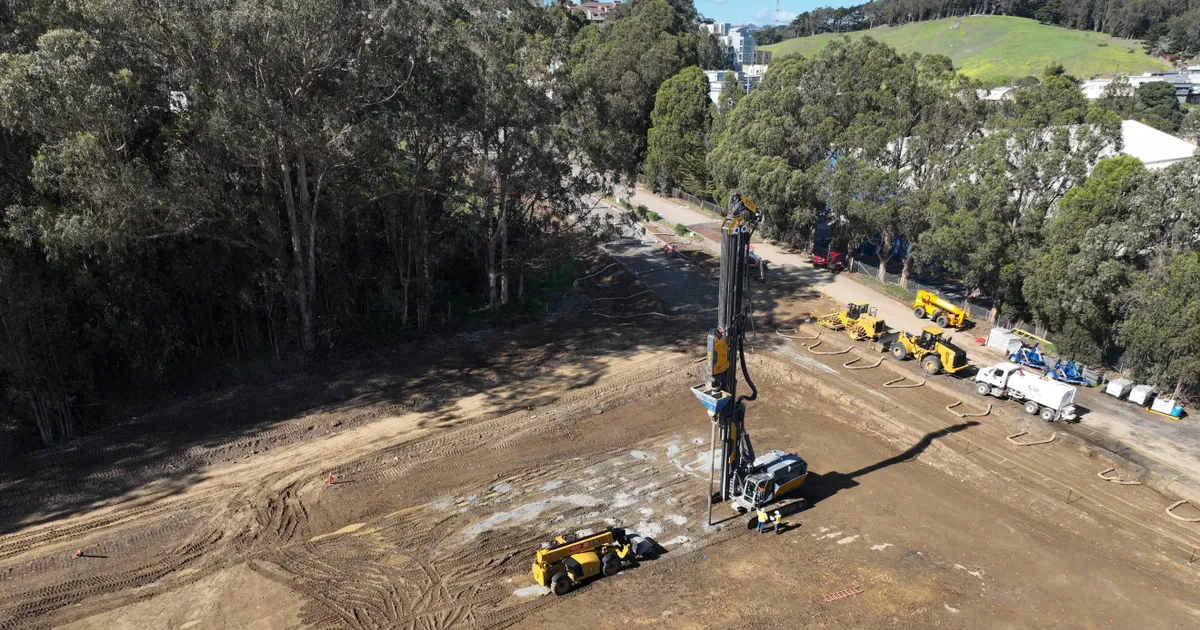
Workers are grading the site and installing “geo piers,” columns of aggregate that extend about 30 feet underground to stabilize the site during earthquakes. This is not an idle threat — the Bay Area just experienced a 4.6 magnitude tremor in the wee hours of Thursday morning. After that work is complete, the 280 Megapacks will take their places so that Cormorant can make its debut.