

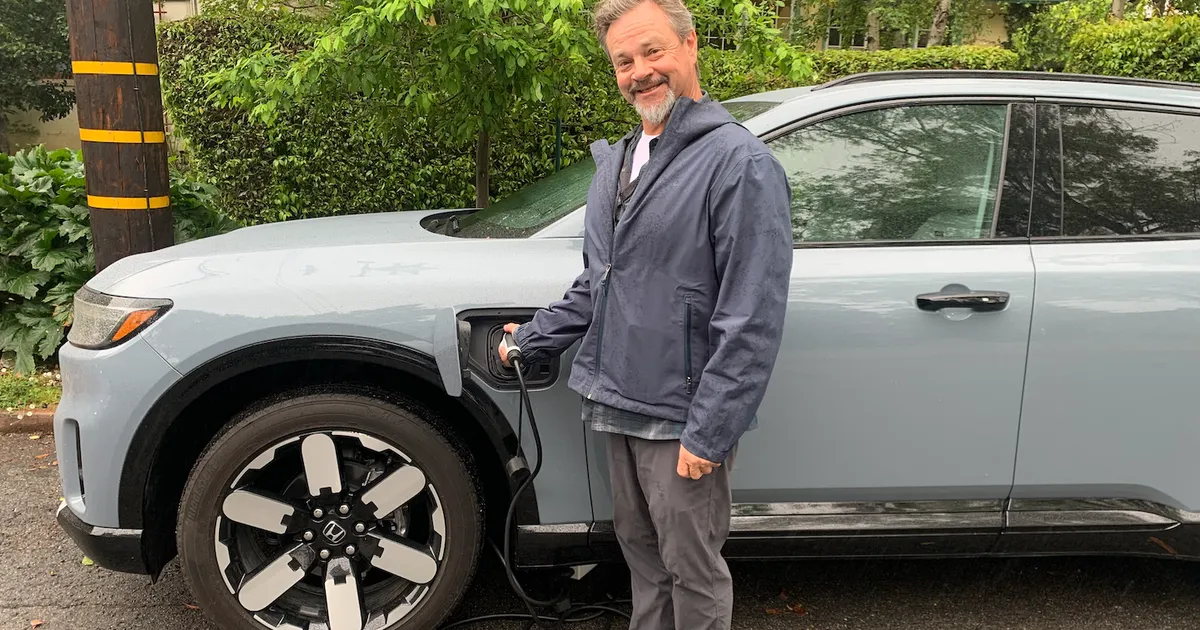
“What is different about 2026 is that for the first time ever, there’s actually a big enough used electrical vehicle market,” he said.
In particular, a lot of those used EVs are coming off leases made popular by a “leasing loophole” that allowed automakers and dealers to offer a full $7,500 federal tax credit, without the income qualification and manufacturer restrictions that applied to claiming the credit on direct sales.
More than 1.1 million EVs were leased from January 2023 to September 2025, when the federal tax credit ended. Shepard said he kept a close eye on those trends when planning to buy a bigger EV. “If you track that, you’ll see that [the cars] all go back to the dealer at the same time,” he said. “They have a flood of them, and the price drops a lot.”
And the latest vintages of used EVs offer an impressive value when compared with their gas-powered equivalents, Case said. Recurrent’s latest data indicates that a used EV is a year newer and has nearly 30,000 fewer miles than a similarly priced used gas car.
“When you compare what you’re getting for each of those, this is not an apples to apples — it’s a crappy apple versus a really awesome apple,” he said.
At least 68% of used EVs that Recurrent is tracking are 2022 models or later, which offer newer technology features than the average 6.5-year-old used internal combustion engine vehicle, Case added. Almost all those newer EVs remain under battery and powertrain warranties that tend to offer eight years or 100,000 miles of coverage, he said — and that’s for a class of vehicle that already costs about 40% less to maintain than a conventional car.
If they’re so much better, why are used EVs so cheap? Case outlined several key factors to explain that.
First is the far more rapid pace of improvements from one model year to the next — “more range, faster charging, more technology” — that make newer EVs more valuable than their predecessors. EVs that are even a few years old are seen as less desirable than the latest models, and thus command a lower price, he said. Federal tax credits also pushed down the expectations of what EV should cost, he said.
But many people remain uncertain about buying an EV, Case said. Range anxiety remains one of the chief concerns, he noted. And for used EVs, there’s another layer of uncertainty around “how the battery is holding up.”
These are important factors for low-income customers looking to EVs to cushion themselves from rising fuel costs, said Jason Zimbler, senior director of light-duty vehicles at clean-transportation nonprofit Calstart. “You’re getting a younger car, less road wear, and the battery degradation has been minimal,” he said. “So you’re not putting lemons in the hands of the secondary market.”
And while last year’s Republican-passed megabill killed a $4,000 tax credit for used EVs, along with the bigger rebate for new ones, many buyers can still access state or utility rebates, said Peter Glenn, co-CEO of EV Life, a startup with software used by customers, car dealers, and automakers to find EV incentives.
California’s biggest utilities offer rebates ranging from $1,000 to over $4,000 for income-qualified customers. States including Connecticut, Delaware, Illinois, Massachusetts, New Mexico, New York, and Rhode Island provide rebates in the thousands of dollars range, he said.
Understanding all the price reductions available up front can push used EVs past price parity with gas-powered cars and into the “tipping point” of being cheaper, Glenn said. “You almost need it to tip into obvious savings beyond, so it becomes a total no-brainer.”
Of course, buyers focused on long-term ownership costs can also use a variety of calculators available online that demonstrate how much cheaper it is to fuel and maintain EVs over time, Glenn added. “If you’re charging at home, it can be the equivalent of paying about $1 to $2 per gallon, even in higher-electricity-cost markets.”
Shepard only recently installed a Level 2 charger at home, so he hasn’t had a chance to calculate his fueling savings yet. But he’s glad he doesn’t have to rely on gasoline anymore.
“I just don’t see any need to use fossil fuels to make our cars go when it works just as well with electricity,” he said.