

“[The]cruel irony here [is] that the world cannot get its act together to address these threats … people are dying, animals are suffering, we’re losing rainforest … these are all interconnected threats,” Neil Vora tells me on this week’s episode of the Mongabay Newscast, just a day after the World Health Organization (WHO) reported more than 80 suspected deaths in the Democratic Republic of Congo from an outbreak of the Ebola virus.
Vora is a former U.S. Centers for Disease Control and Prevention (CDC) epidemic intelligence service officer who deployed to the DRC to combat Ebola. He says the current strain, the Bundibugyo virus, is particularly dangerous because there is no current approved treatment or vaccine for it. While neither this virus nor the Andes virus, a type of hantavirus that originated in Chile and Argentina and killed three people on a cruise ship, is likely to cause a pandemic, says Vora, he stresses member states of the WHO are unprepared to address a pandemic should one occur.
According to Vora, the WHO could have achieved a pandemic agreement to better address the threats pandemics pose. But that fell short when nations failed to adopt a system to equitably share tools such as vaccines.
“ And now those discussions on the pandemic agreement have stalled, and days later, we have these two outbreaks of zoonotic viruses.”
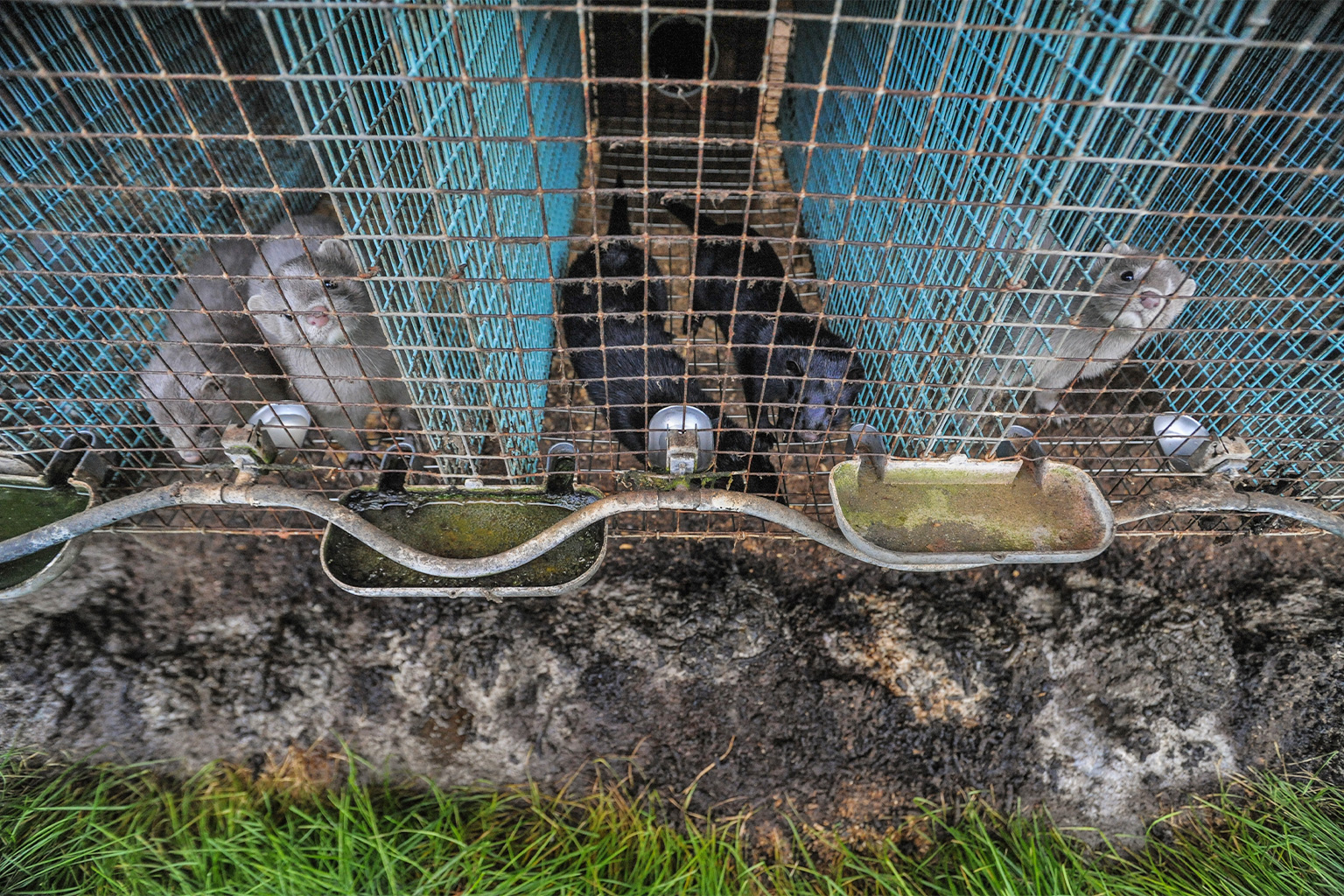
Vora stresses that measures can be taken now to help stop the risk of pandemics, such as by banning fur farms in the European Union , the European Commission has not yet decided whether to adopt a continent-wide ban. Vora says such a ban is crucial to preventing the spread of disease: 17 million minks were killed by the Danish government in 2020 when a novel coronavirus jumped into the animals and rapidly mutated.
“ They just killed them because of that public health threat. And temporarily, the Danish government banned mink farming in Denmark, but now it’s allowed to resume activities. And so this is the irony here, that taxpayers bailed these fur farms out in that situation after the public health incident, frankly, crisis that it caused, and now the industry is allowed to operate once again.”
Mike DiGirolamo is the host & producer for the Mongabay Newscast based in Sydney. Find him on LinkedIn and Bluesky.
Banner image: Minks at a Swedish fur farm in 2009. Living in small cages very close to each other makes for easier transmission of pathogens. Image courtesy of Jo-Anne McArthur/Djurrattsalliansen/We Animals Media.
Notice: Transcripts are machine and human generated and lightly edited for accuracy. They may contain errors.
Neil Vora: This cruel irony here is that the world cannot get its act together to address these threats. And maybe you’re hearing the frustration in my voice because people are dying, animals are suffering, we’re losing rainforests. These are all interconnected threats. Pandemics, outbreaks of zoonotic viruses, these are all symptoms of a planet in distress. But climate change, loss of biodiversity, these are also catastrophic threats to society that are all rooted in underlying causes like inequity in the distribution of resources and access to power, our ruthless appetite for resources and extraction. And so we continue to make the same mistakes and not learn that we are just hurting ourselves.
Mike DiGirolamo: Welcome to the Mongabay Newscast. I’m your host, Mike DiGirolamo, bringing you weekly conversations with experts, authors, scientists, and activists working on the front lines of conservation, shining a light on some of the most pressing issues facing our planet, and holding people in power to account. This podcast is edited on Gadigal land. Today on the newscast, we speak with Neil Vora, a former Epidemic Intelligence Service officer with the U.S. Centers for Disease Control and Prevention, CDC, and now the executive director of the Preventing Pandemics at the Source Coalition. Vora previously appeared on the newscast to discuss the link between deforestation and land use change, and the spillover of viruses into humans from animals. His experience with the CDC has taken him to nations like Liberia and the Democratic Republic of Congo to combat outbreaks of the deadly Ebola virus. Today, we’re going to be discussing the recent outbreaks of the Andes virus, which is a South American strain of the hantavirus, which has so far led to the deaths of three people, and the most recent outbreak of the Ebola virus, which was just confirmed this past weekend in the DRC, which has killed at least 80 people, which the World Health Organization has labeled an emergency of international concern. Vora offers his medical expertise on both of these situations, which he says are unlikely to lead to global pandemics. But he strongly cautions listeners and the international community to take international pandemic preparedness more seriously, which he says is lacking. The words Vora used to describe the lack of pandemic preparedness are “cruel irony.” He’s an advocate of banning fur farms, and he recently wrote an op-ed in The Guardian outlining why they pose a global health risk. The European Commission has not yet officially declared whether it will institute a continent-wide ban on fur farms, but Vora says that one is sorely needed and will do little harm to economic interests and will, in turn, save human lives. Neil Vora, welcome back to the Mongabay Newscast. It’s great to have you with us again.
Neil: Thanks for having me. I appreciate it.
Mike: Just for folks who aren’t aware, last time we had you on the show, about a year and a half ago, to discuss how conservation is critical for preventing outbreaks and pandemics, and that’s certainly going to be something that we’re going to be talking about today. We have a couple of stories that we’re going to be discussing today. One is the hantavirus, and the other is the Ebola outbreak that was just confirmed by the WHO. So why don’t we go ahead and just lay the context for listeners about what is occurring at this moment in the world?
Neil: So unfortunately, right now we’re seeing two major outbreaks of zoonotic viruses. So when I say a zoonotic virus, that means a virus that originates in animals that can then jump into people, and we call that jumping spillover. And so right now, we’re in the midst of controlling an outbreak of hantavirus, a specific type of hantavirus known as Andes virus, that started to spread on a cruise ship. Passengers off of that cruise ship have now been returned to many of their home countries. But over this past weekend, unfortunately, or since Friday, unfortunately, an outbreak of Ebola has been confirmed as well in the Democratic Republic of the Congo. So this as well is related to a spillover event, most likely.
Mike: And before we continue on, I think it’s important that we should note that the Andes virus, from what I understand from scientists, is not as easily contagious as some other viruses could be. Can you explain that factor for our audience here?
Neil: So there are a number of different hantaviruses around the world that can infect people, but the only type of hantavirus that we know of that, once it infects a person, can then spread from one person to the next is Andes virus, which has been identified in various parts of South America. Now, I want to be very clear, though, while there have been prior outbreaks of Andes virus in the past, and these have been contained through robust public health measures, there’s still a lot left to learn about Andes virus. And so what we know about this virus is that it is not as transmissible as other viruses, such as the measles virus or even the COVID virus. If it was a highly infectious virus, we would probably have seen more cases on that cruise ship than we have seen already. But that being said, we have to be humble about what we know and what we don’t know. There are a lot of unanswered questions. That doesn’t change the fact, though, that with robust public health measures and a lot of international cooperation that we’ve already seen happen, I am extremely confident that this outbreak will come to an end in the coming months.
Mike: So the situation in the DRC with Ebola is different here, and I’m reading from The Guardian that there have been at least 80 deaths and more than 300 suspected cases. What more can you tell us about the situation?
Neil: So these are two different viruses. Andes virus, which is a type of hantavirus, is the one affecting the cruise ship. Now, what we’re seeing in the Democratic Republic of the Congo in Central Africa is an outbreak of a type of Ebola virus known as Bundibugyo virus. Unfortunately, this is a virus for which we do not have confirmed therapeutics or a confirmed vaccine, compared to another type of Ebola virus, which will make this outbreak even more difficult to control. But there have been many outbreaks of Ebola since the 1970s. Most of these have come under control rather quickly. We have seen some instances, though, when an infected person or several infected people get into large population centers, or when infection control is not implemented fast enough, which allows the virus to spread over wide areas. And that’s one of the concerns right here, that by the time this outbreak was reported over the last few days, there had already been a large number of suspected cases, even deaths from suspected Ebola. And so that means that there probably has been transmission going on for a few weeks, if anything, and that’s going to make it a little bit more difficult to get this outbreak under control. But again, Ebola virus, or the group of Ebola viruses for which outbreaks have happened in the past, are ones for which public health measures, when implemented, are known to be effective.
Mike: So with that said, we’re going to discuss how the factors that increase the risk of viruses and pandemics are manifesting today, and one that you have focused on recently is fur farms. And you wrote an op-ed in The Guardian advocating that they should be banned. Before we get into the why and the how here, can you describe to our audience what fur farms are and how they pose a public health risk?
Neil: So in a number of countries around the world, farms are maintained to raise what tend to be wild animals, but they’re bred in many of these farms as well. But these are wild animals that are bred for their fur to make luxury products like jackets or shoes or purses. And so fur farming is basically an industry that feeds luxury demand. It’s an industry that is in decline. Many fashion brands around the world have started moving away from fur products, signing declarations that they will no longer use fur in their products. And in Europe, in the United States, we’re seeing a decline in demand, we’re seeing a decline in the number of fur farms, but the reality is that these fur farms are still in operation. They bring thousands of animals into these unsanitary conditions, awful conditions, quite frankly, in many instances inhumane. These animals are bred to be eventually gassed or electrocuted so that their fur can be essentially ripped off to make these fashion products. My concern as a medical doctor is that there is a huge public health risk with these activities. We have plenty of evidence that the activities on these farms can facilitate the transmission of pathogens with real health implications for humans.
Mike: Now, this isn’t to say that these two instances, the hantavirus and the Ebola virus that we’re currently dealing with, occurred from fur farms, but you’re saying that the presence of these fur farms does increase the likelihood that we’ll see more pandemics in the future, correct?
Neil: Absolutely. I’m not saying at all that the hantavirus outbreak right now, or the Ebola outbreak, are related to fur farms. What does concern me, though, is that we are seeing two major outbreaks right now. These are grabbing headlines for a reason. We are all still collectively traumatized, no matter our political affiliation, by what happened six years ago with COVID. There are a lot of eerie parallels between the hantavirus outbreak and COVID when you think about a virus causing a mystery illness on a cruise ship, right? Some people might remember the Diamond Princess cruise ship in early 2020, which also got a lot of news attention. And so my concern here is that we continue to relearn the same lesson, that these zoonotic disease outbreaks are happening because of what we humans are doing. A variety of different things that we’re doing, whether it’s deforestation, or raising farmed animals in awful conditions, or commercial wildlife trade, or fur farming. There are things that we are doing that create the conditions for these viruses to jump over. And we know from experience with COVID or mpox that sometimes when these zoonotic viruses make their way into human populations, they can be exceedingly difficult to control. And that’s why there’s a huge imperative for us to also invest in preventative actions so that we can prevent these outbreaks from happening in the first place.
Mike: So you described that Denmark was once known as the fur farming capital of the world. Why is that?
Neil: Europe used to have a lot of different fur farms, a lot of fur farming activities. In recent years, they have declined as demand has dwindled. Actually, a few years ago in Europe, in 2023, I believe it was, over a million European Union citizens signed a petition urging the European Commission to ban fur farming in the EU. And these actions have had an impact. At this point, the number of fur farms across Europe has declined. Over 15 countries across Europe have some type of restriction on fur farming. Even Poland, which used to be one of the biggest fur-producing countries in the world, has also now placed restrictions on fur farming. Now, in the situation for Denmark, if you think back to 2020, what happened was that scientists basically found that the virus that causes COVID was actually spreading on mink farms, because mink are one of the very common species that are used for fur coats. And so once the virus made its way into these mink, it started to pass from one mink to the next. It picked up mutations along the way, and then it eventually made its way back into people. In the course of that situation, hundreds of people across Denmark became infected with mink-related coronavirus strains. That then prompted the Danish government to kill 17 million mink. They just killed them because of that public health threat. And temporarily, the Danish government banned mink farming in Denmark, but now it’s allowed to resume activities. And so this is the irony here, that taxpayers bailed these fur farms out in that situation after the public health incident, frankly, crisis that it caused, and now the industry is allowed to operate once again. But we know that animals like mink can contract respiratory viruses from humans, whether we’re talking about certain types of coronavirus strains or even some types of flu virus strains. They can contract those viruses, incubate them, allowing them to mutate, and then pass them back to people. This is a huge risk. And again, the point is that this is an industry in decline that is not used to keep people alive. It’s really just to support luxury demand. And so we should be taking action while also supporting those farmers in finding other livelihoods.
Mike: Hello, listeners. The story you’re listening to is developing, and I urge you to find the latest up-to-date information on both the Andes virus and the Ebola outbreaks of 2026. But if you want to learn more about Neil Vora’s work on the Preventing Pandemics at the Source Coalition, you can find a link in the show notes. And as always, we strive to bring you independent news from Nature’s Frontline, but we need your help to do that. You can support the Mongabay Newscast directly by going to patreon.com/mongabay and donating as little as a dollar per month, or you can donate to Mongabay directly by clicking on the Donate button in the upper right corner at mongabay.com. Thank you very much, and back to the conversation with Neil Vora. So you said that there was an effort to ban fur farming in the European Union, but the European Commission did not implement a continent-wide ban. Why do you think that is? There were some reasons that were reportedly leaked. Can you tell us about that?
Neil: Yeah, so this is unfortunately still under deliberation. We expected a decision weeks ago from the European Commission on whether to proceed with a ban on fur farming across the EU. Again, many countries already restrict fur farming in the EU. And like I said, the economic case really does not exist for fur farming. And so there were a number of deliberations that the European Commission was pursuing, whether they were going to actually enact an EU-wide ban on fur farming. But that decision has basically stalled. In lieu of a full ban on fur farming, what’s been floated is the idea of reforming the welfare standards on these farms. But an independent assessment that the European Commission had sought, I’m forgetting exactly how long ago, but it was a recent assessment, showed that under the current situation that involves caging these animals, even reforming the welfare standards for these animals is insufficient. These animals are under awful conditions. They can barely turn around in their cages. They develop bent limbs because of that chronic lack of space that they have. Some of these animals are chewing their body parts off, like their tails. They face depression, based on some of the repetitive behaviors that they are exhibiting. And so the idea that welfare standards can be reformed on these farms doesn’t seem plausible based on that assessment. And again, I’m coming at this from the perspective of being a public health expert. Even if those welfare standards are reformed, I am not convinced that they’re going to be sufficient to mitigate the public health risk that fur farming poses.
Mike: And there was some internal communication, I believe, that was leaked. Perhaps I’m getting that wrong, but is there anything there you can tell us about that communication where it was, I think, alluded to that there were some economic reasons that they were using to not implement a ban?
Neil: Yeah, exactly. The final decision still has not been released, as far as I’ve seen. But yeah, one of the leaks suggests that maybe economic considerations are coming into play here, and why the European Commission would not pursue this ban. But like I was saying before, this is an industry that, according to one assessment, taxpayers are subsidizing. For example, again, when there’s a public health incident like was experienced in Denmark a few years ago, it was taxpayers that paid to bail those farmers out. But now those activities have resumed again. And we are seeing outbreak after outbreak happen under the same circumstances around the world. We keep on failing to learn our lessons, that it is our actions as a species that are creating the conditions for these outbreaks to happen. But there are common sense things that we can do that will save lives, that will save money in the long term. It does require some upfront costs, but again, over the long term, there are cost savings, if we’re going to just think about the economics of this.
Mike: Yeah. And I also must say, if economic concerns were supposedly an issue here for the European Commission, one would think that even the short-term harm posed by pandemics would be enough to say those economic concerns are not sufficient to not pursue a ban. Wouldn’t you agree?
Neil: I would agree, absolutely. An assessment that some of my colleagues did a few years ago, which they published in the journal Science in 2020, showed that it would just cost $20 to $30 billion a year to reduce, to mitigate, a lot of the factors that are driving these spillovers to happen. Now, that sounds like a lot of money, but that’s a drop in the bucket compared to the costs of a full-blown pandemic in terms of human lives and the economic costs. And again, because of what we’re doing, models show that the frequency of pandemics is going to increase in the coming decades. There’s actually a one in five chance that in the next decade, there will be a pandemic that will kill at least 20 million people, right? We’re playing with fire here. We’re already seeing Andes virus, Ebola virus right now. I don’t expect either of those situations to turn into a full-blown pandemic like we saw for COVID, but one of my biggest concerns of what the next pandemic will be is avian flu, because that’s another situation where we are mismanaging how we treat animals, and that creates the conditions that allow this virus to potentially emerge.
Mike: So you’ve also mentioned that the United States is looking into allowing international fur farms to work domestically in the United States. What can you tell us about that?
Neil: Yeah, one of the concerns is that if the EU proceeds with this ban, then it’s possible that some of the production will then shift to other countries with looser standards. In the U.S., actually in the House of Representatives, there is this big bill that recently made it out of the agricultural committee, so not out of the full House of Representatives, but within that agricultural bill, there basically is a provision that would allow for subsidies for mink farming in the United States. But mink farming in the United States is basically done by less than 100 farms. It really is not employing a lot of people. Again, this is a situation where sales are massively declining. It’s not really an industry that has a huge future ahead of it, and yet we’re talking about using taxpayer dollars to prop this industry up. Now, there’s another effort that is being pursued in U.S. Congress to basically actually phase out mink farming and to support farmers as mink farming is phased out for these farmers. And that’s the type of approach that we need. We shouldn’t leave these farmers completely out to hang and dry. We should make sure that if we’re talking about banning fur farming, that we are helping these farmers transition to other industries where they can make money. I’ve even heard people talk about these areas where they’re doing all these mink farms in these cages, et cetera, et cetera. Why not put solar panels on them, right? Convert them into a solar farm or something like that. So there are other ways that these farms potentially could be repurposed to generate revenue for these farmers.
Mike: So California, you’ve mentioned, has banned fur sales as of 2023, and there appears to be legislation in New York that has not been passed, but looks like it’s being proposed to do the same thing. Are there any other states looking at banning fur sales?
Neil: A number of cities have already banned fur farming or fur sales in the United States. California has a statewide ban. New York is now actually the largest market for fur, and so if New York passes this, that would be monumental. I’m not aware of any other active legislation right now. I know there are various efforts in different parts of the country, but I’m not aware of the details of those efforts.
Mike: Okay. We’ve covered a lot of things here, and I know that the nature of viruses and pandemics evolves rapidly, and we want to be careful, of course, how we phrase things to people. But is there anything we’re not looking at, or the media is not covering, that you really think needs attention, that people should be paying attention to?
Neil: I’ll just first point out the irony that we’re having these two major outbreaks of zoonotic viruses that are coming days after the member states of the World Health Organization failed to move forward on a pandemic agreement. So let me just give a little bit more detail here. Sure. Last year, the World Health Organization adopted a pandemic agreement. The negotiations for this had started in the wake of the acute phase of COVID, because many countries realized that the world wasn’t doing a good job addressing outbreaks. And the amazing thing about this agreement that was adopted last year was that it had provisions on preventing spillovers of viruses, which was the first such agreement that had binding obligations on preventing these spillovers. But the next step in that is countries couldn’t agree on how to equitably share vaccines and medicines in the midst of a response. And so they said, “All right, in 2026 we’ll have more negotiations, and after we figure out the equitable sharing of these tools, we’ll then open the agreement up to ratification.” Countries failed to figure out how to equitably share these tools of response, like vaccines, so they couldn’t move forward in those negotiations. And now those discussions on the pandemic agreement have stalled, and days later we have these two outbreaks of zoonotic viruses. So there’s just this cruel irony here that the world cannot get its act together to address these threats. And maybe you’re hearing the frustration in my voice because people are dying, animals are suffering, we’re losing rainforests. These are all interconnected threats. Pandemics, outbreaks of zoonotic viruses, these are all symptoms of a planet in distress. But climate change, loss of biodiversity, these are also catastrophic threats to society that are all rooted in underlying causes like inequity in the distribution of resources and access to power, our ruthless appetite for resources and extraction. And so we continue to make the same mistakes and not learn that we are just hurting ourselves.
Mike: Now, I know you said that the world can’t get its act together, and I certainly see your point there. Are there any actors or nations that stand out? You yourself worked for the Centers for Disease Control for quite a long time. What do you think of the current state of the governance of the CDC and the U.S. federal government’s role in preventing pandemics? Is there anything that you feel that they should be doing that they’re not?
Neil: Over the last week and a half, when we’ve been watching this hantavirus outbreak unfold, it’s been shocking how slow the CDC has been to put out public communications and information for doctors, for example, to use for taking care of patients. That type of information needs to be getting out faster, and I worry that this is a symptom of the challenges that we’re seeing in the public health sector in the United States. This is building on top of recent cuts to public health funding across the United States for medical research, for public health. And now we’re seeing this outbreak of Ebola in the Congo. In the past, the U.S. Agency for International Development, USAID, was very involved in outbreak response, including for Ebola. The CDC was involved as well. And now that USAID is basically nonexistent, I worry that one of the major implementing partners that have helped respond to Ebola outbreaks in the past is going to be completely absent, and I worry that this might mean that this current Ebola response will be impaired as a result.
Mike: Yeah. We’ve actually discussed USAID on this podcast for two episodes this year, and we highlighted that we spoke with reporter Michelle Nijhuis, who found an independent assessment that said that since the effective closure of the agency, about 800,000 people have died as a result of the ending of health programs. What are your thoughts on that situation? Do you have any insight into it that we haven’t covered, do you think?
Neil: Yeah, it’s awful. It’s absolutely awful. And it’s not to say that USAID and CDC didn’t have areas for improvement. Absolutely, there’s always a way for these agencies to improve. But this is a situation in which the treatment is worse than the disease itself. Meaning that, yes, there was some dysfunction within USAID and CDC. That doesn’t mean that USAID should have been completely dismantled. That means that there should have been a good faith effort to improve how it was functioning. This, to me, is a tragedy in terms of the number of lives that have been lost around the world because of this. But on top of that, there are these other knock-on effects because everything is interrelated. USAID also did a lot of important environmental work, and so that means that beyond the important public health work that USAID was supporting, the environmental work is also being impacted. And that means that we might see more and more wildlife trade. We might see more deforestation in certain areas where efforts were previously supported by USAID. And guess what? Those same factors, deforestation, wildlife trade, also increase the risk of outbreaks. And so we are undermining ourselves, in the United States at least, by these actions. And sadly, the price will be paid in human lives.
Mike: Now, you’re the executive director of the Preventing Pandemics at the Source Coalition. Can you tell me about this coalition and the work that you’re focused on?
Neil: This is a coalition that was started back in 2020, after COVID had started. Basically, the founders, Nigel Sizer and Synnøve Cook, saw a need for diverse actors coming together to advocate for upstream interventions to prevent the spillovers of viruses. And so they got a number of different international NGOs that work in different areas, such as conservation and health, to come together and speak as one voice. And I have the great honor of now leading this coalition since 2024. And I can’t emphasize enough how powerful it is to have all these different actors speak together as one voice. I used to be in government, and I have so much respect for government civil servants who pursue their important, impactful work. But I’ve also now seen on the other side how important it is to have robust civil society, that space between the private sphere and the public sphere. And these advocates that I get to work with every day, who are so knowledgeable, who engage policymakers, whether in the World Health Organization, the UN, or in Paris, Kinshasa, Nairobi, India, wherever it is, these are people who are engaging on a number of different levels to affect change. And our main areas of work are in three different categories. We do a lot of engagement with policymakers to provide technical support. We do scientific synthesis. So I have the great honor of co-chairing a commission for The Lancet that’s providing a roadmap on how to prevent spillovers. The Lancet is one of the world’s leading medical journals. Then the third area is that we do public communications, right? So we engage with news and write pieces. And the reason that third area is so important, and why I love being on podcasts such as this, is that, as one of my favorite activists, Ayana Elizabeth Johnson, has said before, cultural change precedes policy change. We need to change hearts and minds so that we can then actually see that reflected in the policies that our lawmakers are pursuing.
Mike: I’m glad you brought that up, Neil, because I’d like to ask you what you would urge listeners or readers right now who are listening to this podcast to do to help effect that cultural change?
Neil: Now I’m going to cite another one of my favorite activists, Clover Hogan, who has said before, “We do not need 100 perfect activists. We need one million imperfect ones.” None of us are perfect. I think in the environmental sphere in particular, we are often worried about being called hypocrites or having a double standard. None of us lead perfect lives. But what I would urge every listener to do is find the one area where you can make an impact and pursue it. And if you’re trying to figure out what that area is, I would urge you all to think about ikigai, which is that Japanese approach, I guess, to different ways of approaching life. But through that approach, I’ve learned about three important questions that I always try to ask myself at least on a yearly basis, which is, what am I good at? What does my community need from me? And what brings me joy? And I hope that everyone listening today can try to be at the intersection of the answers to those three questions for themselves. I’m so lucky that I’ve been able to do this by bringing in my health background with my passion for nature and animals, with my passion for creating a better world. And that’s how I’ve been able to find my current space. So what should listeners do? Again, ask yourself these questions, and remember that we just need to find the area where we have the power to make a change. And sometimes it’s helpful not to get stressed about the areas in which we have less of an impact that are out of our control.
Mike: Are there any resources or websites that you’d like to direct our listeners to?
Neil: First of all, I have to say I appreciate the reporting that Mongabay does. You all provide such important environmental news and give us up-to-date information that helps our work, at least in the public health space that I work in. Other sources, I would just have to recommend a book that I recently read that’s also really been shaping how I see my place on this planet. It’s The Arrogant Ape by Christine Webb. It’s such a beautiful book. I recently finished it. And so that’s a resource that I would strongly recommend that people pick up, a book to pick up.
Mike: Neil Vora, it’s been a pleasure speaking with you. It’s great to have you back on the show, and thank you for speaking with me today.
Neil: Thank you so much, Mike. Really appreciate your time.
Mike: As I mentioned earlier, you’re encouraged to check out the Preventing Pandemics at the Source Coalition by clicking on the link in the show notes. As always, if you’re enjoying the Mongabay Newscast or any of our podcast content and you want to help us out, we encourage you to spread the word about the work that we’re doing by telling a friend and leaving a review. Doing this really helps elevate our profile, but you can also support us by becoming a monthly sponsor. Go to our Patreon page at patreon.com/mongabay. We’re a nonprofit, so even when you pledge a dollar per month, it makes a very big difference and it helps us offset costs. So if you’re a fan of our audio reports, go to patreon.com/mongabay to learn more and support the Mongabay Newscast. You can also read our news and inspiration from Nature’s Frontline at mongabay.com, or you can follow us on social media. Find Mongabay on LinkedIn at Mongabay News and on Instagram, Threads, Blue Sky, Mastodon, Facebook, and TikTok, where our handle is @Mongabay, or on YouTube at Mongabay TV. Thank you, as always, for listening.