

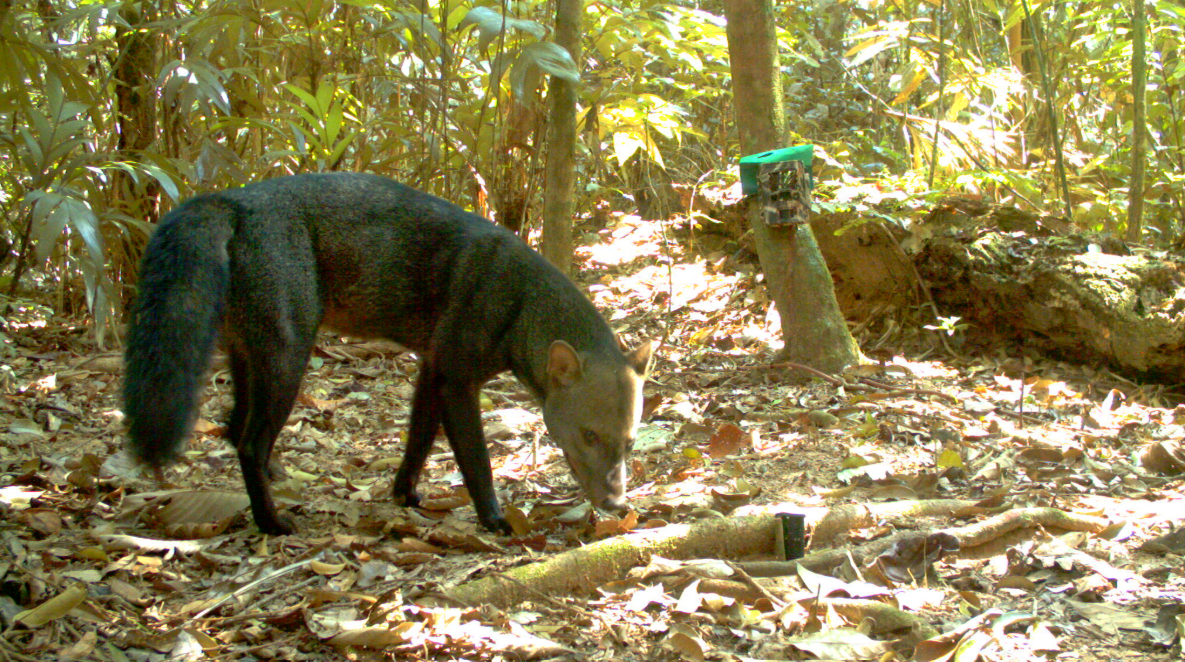
- A study conducted for more than 20 years with camera-trap surveys in different parts of the Bolivian Amazon has recorded 594 independent events for the short-eared dog in more than 4,600 images.
- This species, popularly known in Bolivia as the ghost dog, is one of the least-known canids in the world. Its survival depends highly on the quality of its natural habitat, according to experts.
- In the Bolivian forests, it can generally be found in protected areas or Indigenous territories, which scientists say underscores the importance of these kinds of areas for biodiversity conservation.
It has a fox-like snout, webbed toes and a thick tail. It’s called the short-eared dog (Atelocynus microtis), but also the ghost dog (perro fantasma in Spanish) in Bolivia, and the Amazonian dog. It’s one of the world’s least-known canids and one of the least frequently sighted carnivores in Latin America.
Now, though, a study conducted over the course of more than two decades — from 2001 to 2024 — in Bolivia has revealed more than 4,600 camera-trap images that show how it lives, the places it inhabits, and why this species is so dependent on South America’s forests remaining intact to survive.
The research underscores that the ghost dog is very much an Amazonian species, and in particular a forest one. In Bolivia, it can be spotted in the country’s continuous Amazonian forests, in the northern portion of the department of La Paz, but also in the department of Pando, in northern and northeastern Beni, and in the far north and northeast of Santa Cruz.
It’s also found in the pre-Amazonian forests of the Andes mountain range, also called piedmont forests, at elevations up to 750 meters (2,460 feet).
Robert Wallace, a British biologist from the Wildlife Conservation Society (WCS) in Bolivia and a co-author of the new study, said the team conducted a systematic review of published and unpublished distribution records of the species in Bolivia. Throughout the 23 years, they also carried out 34 intensive camera-trap surveys in the lowland areas of the Greater Madidi-Tambopata Landscape (in northwest Bolivia) and the Llanos de Moxos Biocultural Landscape (northern Bolivia).
Wallace said the short-eared dog is native to the Amazonian forests, not the Amazonian grasslands. “Our [collected] data shows that what it seeks the most is the forest itself, as it avoids transitional habitats leading to more open areas. It is a forest species,” he said.
He added that the use of hidden technology, such as camera traps, makes the mysterious dog not as hard to find as people think. Even so, Wallace said, it’s still challenging to witness the species directly: this canid is quite skittish and has a highly developed sense of smell, which allows it to avoid encounters with humans and natural predators.
“The short-eared dog is primarily diurnal, but also crepuscular, meaning it’s quite active around dawn and dusk. It can be active at night, but the vast majority of camera-trap sightings occurred during the day,” Wallace said.
He added the species’ preferred biome type is the lowland forest, “not right next to the river, but in the mature forest, further inland.”
A two-decade-long initiative
The study was backed by WCS Bolivia and included a lot of camera trapping, done every year during the dry season.
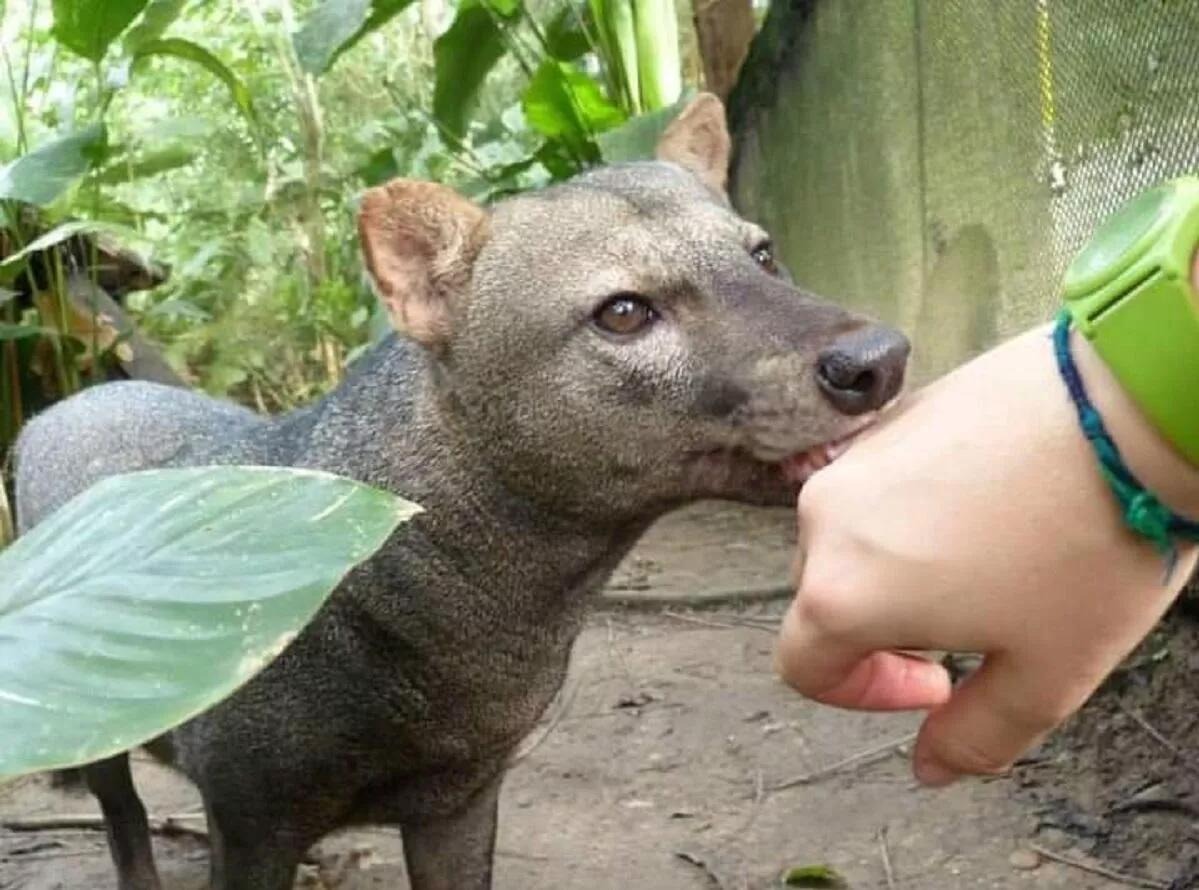
This method revealed an animal with a relatively low-slung body, short legs, small and rounded ears, a large head, and dense, dark fur ranging from blackish-gray to reddish-brown, with a dark dorsal stripe and a long bushy tail that usually drags on the ground. Its feet are partially webbed, meaning the toes are connected by a membrane — a unique trait among Amazonian canids.
The camera-trap surveys yielded a combined 4,635 photos covering 594 separate events featuring the short-eared dog.
“Camera-trap surveys provided significant information on the behavior and relative abundance of the short-eared dog, suggesting that it is more abundant than previously believed, although it remains a relatively rare medium-sized carnivore,” Wallace said.
He said it’s encouraging that the short-eared dog’s relative abundance was higher in protected areas and Indigenous territories that overlap with protected areas, emphasizing that this reinforces the importance of these kinds of areas for biodiversity conservation.
“These results have important implications for conservation, as they suggest that large tracts of continuous forest, comparable in size to larger protected areas, will be necessary to uphold viable long-term populations of short-eared dogs,” Wallace said.
According to the Bolivian environmental NGO ORÉ, six species of canids are known in Bolivia, including the short-eared dog, also known in the Amazon lowlands as the bush dog (perro de monte in Spanish). ORÉ noted that the species shouldn’t be confused with the more common bush dog (Speothos venaticus) or the black-footed fox (Cerdocyon thous).
ORÉ collaborated on a 2024 related study with the Noel Kempff Mercado Natural History Museum, located in Santa Cruz de la Sierra, the largest city in Bolivia. The organization told Mongabay that the short-eared dog is the only species in its genus and is a solitary carnivore. It measures 70-100 centimeters (28-39 inches) in length, stands 35 cm (14 in) tall, and has a bushy black tail — except at the base — that’s long enough to touch the ground.
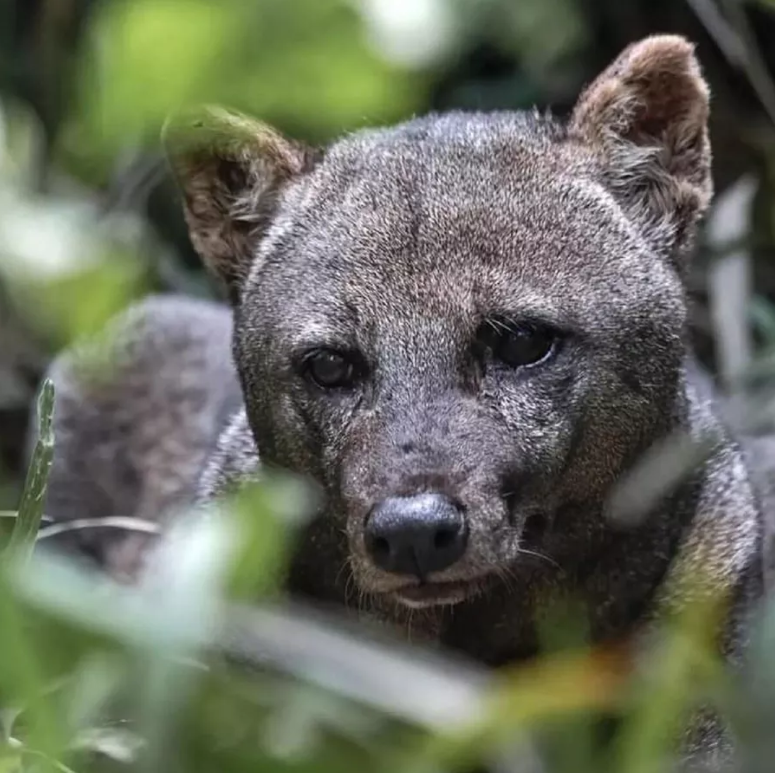
The short-eared dog’s characteristics
The dog’s head is large and more brownish than its grayish back. Its snout has a distinct black line running from the nose to the area below the eyes. The ears are small, hence the name, but emerge above the crown of the head. They’re rounded and light brown, contrasting with the head’s tone. The dog can weigh between 9 and 10 kilograms (20-22 pounds), with the females up to 30% larger than the males. The species’ diet is believed to consist of amphibians, fish and reptiles, although it also eats fruit.
Marco Greminger, a veterinary zootechnician and professor at the Autonomous University of Beni in Bolivia, told Mongabay that a ghost dog was once captured alive near the university. He said the animal was found hidden in a disused ground-level air duct.
“It was incredible how we managed to capture that ghost dog alive. They called me to help, and I did it. The [short-eared] dog came into the kennel , it was really weak. I remember giving him 350 grams [12 ounces] of chicken liver — which is rich in folic acid — chicken feet, and an oral rehydration solution. He ate all 10 pieces I gave him,” Greminger said.
He added the animal has a strong odor. “It’s stronger than that of a porcupine or a fox , it’s more sour,” he said.
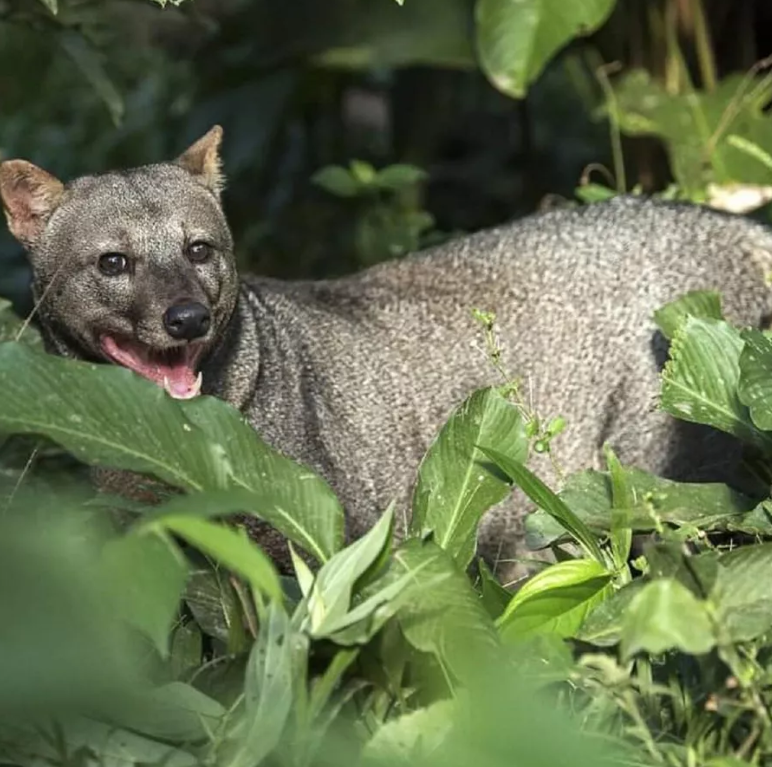
Veterinarian and ecologist Renata Leite Pitman, a researcher at Duke University in the U.S., has studied short-eared dogs for 14 years, calling them “very elusive and hard to spot.” In that time, she’s located just five of them in the wild, in the Amazon Basin, her place of fieldwork, and fitted them with tracking collars to study their habits. “They are very shy, totally different from pets,” she said.
In 2023, Pitman was contacted by Greminger, who was seeking advice after finding the dog in the air duct. “I shared what I had been feeding it. We agreed and coordinated a few steps. She recommended papaya , I had been giving guava,” Greminger said.
Banner image: The short-eared dog inhabits the Amazon and prefers untouched forests. Image courtesy of Guido Ayala & María Viscarra/WCS Bolivia.
This story was first published here in Spanish on May 6, 2026.
Bolivia Indigenous communities, local gov’ts help protect nearly 1 million hectares
Citation:
Wallace, R. B., Ayala, G., Viscarra, M., & Porcel, Z. (2026). Unveiling the ghost: Short-eared dog (Atelocynus microtis) distribution, activity patterns, habitat use, relative abundance, and occupancy in Bolivia. Neotropical Biology and Conservation, 21(1), 49-66. doi:10.3897/neotropical.21.e183324
FEEDBACK: Use this form to send a message to the author of this post. If you want to post a public comment, you can do that at the bottom of the page.