

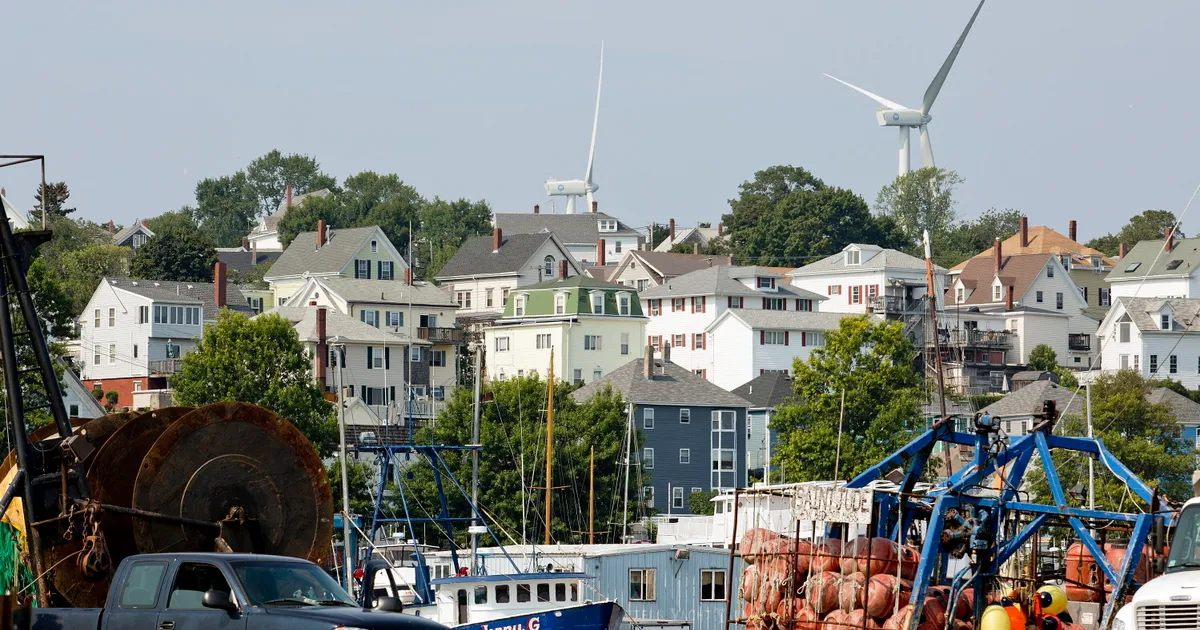
The wind turbines arrived in Gloucester at the same time I did. My husband and I moved into a cheap third-floor apartment in the small coastal city in northern Massachusetts in November 2012, just as cranes were assembling the imposing white towers right next to the highway that ushered us into town.
I loved them immediately. Like me, they were newcomers in an old town, looking to the future. Gloucester celebrated its 400th birthday a few years ago, and many families, including my husband’s, have lived here for well over a century. Our daughter, born in 2016, is at least a fifth-generation Gloucesterite. As a toddler playing in our yard, she would glimpse the blades turning in the distance and announce excitedly, “The fans are spinning!”
There were originally three turbines, standing sentinel over the town at the ocean’s edge. Two of these provided electricity to the city through a 25-year power purchase agreement, offsetting 50% to 70% of Gloucester’s municipal energy use. The city also received 20% of the money the spinning blades generated each year, a number that ranged from around $100,000 in the first year of operation to as much as $478,000 in later years.
The first turbine to go up was also the first to come down, removed in 2023 after a series of mechanical failures and a blade unexpectedly falling off. The two that remained continued generating power for years, though supply chain problems delayed needed maintenance and caused unexpected downtime, the owners said. In recent months, residents noticed the turbines appeared to be dripping oil. When the blades stopped turning this fall, people started asking questions about their future.
In January, our local paper broke the news that the turbines’ owner had decided to decommission them. The explanation: The company, a major semiconductor engineering firm, wants to expand its footprint here and needs the land. In compensation for the early termination, Gloucester will receive a payment of $587,000.
Some staunch opponents of wind power have taken the announcement as vindication. Community Facebook groups immediately lit up with I-told-you-sos, declaring the turbines’ 13 years of operation a clear failure. Some even used the early end of Gloucester’s three land-based turbines as proof that large-scale offshore wind could never be successful.
“They are painting the reason why they are being taken down as a failure of wind power,” said City Councilor Jason Grow, a vocal supporter of the turbines.
A second, somewhat quieter group, though, is lamenting their imminent loss.
“I have a feeling of not despair, certainly, but I feel stalled,” said Janet Ruth Young, a local writer and musician. “I feel that there’s a stagnancy where there used to be hope and movement and change.”
When new solar farms or wind turbines are proposed, news stories usually follow detailing opponents’ objections, which are largely rooted in a connection to place and respect for the character of a community. The opponents chose to live in this place — the small mountain town, the historic waterfront city — for the trees and the air and the character, not the lines of turbines on a hilltop or the sun glinting off expanses of solar panels. These positions are, at their heart, emotional and, it seems to me, sincerely felt. I am not here to judge motivations or to parse how much weight such arguments should be given.
However, stories about the debate depict support for clean energy as all about the money to be saved and the greenhouse gas emissions to be lowered. The proponents of solar panels and wind turbines are rendered as a collection of financial and environmental abstractions rather than real people.
In Gloucester, it is clear that framing doesn’t fully capture the reality. Though our community is deeply — sometimes stubbornly — dedicated to history and tradition, the turbines worked themselves into the fabric of the city. They were symbols of progress, an indelible part of our skyline, friendly ambassadors welcoming visitors and residents driving into town.
Linda Brayton was involved in the turbine project from the very beginning, when she volunteered in 2005, she thinks, to serve on a task force investigating the possibility of bringing wind energy to the city. Renewable power was still on the margins of the energy conversation then — Massachusetts had less than a gigawatt of installed capacity, a number that more than quintupled from 2013 to 2024.