

Measures proposed by organizers of the upcoming FIFA World Cup won’t be sufficient to protect players and fans from the significantly higher risk of extreme heat and humidity expected at this year’s tournament, a medical expert warns.
In December 2025, FIFA announced there would be three-minute hydration breaks for players in each half of every game “to ensure the best possible conditions for players”. However, a recent analysis says conditions at the 2026 World Cup, co-hosted by the U.S., Mexico and Canada, will be much warmer than during the USA ’94 tournament. Scientists from World Weather Attribution (WWA), an international initiative studying the role of climate change in extreme events, warn that human-induced climate change has nearly doubled the likelihood of dangerously hot match conditions since then.
That makes it much more difficult for the body to dissipate heat, said Chris Mullington, a consultant anesthetist and clinical senior lecturer at Imperial College London.
“That matters because footballers generate large amounts of metabolic heat during repeated sprints, accelerations, and high-intensity play,” he said at a press briefing. “As WGBT rises, the body’s usual cooling mechanisms become less effective.”
WGBT is the Wet Bulb Globe Temperature (WGBT) index, a combined measure of humidity, wind, air temperature and direct sunlight, which gives the “real feel” of heat on the human body.
Mullington said high WBGT can compel players to “reduce high intensity running, sprint less often, pace themselves more conservatively, and experience impaired decision making as thermal strain accumulates.”
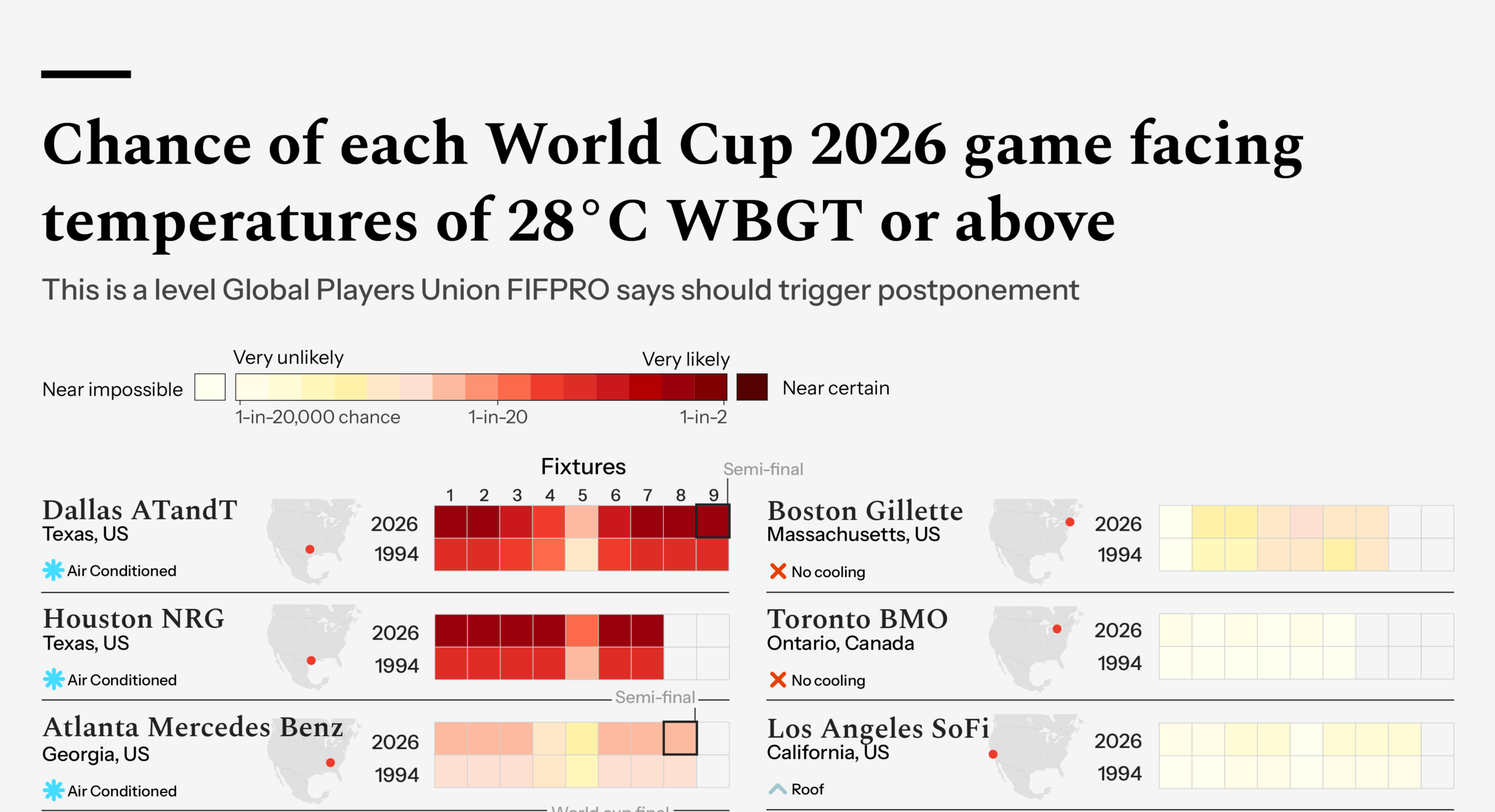
The WWA analysis identified Miami, Kansas City and New York/New Jersey as among the host cities at risk of peak heat and humidity. Twenty-six games are likely to be played at WBGT of 26° Celsius (79° Fahrenheit) or higher, when heat strain becomes a real risk, the authors say. There’s also a 1-in-3 chance of WBGT above 28°C (82°F) — conditions deemed unsafe for play, the authors add.
Mullington said physiological research suggests extended halftime breaks, and spray misting stations to fully mitigate heat strain.
He also called attention to fan well-being. “If you have a longer halftime, a longer match, fans are outside in those conditions for a longer period of time,” Mullington said. “So in reducing the risk for players, you might actually increase the risk for fans.”
To reduce risks for spectators, Mullington recommended organizers not charge for water. “I think your average football fan would not pay 8 pounds [nearly $11] for a bottle of water,” he told Mongabay at the briefing. “But if they were given it for free, they would take it gladly.”
Ultimately, Mullington said, it’s about raising awareness of the risks for the fans. “I don’t think that the majority of fans are aware that they might be putting themselves at risk in this situation, so just being transparent about that [so they can] make their own decisions at that point,” he said.
Banner image of the chances of each World Cup 2026 game facing temperatures the study authors consider unsafe for play. Image of World Weather Attribution.