

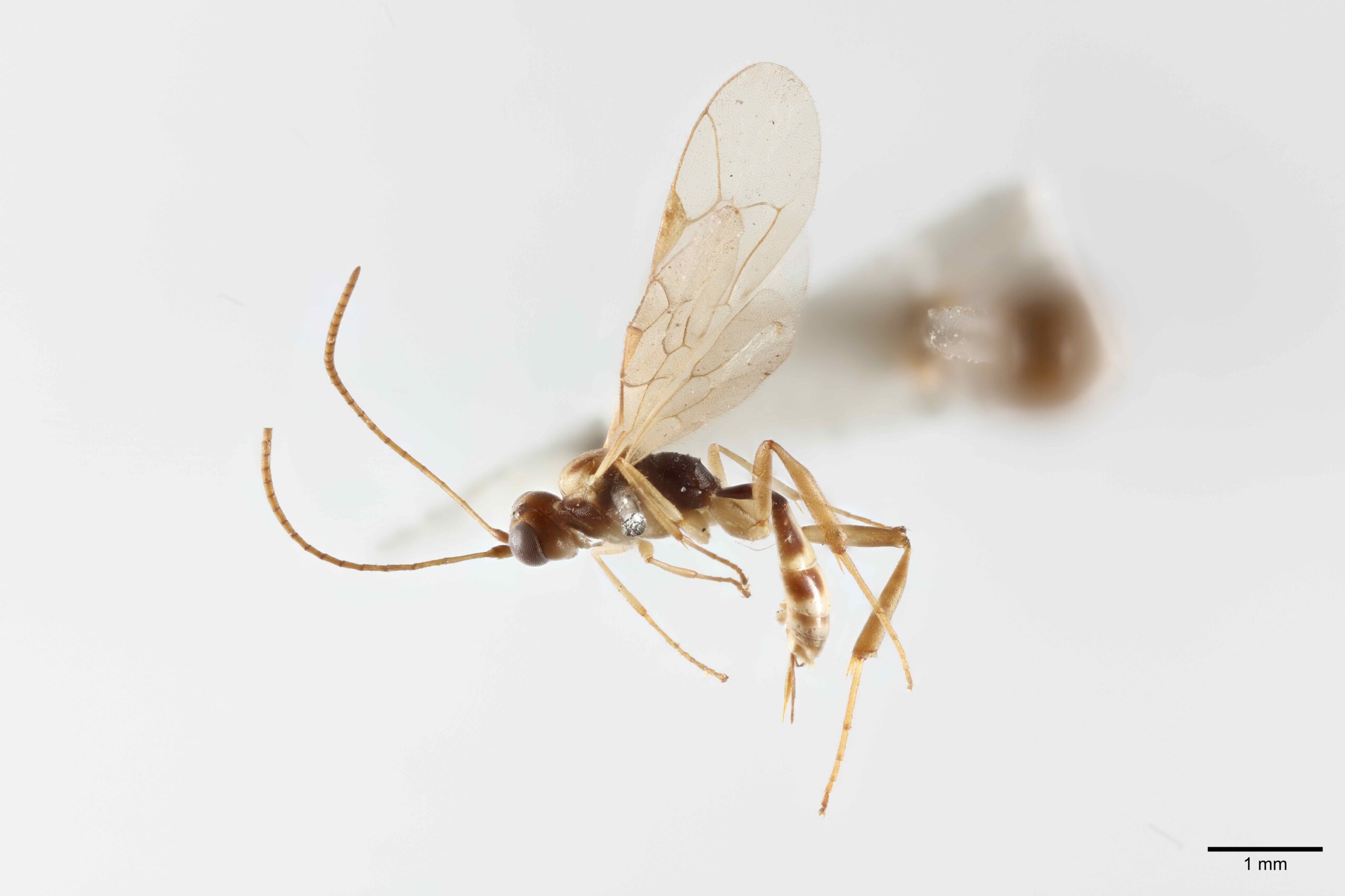
A tiny wasp, collected in the early 1980s in Chile’s Valdivia province, lay inside an unsorted drawer in the Natural History Museum, London, for more than 40 years. After taking a close look, researchers have recently confirmed it’s not only a new-to-science species, but also represents a new genus.
The wasp, only 3.5 millimeters (0.14 inches) long, is a kind of ichneumonid or Darwin wasp. This is a family of parasitoid wasps that lay their eggs inside the larvae, pupae or eggs of other arthropods, killing the host as the young wasp develops.
Researchers have named the newly described wasp Attenboroughnculus tau. The genus name is in honor of nature broadcaster David Attenborough, who marked his 100th birthday on May 8.
The authors write that they wanted to recognize Attenborough’s his contributions to humanity’s understanding of the natural world. In particular, they highlighted his work featuring Chile’s diverse and extreme landscapes, its unique environmental challenges, and the world of parasitoid wasps presented in his documentaries.
“When I was young, five or six maybe, I was given the Life on Earth book. In it [Attenborough] mentions taxonomists and what they do, and I was hooked,” Gavin Broad, study co-author and principal curator of wasps at the museum, said in a statement. “I decided from a far too early age I was going to be a taxonomist, thanks to David Attenborough, and weirdly I’ve ended up as a taxonomist. So I’ll pay something back.”
Study lead author Augustijn De Ketelaere, from the Royal Belgian Institute of Natural Sciences, chanced upon the new wasp while examining a collection of ichneumonid wasps at the Natural History Museum in London.
A detailed examination of the wasp’s physical and anatomical traits revealed that it belongs to a small subfamily called Pedunculinae. With the addition of Attenboroughnculus tau, there are now four known species, representing four different genera in the subfamily.
However, very little is known about Pedunculinae due to a lack of taxonomic work, the authors write. “No photographs of any Pedunculinae seem to be available online, so we hope that the publication of our photographs will draw attention to this interesting little subfamily,” they add.
“We hope to inspire global scientists to take another look in their collections to see if there is something small that could contribute to our collective understanding and therefore the future of our natural world,” Jennifer Pullar, science communications manager at the Natural History Museum and a co-author of the study, said in a press release.
Banner image of Attenboroughnculus tau, courtesy of the Trustees of the Natural History Museum.