

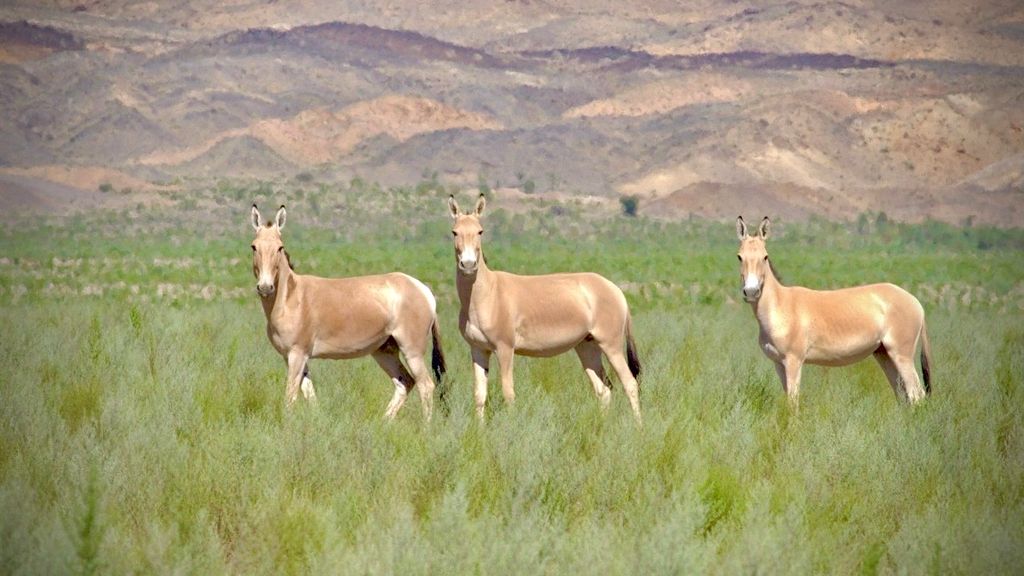
The Asiatic wild ass, or khulan, is reestablishing itself in eastern Mongolia for the first time in more than six decades, according to a recent study. It found hundreds of these wide-roaming herbivores have successfully crossed through a gap along the perimeter of the otherwise fenced-off Trans-Mongolian Railway, a barrier that kept them restricted to the west of the tracks since the mid-20th-century.
“Khulan are highly mobile nomadic ungulates that depend on access to vast, connected landscapes to track highly variable pasture and water resources,” Buuveibaatar Bayarbaatar, the study’s lead author from the Wildlife Conservation Society (WCS) Mongolia, told Mongabay by email. “In highly variable dryland ecosystems like the Gobi [Desert], mobility itself is a crucial adaptation that allows wildlife to cope with drought, extreme winters, and fluctuating resources.”
The khulan (Equus hemionus) once ranged widely across the Mongolian plains. However, the construction of the Trans-Mongolian Railway, fenced nearly throughout its extent to prevent livestock straying onto the tracks, created a near-continuous barrier for wildlife movement as well. This fragmentation, combined with severe winters and pressures such as hunting, led to the species’ local extinction east of the tracks by the 1950s.
In 2019, a pilot project by WCS Mongolia and local government authorities and partners temporarily removed 1.5 kilometers (nearly 1 mile) of fencing across three sections. Camera traps recorded a khulan crossing the southernmost gap in March 2020 — the first such confirmed crossing in 65 years. The gaps were re-fenced in 2021 over livestock safety concerns.
In the recent study, researchers combined data from the previous pilot projects, GPS collars on 29 individual khulan, and large-scale field surveys to confirm that the species is returning to the eastern side of the railway. The GPS data, for example, showed two khulan crossing a fence-free section of the tracks near the town of Zamiin-Uud on the border with China.
In October 2024, the researchers observed 384 khulan in four large groups. Previously, in June 2024, they documented 25 individuals, and a khulan carcass roughly 200 km (about 120 mi) east of the tracks, suggesting the species is dispersing farther into its historical range.
The findings confirm that khulan are now using at least 4,000 square kilometers (more than 1,500 square miles) of their historical range east of the railway, the authors write.
In May 2025, Mongolian authorities and conservation organizations including WCS Mongolia signed an agreement to formally designate a monitored “safe passage” zone near the Zamiin-Uud fence-free section, Bayarbaatar said. “Prior to the agreement, wildlife approaching the border area were often pushed away from crossing zones,” he said, adding the new collaboration aims to manage wildlife movement in a more coordinated way.
Since the establishment of the safe passage zone, “monitoring efforts in the area have included camera traps, field observations, ranger patrols, and review of GPS tracking data from collared khulan where available,” Bayarbaatar said.
Banner image of khulan in eastern Mongolia. Image courtesy of WCS Mongolia.