

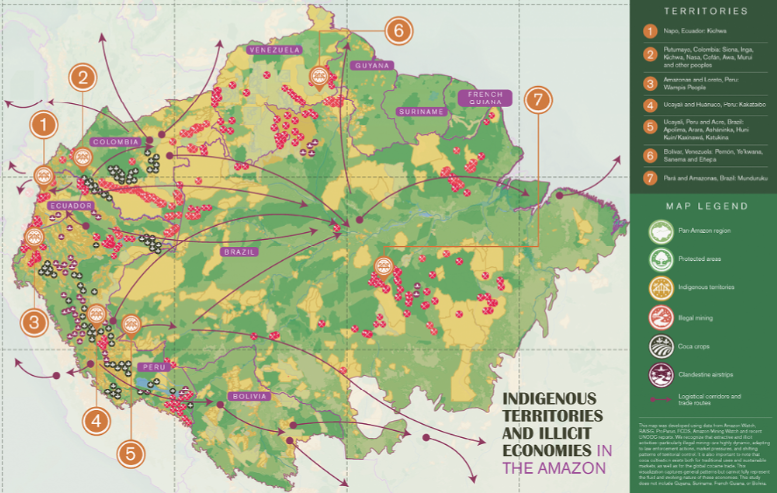
- The report by the NGO Amazon Watch looks at how organized crime activities and illicit economies are transforming dynamics within different Indigenous Amazonian territories.
- It also highlights the impacts from state military operations deployed in response to these criminal activities. The research was conducted in seven Indigenous territories across Colombia, Ecuador, Peru, Brazil and Venezuela.
- Among the consequences highlighted by the report, experts cite the systematic violations of land rights, violence against young people and women, and various health impacts, among other problems.
A report by advocacy group Amazon Watch highlights how deeply criminal activity and the militarized state responses that they’ve triggered have impacted Indigenous communities across much of the Amazon Rainforest.
“The Amazon Under Siege: How Crime and Militarization Threaten Indigenous Peoples” looks at seven case studies in five countries: Colombia, Ecuador, Peru, Brazil and Venezuela. It describes how illicit activities and state repression are transforming the ways of life and cultural habits of Indigenous peoples, as well as undermining their self-determination and collective rights.
“Across the Amazon, activities such as illicit gold mining, drug trafficking, illegal logging, wildlife trafficking, fuel smuggling, and human trafficking increasingly operate as interconnected systems,” says the report, published in April. “These economies share routes, infrastructure, financing, and armed protection mechanisms, allowing criminal organizations to diversify income streams, reduce risks, and adapt rapidly to market fluctuations and government pressure.”
As a result of this spiral of violence, at least 296 environmental defenders have been killed in the Amazon since 2012, with Colombia and Brazil being the most dangerous nations for those who defend nature. The report says criminal networks already affect 67% of Amazonian municipalities and have subjected 32% of Indigenous territories to dispute among armed groups.
The report also says that military-oriented state strategies and actions in response to organized crime have repeatedly failed.
“The state’s response often makes things worse,” said co-author Raphael Hoetmer, director of the Western Amazon Program at Amazon Watch. “When they opt for militarization and repression, they end up taking over territories and generating other forms of violence and control, rather than strengthening the Indigenous peoples’ own responses.”
The report was presented on April 20 at the United Nations Permanent Forum on Indigenous Issues in New York. Amazon Watch conceived it with the participation of 15 Indigenous organizations from the five Amazonian countries and with the support of a network of independent journalists and researchers.
Findings in the territories
“In the Amazon, the way of life of Indigenous peoples is being dramatically altered by these illicit activities,” Hoetmer told Mongabay. He highlighted three key issues unearthed through the report.
The first concerns the violence women face due to human trafficking and sexual violence, and the challenges they face in dealing with health issues within the community and access to water, among others. The second key issue is the situation of children and adolescents: “In all cases, we have seen recruitment, forced labor, and even slavery,” Hoetmer said.
The report also underscores specific impacts on communities living in voluntary isolation. “We are seeing that locations that protect isolated Indigenous communities have become hotbeds of organized crime, as is the case, for example, with the Kakataibo people [in Peru] and cross-border Indigenous communities,” Hoetmer said.
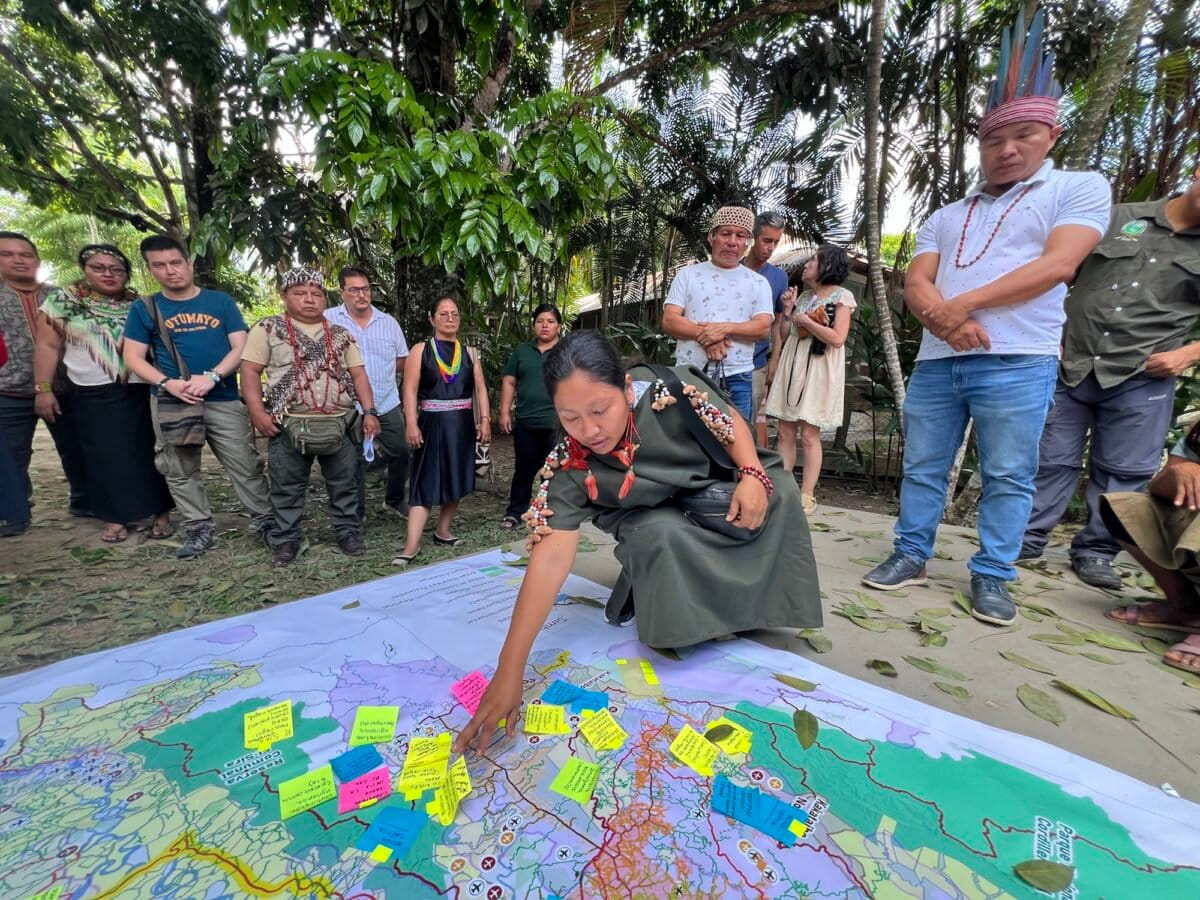
The report’s findings are based on an analysis of seven territorial scenarios in the five countries, as well as on testimonies collected during the International Summit of Defenders from Brazil, Colombia, Ecuador and Peru, held in February in the Peruvian city of Pucallpa.
“We selected seven distinct cases across five different countries to conduct a systematic analysis of rights violations, the role of states, the shortcomings in their policies, and the responses of Indigenous peoples to what is happening,” Hoetmer said.
Through these case studies, certain patterns of violence and modifications occurring in ethnic territories were identified. When it comes to Indigenous peoples’ rights to their lands and resources, these aspects are systematically violated by armed actors, criminal networks and extractive activities, both legal and illegal. “Defending territory often comes at high cost, including threats and violence,” the report says.
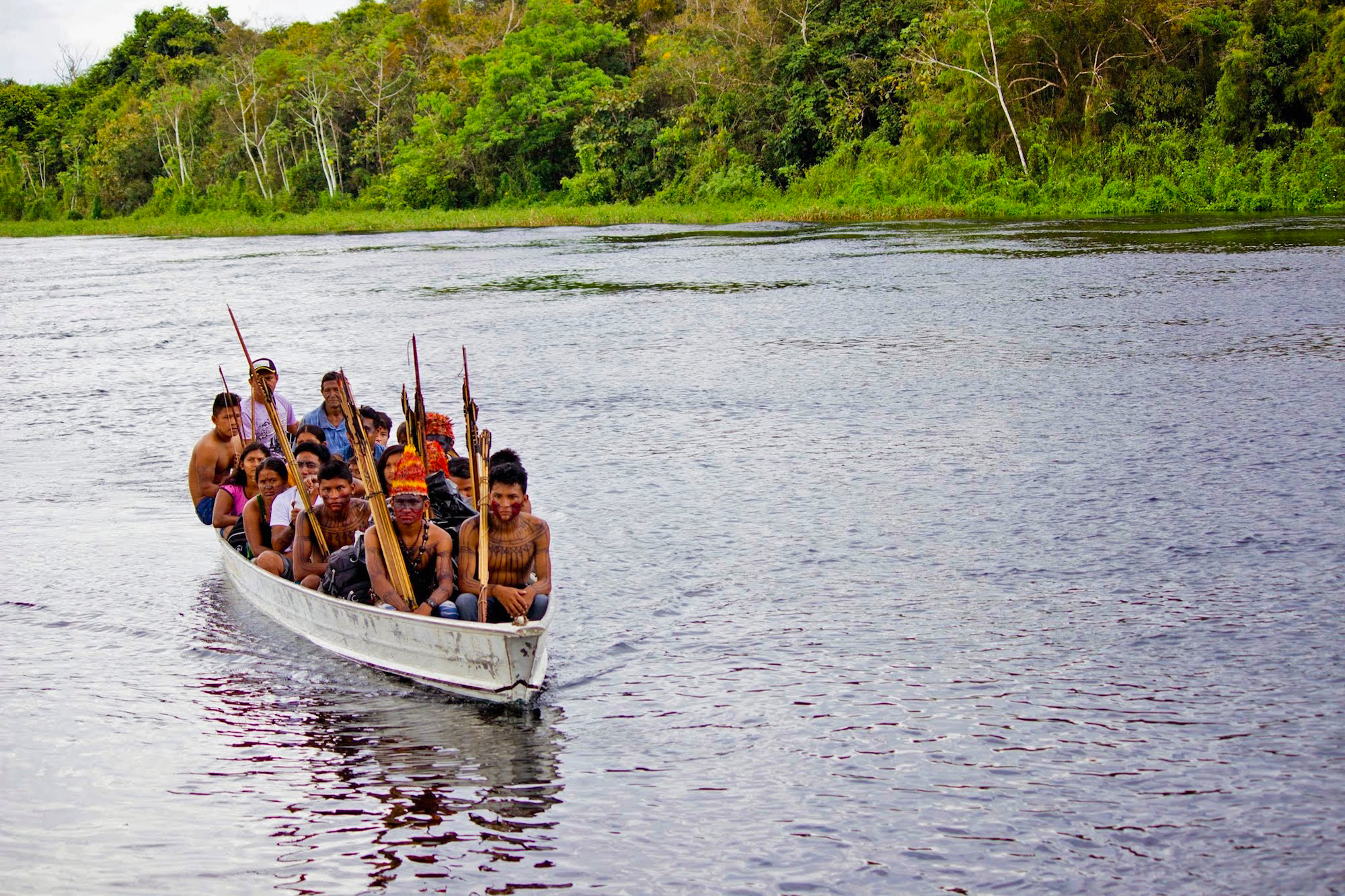
Forced displacement, confinement and territorial control that restricts mobility in Indigenous territories are also results of illegal economies that fragment community life and undermine Indigenous self-governance.
“Our territories are territories of life , they are territories of good living,” said Ecuadorian Indigenous leader Josefina Tunki, vice president of the board of directors of the Territories of Life Network (TICCA) Latin America. “We preserve our territories because they are a great source of strength for human life.”
Tunki also spoke of other impacts on the territories, such as the displacement of populations and river pollution. “In the Cordillera del Cóndor [on the Ecuador-Peru border], the rivers are polluted. And we, the leaders, are resisting to protect biodiversity, but we are being persecuted to be silenced. Indigenous peoples are being displaced from our territories by organized groups in Ecuador.”
Among the cases in focus in the report is that of the Munduruku people in Brazil, whose territory has become one of the main hotspots for illicit gold mining over the past decade, with the presence of criminal networks such as First Capital Command (PCC) and Red Command (CV). A second case in Brazil, on the border with Peru, looks at the situation of the Indigenous peoples of the Yuruá-Jurúa-Alto Tamaya transboundary territory, who face a slew of growing threats from the expansion of illicit economies, from drug trafficking and coca cultivation to illegal logging.
The territory of the Indigenous peoples of Putumayo in Colombia, near the tri-border with Ecuador and Peru, is also among the examples presented. This is also a key epicenter for illicit economies, particularly for the production and trafficking of cocaine, with the presence of armed groups such as Comandos de la Frontera (CDF), Carolina Ramírez Front and Raúl Reyes Front.
As for Ecuador, the report selected the case of the Kichwa Nation of Napo, an area with illegal gold mining where the rivers serve as logistical corridors for mining operations, drug trafficking, logging and other illicit activities. Criminal groups in this region include Los Lobos and Los Choneros.
There are also two case studies from Peru. The first concerns the Kakataibo people, who are under increasing pressure due to drug trafficking, illegal logging, land grabbing and illegal gold mining. The second is the territory of the Wampís Nation, which faces growing pressure from illicit mining, illegal logging and activities associated with drug trafficking, with the presence of criminal groups such as the Trujillanos and the Huanuqueños.
The last case involves the Indigenous lands of the Pemón, Kariña, Akawayo, Piaroa and Warekena peoples in southern Venezuela. These territories, rich in gold, coltan and other critical minerals, have become major crossroads for illicit economies, with the presence of Colombian armed groups such as the National Liberation Army (ELN) and dissident factions of the Revolutionary Armed Forces of Colombia (FARC), which disbanded after Colombia’s 2016 peace deal.
Violence in Indigenous territories
Jackeline Odicio, president of the Kakataibo Women’s Federation (Femuka) in Peru, called for an end to violence and the criminalization of Indigenous peoples during the presentation of the Amazon Watch report at the U.N. forum in New York.
“We are not violent , we are simply defending our territories. I come from a territory where six people have been murdered, and we are being equally criminalized and threatened,” she said.
Odicio also spoke about the consequences for children, the young and women in Indigenous communities.
“The rape of Indigenous children in the territories, teenage pregnancy, prostitution and recruitment [by gangs] — all of this affects our territories. The consequences are very serious.”
The various forms of violence against Indigenous women, children and adolescents are reflected in the dynamics of recruitment, sexual exploitation, forced labor and coercion. “These abuses are not isolated incidents but are rooted in structural gender inequalities and historical patterns of dispossession, now exacerbated by the expansion of criminal governance,” the report says.
The recruitment and exploitation of children and adolescents are fundamental strategies for sustaining armed groups and illicit economies. Throughout the Amazon, minors are recruited for mining, drug trafficking and territorial control activities, often through coercion, deception, or simply the lack of other viable economic alternatives.
Hoetmer told Mongabay that the latter is one of the reasons why young people end up involved in illegal economies. “Frequently, working in coca cultivation or mining is the only opportunity they have, which leads many young people to be drawn to these activities.” However, Hoetmer said, these shifts, when it comes to the new generation, affect their forms of intergenerational cultural and spiritual transmission. “Restrictions on movement within territories can prevent access to sacred sites and territorial routes that are key to the survival of the people.”
Territorial management
The report also cites evidence of large-scale operations carried out by organized crime groups throughout the region. It records police and military interventions to dismantle illegal mining infrastructure, as well as to conduct seizure and arrest operations — but without addressing the structural causes that underpin illicit economies.
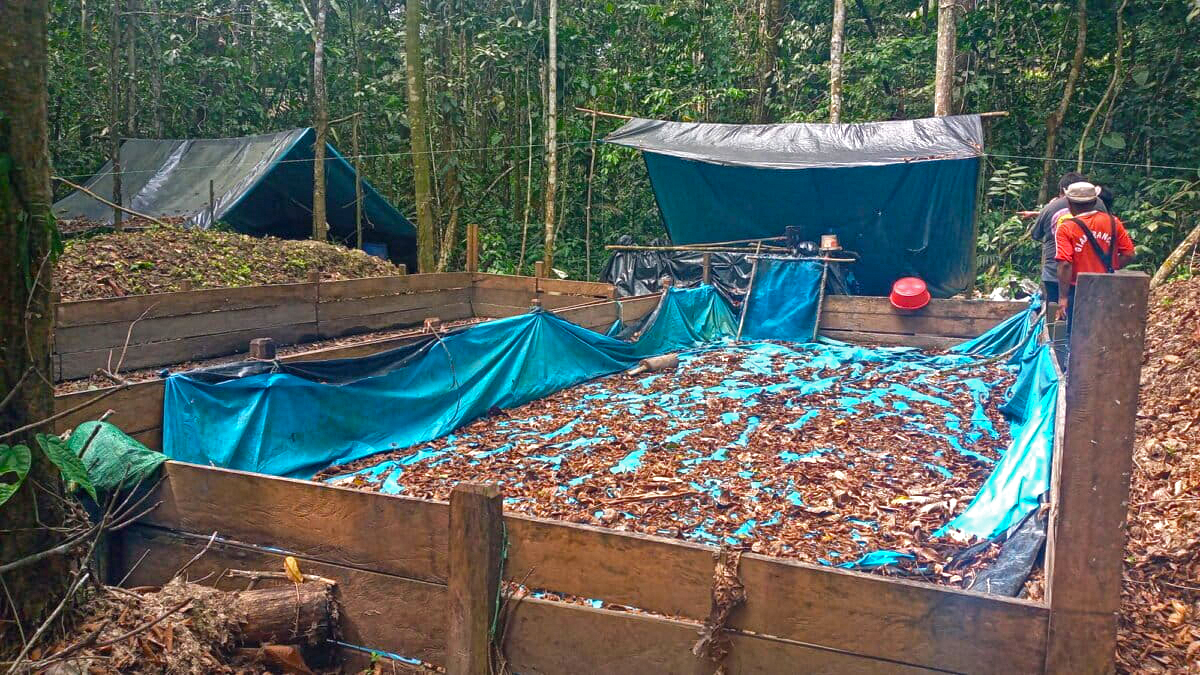
Ricardo Soberón, former executive president of Peru’s National Commission for Development and Life without Drugs (Devida), said that “the rhetoric with which many actors describe the expansion of extractive economies contributes to a criminalistic or militaristic view of illicit extractive economies. This distorts any possibility of addressing the problems behind the mining camps, the maceration pits, and the deforestation of forests.”
“We find ourselves in a situation where either repressive measures are overused — as in the case of the eradication of coca fields and the criminalization of coca farmers — or the state maintains a tepid and timid stance on the rule of law,” Soberón said.
Hoetmer said it’s urgent to propose a different perspective on the security in Indigenous territories. “The path forward is a necessary territorial transformation to curb illegal economies. History shows that exclusively military responses do not work.”
The best security strategy in Indigenous territories, he went on, is respect for their rights, self-determination, and the participation of the respective peoples. “Indigenous peoples should be seen as a central strategic partner in addressing the problem,” Hoetmer said. “But obviously, these peoples cannot do it by themselves , they need to be backed, supported, and complemented by state actors.”
Herlin Odicio, vice president of the Peruvian Amazon-based Regional Organization AIDESEP Ucayali (ORAU), said Indigenous guards are among the mechanisms they have developed to combat illegal economic activities. “Within our territory, our only option is to protect ourselves for survival. The Indigenous guards are community members who patrol their territories. We work with partners to deploy equipment such as drones and cameras that can help monitor the territories, but we need more resources.”
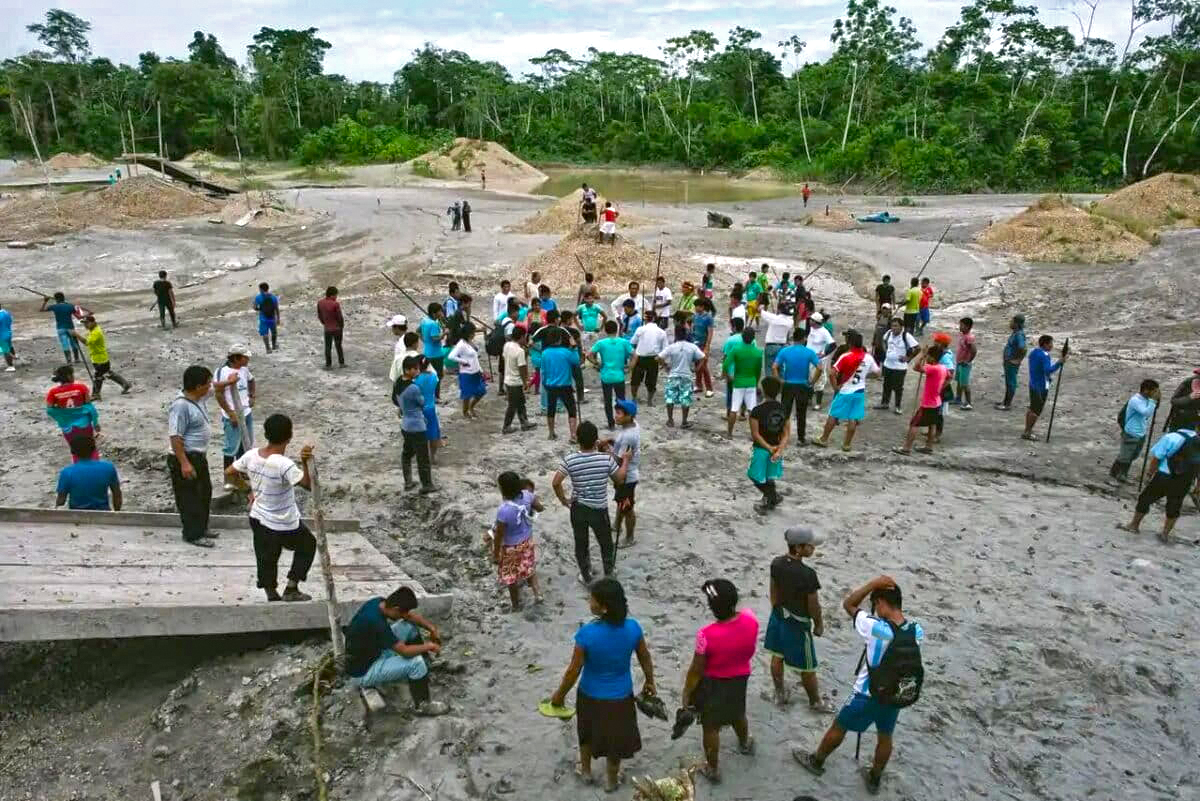
Banner image: Indigenous communities face changes to their ways of life due to the presence of illegal economies. Image courtesy of Amazon Watch.
This story was first published here in Spanish on April 29, 2026.
Brazil taps legal loophole to issue bids for Amazon ‘tipping point’ road