

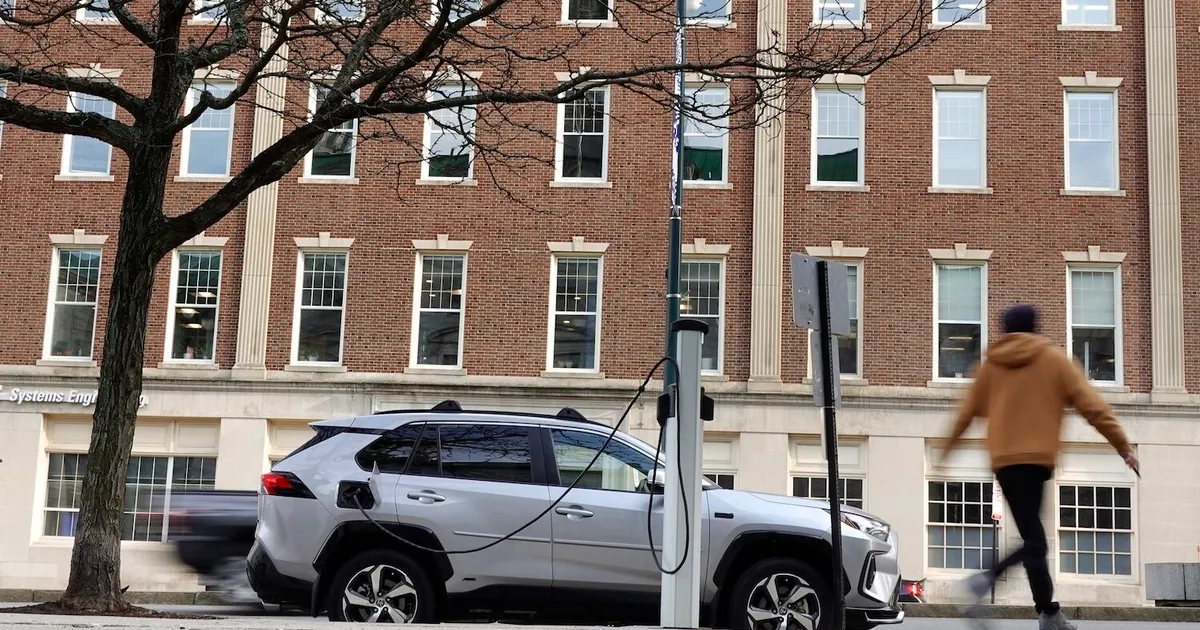
The Trump administration has left no stone unturned and no fund untouched in its attempt to undo the Biden administration’s clean-energy legacy. That includes $5 billion in funding for the National Electric Vehicle Infrastructure Formula Program, which President Donald Trump first tried to freeze soon after he started his second term.
NEVI, as it’s better known, was meant to accelerate a nationwide buildout of EV chargers. But not much of the funding was spent under Biden, and a lot of the remaining money was plunged into uncertainty by the Trump administration freeze. The Department of Transportation ended up relaunching NEVI last August, but it required states to first revise and resubmit their charger plans, setting up more delays.
Things seemed to be getting back on track in January when a judge ruled that the DOT had illegally withheld NEVI funding, and ordered the funds released under their original terms. But the Trump administration tried another angle in February, proposing that 100% of a charger’s materials would have to come from the U.S. to be eligible for NEVI money. Current rules require at least 55% of a charger’s cost to be spent on components produced domestically, a standard that remains in place while the DOT considers feedback on its change.
“There are currently no 100% domestically produced chargers available for purchase, there is not enough demand for 100% domestically produced chargers to justify investing in domestic production, and some critical components of the chargers are simply not produced in the United States,” the officials wrote in a letter to the head of the DOT’s Federal Highway Administration. Instead of juicing domestic production, this move will “jeopardize the economic viability” of companies making chargers to the previous 55% standard, they continued.
But while it certainly would be good to unlock those sweet NEVI dollars, charger installations are still moving forward without them. The U.S. set a new record last year as it installed more than 18,000 new fast-charging ports, expanding the nationwide network by 30%. That means less driving around to find a charging station, and less waiting around for an unoccupied charger when you find a spot.
Private investment, not government funding, built pretty much all of that new infrastructure. So if the federal government falls through once again, we’ve still got ways to keep charger deployment driving forward.
More big energy stories
For offshore wind, two steps forward and one step back
Two offshore wind projects notched major victories late last week — but that doesn’t mean Trump’s crusade against the industry is over.
Last Friday, developers installed the final turbine blades on Vineyard Wind, an array off the coast of Massachusetts. The project has been producing power for more than two years, though it’ll still be a while before it’s spinning at full capacity. Revolution Wind announced a milestone of its own that same evening. The project is now generating power, which it’s delivering to nearby Connecticut and Rhode Island.
Both Vineyard Wind and Revolution Wind were targeted by the Trump administration’s December stop-work orders, which judges later struck down. But while the federal government has declined to appeal the Revolution ruling, it is seemingly looking for new avenues to block future offshore wind projects. The New York Times reported this week that senior Trump officials are drafting settlement agreements that would pay TotalEnergies nearly $1 billion to cancel its two offshore wind leases in federal waters, and commit the company to building gas infrastructure instead.