

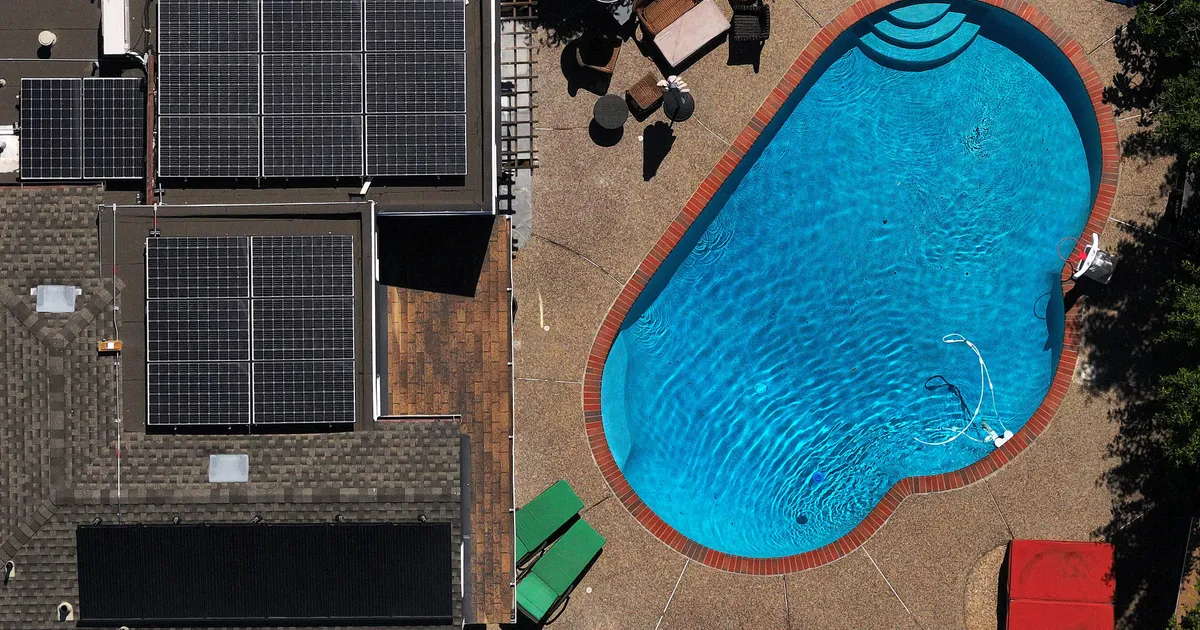
California made itself a rooftop solar leader — and now it’s undoing that legacy.
Sure, sunny skies have played a big role in getting Californians to install panels at their homes. But for years, the state has also offered hefty incentives to help rooftop solar grow, including net-metering policies, which determine how much utilities pay solar panel owners for sending excess generation back to the grid. Under the first two iterations of California’s net-energy metering policies — NEM 1.0, established in the 1990s, and NEM 2.0 in 2016 — that power was heavily rewarded. Those big payments for solar power made it easier to recoup the cost of putting up panels — and easier for homeowners to justify their clean investments.
Then came NEM 3.0. In 2022, California utility regulators approved a plan to slash net-metering payments by as much as 75%. The policy, which went into effect the following year, has seen numerous legal battles ever since. And just this week, a court upheld regulators’ solar-tanking move.
The decision comes at a crucial moment for rooftop solar nationwide. After years of setting records, residential solar installations in the U.S. slumped after 2023, falling in both 2024 and 2025, according to a new Solar Energy Industries Association report. Last year’s dip was largely due to economic uncertainty, tariffs, and contractors’ inability to quickly ramp up installations before federal tax credits expired, SEIA said.
In the post-incentive new year, some states have increased their own rebates and tax credits to keep clean energy rolling. But with this week’s ruling, California will continue heading in the opposite direction. Recent numbers of total residential solar installations in California suggest what the state’s future under NEM 3.0 will look like: Annual installations of residential solar dipped significantly from 2023 to 2024 and remained low in 2025. SEIA expects NEM 3.0 to slow installs even further in 2026.
Permissionless, plug-and-play balcony solar, anyone?
More big energy stories
Good news for wind power in the U.S. and beyond
Wind power in the U.S. may be riding a roller coaster, but in the rest of the world, the industry is still on an upward climb.
A record 169 gigawatts of wind power came online around the globe last year, according to a report out this week from BloombergNEF. More than 100 gigawatts’ worth of those turbines were installed in China, though the rest of the world saw increases as well.
There’s also some good wind news to share on the home front. All five under-construction offshore wind farms the Trump administration tried to shut down are set to hit major milestones this month, Canary Media’s Maria Gallucci reports. Off Massachusetts, Vineyard Wind is nearly complete , the Coastal Virginia Offshore Wind project and Rhode Island’s Revolution Wind will soon begin delivering power to the grid , Sunrise Wind is about halfway complete , and New York’s Empire Wind is getting a turbine-installation vessel this month to continue building.